Cherry Blossom Spots in Kyoto
Last updated: August 2026
Kyoto is the most celebrated destination for cherry blossom viewing in Japan. The city’s combination of ancient temples, manicured gardens, and historic waterways provides a backdrop for sakura that nowhere else can quite replicate. When the timing aligns — and you have planned for the crowds — cherry blossom season in Kyoto is one of the great travel experiences anywhere in the world.
This guide covers the best spots ranked by the quality of the experience, accurate timing information, and practical advice for managing the season’s considerable challenges.
At a glance
| Where | Temples, parks, and canal paths across Kyoto, concentrated in Higashiyama and Arashiyama |
| Cost | Free at most parks and paths; paid gardens (Heian Shrine, Daigo-ji, Ninna-ji) typically 500–1,500 yen |
| Time needed | 3–4 days to cover the major spots without rushing |
| Getting there | Kyoto Station by Shinkansen from Tokyo (around 2h15) or Osaka (around 15 minutes) |
| Best time | Late March to mid-April, with full bloom typically the first week of April |
For national timing and spots beyond Kyoto, see Cherry Blossom Season and Japan in Spring; for wider Kyoto planning, see Kyoto in 3 Days.
When Do Cherry Blossoms Peak in Kyoto?
Peak bloom in Kyoto typically falls between late March and mid-April, with full bloom (mankai) usually occurring in the first week of April. In recent years, warming temperatures have pushed the peak earlier — the Japan Meteorological Corporation publishes annual forecasts beginning in January that are accurate to within a few days.
The bloom window is short. Full bloom lasts approximately one week before petals begin to fall. The falling-petal period (hanafubuki, or “cherry blossom blizzard”) is beautiful in its own way and typically continues for several days after peak bloom. Cold snaps or wind can shorten the window significantly; warm, calm weather extends it.
Planner’s rule: Book accommodation in Kyoto 3 to 6 months in advance for any dates between late March and mid-April. Prices approximately double during peak bloom, and many properties sell out entirely.
Maruyama Park — The Weeping Cherry
Maruyama Park in Higashiyama contains Kyoto’s most famous single cherry tree: a massive weeping yoshino (shidarezakura) that has been the anchor of hanami gatherings in the city for over a century. The tree is illuminated at night during bloom season, and the combination of its cascading form glowing against the dark sky and the lantern-lit picnic parties surrounding it is quintessentially Japanese.
The park is free to enter and open around the clock. Crowds are heavy from midday through late evening during peak bloom. The best time to see the weeping cherry is either early morning (before 8am) or during the illuminated evening period after 6pm. Blue tarps reserved for picnic groups appear from late March — this is intentional, not unsightly. Hanami parties beneath the trees are the correct way to experience the park.
The park connects directly to Yasaka Shrine and the Gion neighborhood, making it natural to combine with an evening walk through the Gion lantern-lit streets.
Entry fee: Free Access: Bus 100 or 206 to Gion stop, 5-minute walk.
Philosopher’s Path
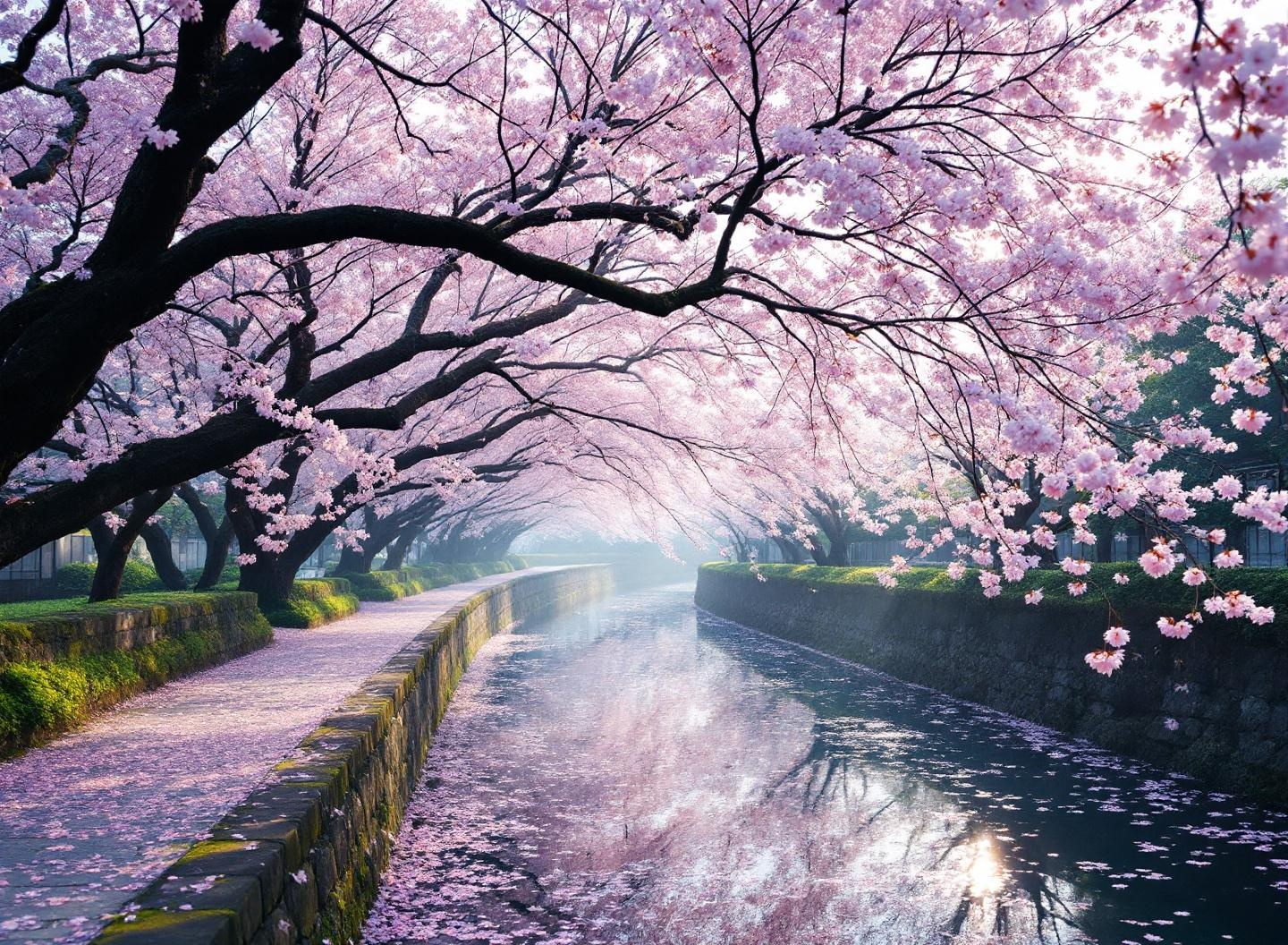
The Philosopher’s Path (Tetsugaku no Michi) is a 2-kilometer stone-paved footpath following a canal lined on both sides with several hundred cherry trees from Ginkaku-ji in the south to Nanzen-ji in the north. During peak bloom, the overhanging branches create a continuous canopy of pink and white above the path, and fallen petals drift on the water below.
The path takes its name from philosopher Nishida Kitaro, who reportedly walked it daily between his home and Kyoto University. Today it is lined with small cafes, galleries, and craft shops, all of which feel appropriately scaled to the narrow lane.
Walk the path from south to north, starting at Ginkaku-ji and finishing at Nanzen-ji (or continuing to Eikan-do). The southern section near Ginkaku-ji sees the most visitors; the middle section between Otoyo Shrine and Anraku-ji is significantly quieter and arguably more beautiful.
Entry fee: Free (path itself) Best time: Early morning weekdays during full bloom; also lovely in soft rain Access: Bus 5 or 17 to Ginkakuji-michi stop for the southern end.
Keage Incline
The Keage Incline is a disused narrow-gauge railway that once carried boats between two sections of the Lake Biwa Canal. Its gentle sloping tracks, now unused, are flanked by roughly 90 weeping cherry trees that bloom in early April. The combination of the old rail infrastructure and the blossoming trees creates a composition unlike any other spot in Kyoto.
The incline is free, short (about 600 meters), and located between Nanzen-ji and Heian Shrine — making it easy to combine with either. It is less well-known than the Philosopher’s Path but consistently produces some of the most photographed sakura images of the season.
Entry fee: Free Best time: Morning light on a clear day Access: Tozai subway line to Keage Station (2-minute walk).
Daigo-ji
Daigo-ji has one of the finest cherry blossom environments of any Kyoto temple, and because it is located in the southeastern suburbs (further from the tourist center), it draws surprisingly manageable crowds even during peak bloom. The lower temple precinct contains 700 cherry trees — mostly somei yoshino and some weeping varieties — planted after Toyotomi Hideyoshi’s legendary 1598 flower-viewing party.
The trees surround the historic five-story Garan pagoda and the Sanpoin sub-temple garden, creating a scene of considerable formal beauty. Arrive in the morning; the afternoon crowd is denser.
Entry fee: 1,500 yen (includes garden entry) Access: Daigo subway station on the Tozai Line (10-minute walk).
Arashiyama
The Arashiyama district offers sakura in several distinct settings within walking distance of each other. The riverbanks along the Oi River are lined with cherry trees that frame views of the Togetsukyo bridge and the bamboo-covered mountains behind it. The approach path along the river from the bridge toward Tenryu-ji is particularly beautiful when the trees are at peak bloom and petals fall into the moving water.
Tenryu-ji garden itself has several cherry trees that bloom inside the garden walls. The boat tours on the Oi River offer a different perspective on the blooming hillsides from the water.
Best combination: Arrive by 8am, walk the riverbank, enter Tenryu-ji garden at opening (8:30am), then walk through the bamboo grove before crowds arrive.
Access: JR Sagano Line from Kyoto Station to Saga-Arashiyama Station (15 minutes, 240 yen).
Kiyomizu-dera
Kiyomizu-dera’s hillside position in the Higashiyama mountains provides a striking context for cherry blossoms — the pink and white trees soften the dark wood of the main hall stage and frame the city views below. The approach through Sannenzaka and Ninenzaka is lined with cherry trees overhanging the stone-paved lanes, creating one of the most photogenic walks in the city.
The temple holds night illumination events during cherry blossom season (typically late March to mid-April) from 6:30pm to 9:30pm. Viewing the illuminated temple and surrounding trees from the main stage at night is well worth the separate evening visit.
Entry fee: 500 yen Night illumination: 400 yen (separate ticket, specific dates announced annually) Access: Bus 100 or 206 to Gojo-zaka stop, 15-minute uphill walk.
Heian Shrine Garden
The grounds of Heian Shrine — particularly the large stroll garden east of the main buildings — contain several dozen weeping cherry trees that are considered among the most beautiful in Kyoto. Unlike the exposed weeping cherry at Maruyama Park, the Heian Shrine trees are surrounded by an enclosed garden with ponds, stone bridges, and covered walkways, creating a more intimate and consistently excellent viewing experience.
The garden is only accessible by paying the entry fee, which means it is considerably less crowded than public parks during peak bloom.
Entry fee: 600 yen (garden; shrine grounds free) Opening hours: 8:30am–5pm (extended during sakura season) Access: Tozai subway to Higashiyama Station, 10-minute walk.
Ninna-ji — Late Blooming Omuro Sakura
Ninna-ji in northwestern Kyoto is famous for a variety of late-blooming cherry tree called the Omuro cherry (Omuro-no-sakura), which flowers roughly two weeks after the main somei yoshino peak. These are low-growing, multi-petaled trees that create a distinctive wave of soft pink at ground level rather than the overhead canopy typical of other species.
For travelers who have missed the main bloom period — or those visiting in mid-to-late April — Ninna-ji offers one of the last reliable sakura experiences in Kyoto, usually around April 15–25 depending on the year.
Entry fee: 500 yen (additional 500 yen for the special cherry blossom garden) Access: Randen Kitano Line to Omuro-Ninnaji Station (1-minute walk). Or bus 26 to Omuro-Ninnaji stop.
Gion Shirakawa Canal
The narrow Shirakawa Canal running through the Gion entertainment district is lined with cherry trees whose branches overhang both the water and the historic ochaya (teahouse) facades along the bank. In the evening during bloom season, the lanterns above the teahouse entrances illuminate the trees from below while the canal reflects the blossoms from above.
This is a short stretch — perhaps 300 meters — but the visual density makes it one of the most atmospheric sakura spots in the city. The best time is after 7pm during illuminated evenings in early April.
Entry fee: Free (public street) Access: Keihan Line to Gion-Shijo Station, 5-minute walk north.
Kamogawa Riverbanks
The long stretch of Kamogawa riverbank between Sanjo and Imadegawa (roughly 2 kilometers) is lined on both sides with weeping cherries, creating a double avenue of blossom above the path that parallels the river. This is where Kyoto residents come for genuine hanami rather than tourist viewing — plastic sheets on the grassy banks, convenience store bento, and long afternoons of conversation.
The riverbank is free, accessible from multiple points, and beautiful in a completely unpretentious way. It is also far less crowded than the designated tourist spots, particularly on weekday afternoons.
Entry fee: Free Best access: Keihan Line to Sanjo or Demachiyanagi Station, then walk along the river.
Night Illuminations
Several Kyoto temples hold special evening illumination events during cherry blossom season, typically from late March through early April (specific dates vary annually and are announced in January):
Kodai-ji: The garden and bamboo grove are illuminated with colored light projections onto the blossoming trees. One of the most theatrical illumination events in the city. Entry 600 yen.
Nijo Castle: The castle grounds host cherry blossom illuminations with special light art installations among the trees. Entry 1,200 yen during events.
Kiyomizu-dera: See above. The hillside temple glowing with light, surrounded by pink blossoms, visible from across the eastern hills. 400 yen.
Maruyama Park: Free and the most atmospheric. The weeping cherry at the center of the park is lit from below all night during peak bloom.
Hanami Strategy: Managing the Crowds
Cherry blossom season is Kyoto’s busiest tourist period. A few principles will help significantly:
Book early and arrive early. The best slots at every major spot are before 8am. By 10am, the Philosopher’s Path, Maruyama Park, and Kiyomizu-dera are extremely crowded. Plan your most important spots for the first 2 hours of the day.
Split popular sites across days. Do not try to see all the major spots in a single day. One exceptional experience is worth more than five rushed ones.
Prioritize paid gardens. The fee at Heian Shrine garden, Tenryu-ji, and Daigo-ji keeps crowds at a manageable level even during peak season.
Consider the outer districts. Daigo-ji, Ninna-ji, and Arashiyama receive fewer visitors than Maruyama and the Philosopher’s Path. The outer areas also tend to preserve more of the traditional hanami atmosphere.
Weekdays are significantly better than weekends. If your dates are flexible, mid-week visits during peak bloom are dramatically better than weekend visits.
Bloom Timing by Location
Because elevation, tree variety, and microclimate all affect bloom dates, sakura in Kyoto does not appear everywhere at once. Understanding the sequence helps you extend a short trip.
| Spot type | Typical bloom window | Crowd level | Notes |
|---|---|---|---|
| Somei yoshino at major parks (Maruyama, Kamogawa) | Late March–early April | Very heavy | The main citywide peak |
| Weeping cherries (Maruyama’s centerpiece, Keage Incline) | Late March–early April, similar to somei yoshino | Heavy | Often blooms slightly earlier than surrounding trees |
| Temple gardens (Heian Shrine, Daigo-ji, Tenryu-ji) | Early April | Moderate (entry fee limits numbers) | Paid entry keeps crowds more manageable |
| Ninna-ji’s Omuro cherries | Mid-to-late April | Light | The most reliable late-season option |
Combining Sakura With a Wider Kyoto Trip
A cherry blossom trip doesn’t have to be only about flowers. Maruyama Park connects directly to Gion, so an evening hanami visit pairs naturally with dinner and a walk through the lantern-lit streets. The Philosopher’s Path links Ginkaku-ji and Nanzen-ji, both worth visiting on their own merits regardless of season. For travelers building a full itinerary around the season, Kyoto in 3 Days and Best Things to Do in Kyoto cover how to structure a visit so sakura viewing sits alongside temples, food, and day trips rather than crowding out everything else.
See our complete cherry blossom Japan guide for national timing and the best spots across the country, and our Japan in spring guide for full trip planning advice.
More tours on Viator
Top-rated experiences with verified reviews, bookable on Viator (a Tripadvisor company).
 Viator
Private Tea Ceremony and Sake Tasting in Kyoto Samurai House
FromUSD 102Check availability → Viator
Kyoto: Zen Garden, Zen Mind (Private)
FromUSD 380Check availability → Viator
Private car tour in Kyoto (up to 4)
FromUSD 287Check availability → Viator
Become a Samurai Movie Star in Kyoto by Filming with a Real Actor
FromUSD 126Check availability → Viator
Near Fushimiinari: Kyoto Home Cooking Class & Supermarket tour
FromUSD 121Check availability → Viator