Onsen and Tattoos in Japan
Last updated: March 2026
Can I visit onsen in Japan with tattoos?
Many traditional onsen still prohibit visible tattoos, but the situation is improving. Options include tattoo-friendly onsen (growing in number), private onsen rooms (kashikiri), cover-up patches/tape, and ryokan with in-room private baths. With some planning, tattooed travelers can absolutely enjoy onsen.
The Situation in 2026
Onsen — Japan’s natural hot spring bathing culture — is one of the most distinctive and rewarding experiences the country offers. Soaking in mineral-rich water in a tiled bathhouse or a rock-edged outdoor pool in the mountains, in a ritual that has been practiced in essentially the same form for over a thousand years, is genuinely transformative. It is also, for tattooed travelers, one of the most practically complicated aspects of a Japan trip. For general bathing etiquette, see the Japan etiquette guide.
The short version: many traditional onsen still prohibit tattoos. But the landscape is changing faster than most online guides reflect.
Japan’s tourism ministry has actively encouraged onsen facilities to reconsider tattoo bans to accommodate the growing number of international visitors — and many have responded. Tattoo-friendly onsen have increased significantly in major tourist cities. Private onsen rooms (kashikiri-buro) are now standard at most mid-range and higher ryokan. The 2024 Japan Tourism Agency guidelines formally recommended that facilities either lift bans or provide alternatives such as private baths.
The result is a complicated patchwork: some facilities still strictly prohibit tattoos, some allow them in private baths only, some allow cover-ups, and a growing number have lifted restrictions entirely. This guide gives you the specific knowledge to navigate all of this.
Why Tattoos Were Prohibited: The Yakuza Association
The tattoo-onsen conflict has roots in Japan’s 20th-century association between full-body tattooing (irezumi) and the yakuza criminal syndicates. In postwar Japan, yakuza members frequently wore elaborate full-body tattoos as a marker of membership and commitment to criminal life. Onsen facilities, which require patrons to bathe without clothing in communal settings, prohibited tattoos primarily to exclude yakuza members and signal to ordinary customers that the facility was safe and respectable.
This association meant that for decades, any tattoo — regardless of size, placement, or meaning — was conflated with organized crime. A small flower on an ankle and a full yakuza-style chest piece were treated identically under blanket prohibition policies.
The generational shift in Japan itself, plus the massive increase in international visitors with casual tattoos, has broken down this association significantly. Many young Japanese people have tattoos with no criminal connotation whatsoever. The yakuza-tattoo association now reads as outdated to most Japanese people under 40, even if older facility operators and rural onsen towns still maintain it.
That said: the prohibition is not purely about yakuza. Japanese bathing culture values group harmony and the idea that a communal bath should be equally comfortable for all present. A large visible tattoo can still make some older or more conservative bathers uncomfortable, and facility operators respond to this reality. Understanding the cultural root helps you approach the situation with more patience and less frustration.
Types of Onsen Facilities
Understanding the different types of onsen facilities helps you assess where tattoos are more or less likely to be an issue.
Public Sento and Day-Use Onsen
These are large public bathhouses — either municipal facilities or private commercial operations — that draw mineral spring water for communal bathing. They are open to anyone who pays the entry fee (typically 600–1,500 yen). They have separate male and female sections with multiple bath pools, indoor and sometimes outdoor, ranging in temperature from about 38°C to 43°C.
These facilities have the strictest tattoo policies. Many display explicit signs at the entrance: “No tattoos” (日本語: 刺青・タトゥーのある方の入浴はご遠慮ください). If you have a tattoo and no private bath is available, you may be turned away at the door.
Hotel and Ryokan Onsen
Most ryokan (traditional Japanese inns) and many hotels in onsen resort towns have their own bath facilities, which may include communal baths open to guests, private onsen rooms (kashikiri-buro), and sometimes outdoor baths (rotenburo). Hotel and ryokan onsen facilities vary widely in their tattoo policies.
A growing number explicitly market themselves as tattoo-friendly. Many more have a flexible private-bath-only policy: guests with tattoos are welcome to use the private kashikiri-buro but asked not to use the communal baths. This is a workable and reasonable arrangement.
Private Onsen Rooms (Kashikiri-Buro)
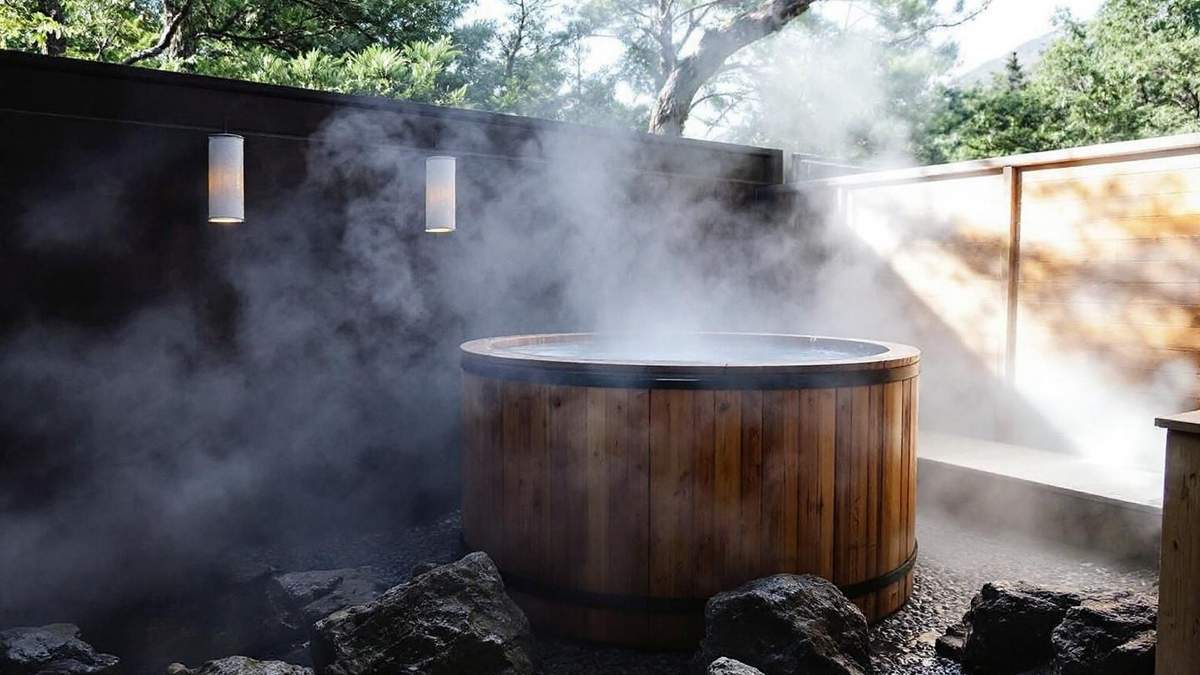
A kashikiri-buro is a private onsen room reserved exclusively for your group for a set time period (typically 45–60 minutes). The room contains one or more soaking baths fed by the same mineral spring water as the communal baths, a small changing area, and often an outdoor component. It is essentially the full onsen experience in a private setting.
Cost: 1,500–4,000 yen per session (the room rate, not per person). Most ryokan charge extra for kashikiri; some include it in the room rate. Day-use facilities at many hot spring towns also offer kashikiri rooms.
For tattooed travelers staying at a ryokan, this is the standard solution: use the private bath, avoid the communal facilities. In terms of experience quality, a well-designed kashikiri room is at least as satisfying as the communal bath, and more intimate.
Outdoor Onsen (Rotenburo)
Many ryokan and resort facilities have outdoor baths (rotenburo) that are either communal or private. The communal outdoor baths tend to have the same tattoo policies as indoor communal baths. Private outdoor rotenburo — including in-room baths that open to a small private garden — are increasingly common at mid-range and luxury ryokan and are typically available regardless of tattoo status.
Mixed-Gender Onsen (Konyoku)
Mixed-gender onsen (konyoku) are relatively rare and tend to be at outdoor natural spring settings in more remote areas. They typically require wearing a towel or light bathing garment, unlike standard onsen where swimwear is not permitted. Tattoo policies at konyoku vary; many are informal enough that small tattoos are tolerated.
Tattoo-Friendly Onsen by City and Region
Tokyo
Tokyo is the most tattoo-friendly major city in Japan for onsen. Several significant facilities have explicitly removed tattoo prohibitions:
Thermae-Yu (Kabukicho, Shinjuku): One of Tokyo’s most popular onsen complexes, with multiple indoor and outdoor baths, sauna, and rest areas. Explicitly tattoo-friendly for those with tattoos under a certain size or location. Full-body or highly visible large tattoos may still require use of private baths. Entry approximately 1,600–2,300 yen.
Spa LaQua (Tokyo Dome City, Bunkyo): Large natural onsen spa with extensive bathing and relaxation facilities. Has adapted its policy to allow tattoos under certain conditions (check current policy before visiting). Entry approximately 2,900–3,500 yen.
Ooedo-Onsen Monogatari (Odaiba): Closed in 2021 but has reopened under new management. Check current tattoo policy directly with the facility.
Juju and several other newer onsen cafes in Tokyo’s trendier neighborhoods have opened with explicit tattoo-friendly policies as a selling point for younger Japanese and international clientele.
Hakone
Hakone has a complex relationship with tattoo policies. The area has many onsen facilities and a large international visitor base, but many traditional facilities maintain stricter rules.
Tenzan Toji-kyo (near Hakone-Yumoto): One of the most popular day-use facilities in Hakone. Has private kashikiri rooms available for tattooed visitors; communal baths have restrictions. Entry approximately 1,300 yen (day use), kashikiri extra.
Kappa Tengoku (Hakone-Yumoto): Another popular day-use option; small tattoos covered by a patch may be permitted in some baths. Inquire in advance.
Most Hakone ryokan: The majority of mid-range and higher ryokan in Hakone include private kashikiri or in-room onsen access for guests. Booking a ryokan and using the private bath is the most reliable approach for tattooed visitors in Hakone.
Kyoto
Kyoto’s traditional culture means tattoo policies here tend to be stricter at historic facilities. However:
Funaoka Onsen (Kita ward): A historic sento with beautiful Edo-era interior and outdoor bath. Historically strict on tattoos; check current policy as it has been reconsidering.
Sauna & Capsule Hotel Kyoto Shijo: Modern facility with spa and onsen elements that has a more relaxed tattoo policy.
For tattooed visitors in Kyoto, the most practical recommendation is to stay at a ryokan with private in-room onsen or kashikiri, particularly in the Higashiyama or Fushimi areas.
Osaka
Osaka is relatively more relaxed than Kyoto in general cultural attitudes, and this extends somewhat to onsen.
Spa World (Namba area): A massive multi-floor spa facility with themed bath zones (European and Asian floors, rotating monthly). Spa World allows tattoos in private bath areas and has dedicated times or sections that are more accommodating. Check current detailed policy before visiting.
Various super-sento in Osaka: The mid-size commercial onsen facilities throughout Osaka (Super Sento, Yuami Shachi, Solaniwa Onsen) have varied policies. Several explicitly allow small tattoos. Research current policy before visiting.
Beppu (Kyushu)
Beppu, in Oita Prefecture, is one of Japan’s most concentrated onsen resort areas with over 2,800 individual spring vents. It is also one of the most tattoo-progressive areas, partly because of its long history of international visitors and its coastal, relatively cosmopolitan character.
Hyotan Onsen: One of the most celebrated onsen complexes in Beppu, with multiple outdoor and indoor pools of different types. Tattoo policy is relatively flexible; small tattoos are generally accommodated. Entry approximately 770 yen.
Takegawara Onsen: A historic wooden bathhouse in central Beppu, famous for its sunamushi (sand bath) experience. Sand baths cover your body entirely in warm volcanic sand — tattoos are fully covered during the experience. Entry approximately 1,500 yen.
Beppu generally: The Beppu municipality has actively promoted tattoo accommodation as a tourism initiative. The “Beppu Tattoo Friendly” project has certified a growing list of facilities. Check the official Beppu tourism site for the current certified list.
Noboribetsu (Hokkaido)
Noboribetsu is Hokkaido’s premier onsen resort town, known for its diverse spring types (nine different mineral compositions) and dramatic volcanic terrain.
Dai-ichi Takimotokan: One of the largest onsen facilities in Japan, with 35 different baths. Has historically been strict on tattoos for communal baths but provides private facilities. Book in advance as it is very popular.
Mahoroba (Grand Hotel): Offers private kashikiri and some accommodating policies for tattooed guests.
Cover-Up Options
If you want to use communal onsen facilities and your tattoo is small enough to cover:
Waterproof Bandages and Skin-Tone Patches
Standard waterproof bandages (available at any Japanese pharmacy, convenience store, or drug store) can cover very small tattoos effectively. The coverage must be complete — no ink visible. This approach works for small tattoos (roughly the size of a large postage stamp or smaller). It does not work for large pieces.
What to buy: Nexcare waterproof bandages, Band-Aid flexible fabric patches (available in skin-tone colors), or the Japanese equivalent at Matsumoto Kiyoshi or Sundrug pharmacies.
Cost: 400–800 yen for a pack.
Limitations: Waterproof bandages begin to peel at the edges after extended immersion in hot water. Re-check coverage after getting into the water. Most facilities that allow covered tattoos will ask that the covering remains in place throughout your bath.
Tattoo Cover-Up Patches (Sato no Hada)
Specialized tattoo cover patches designed for onsen use are available at some Japanese pharmacies and online. These are skin-toned silicone or adhesive patches designed to stay in place longer during water immersion than standard bandages.
Available at: Some Matsumoto Kiyoshi, Welcia, or Tsuruha pharmacy branches, or via Japanese Amazon (delivered to a convenience store using Japan’s click-and-collect service).
Tegaderm-Style Transparent Film Dressings
Medical-grade transparent film dressings (originally designed to cover wounds) are among the most effective cover options for onsen use. They adhere very firmly to skin, are fully waterproof, and stay in place through prolonged immersion. They are, however, transparent — the tattoo is still somewhat visible beneath them. Some facilities accept this; others require skin-tone coverage.
Available at: Pharmacies, medical supply stores, or online.
Rash Guards
A rashguard (tight-fitting long-sleeve swimwear top) covers arm and torso tattoos effectively and is accepted at some onsen facilities, particularly mixed-gender outdoor baths (konyoku) and resort-type spa facilities. Standard onsen etiquette prohibits swimwear — you enter the bath fully unclothed — but facilities that permit rash guards usually specify this explicitly.
This is not a solution for traditional communal onsen where swimwear is prohibited by the bathing rules.
Kashikiri Private Onsen: The Full Guide
A kashikiri-buro is the best solution for tattooed travelers who want the authentic onsen experience. Here is everything you need to know:
What It Is
Kashikiri means “reserved exclusively.” A kashikiri-buro is a private onsen room booked for your group alone for a fixed time period. It contains a tub (or tubs) filled with the same mineral spring water as the facility’s communal baths, a shower area, and changing facilities. It is essentially the identical experience, minus other bathers.
How to Book
- At a ryokan: Book the kashikiri session when reserving your room, or ask at check-in. Most ryokan that have kashikiri rooms take bookings on a first-come-first-served basis on the day of your stay. Arrive at the ryokan front desk and book your session time as soon as you check in.
- At day-use onsen facilities: Booking is usually done at the reception desk on the day. Some popular facilities require phone booking in advance.
- Online (some facilities): A growing number of facilities allow kashikiri reservations through their website or through booking platforms.
Cost
The session fee is charged for the room, not per person. Typical fees:
- Budget ryokan or day-use facility: 1,000–2,000 yen per session (45–60 min)
- Mid-range ryokan: included in room rate (one or two sessions per night) or 1,500–3,000 yen
- High-end ryokan: included in room rate; some have multiple private outdoor baths available on demand
What to Bring
- A small towel (provided by the ryokan or facility; in day-use, you may need to rent one for 200–400 yen)
- Your toiletries if you plan to shower; most facilities provide shampoo, conditioner, and soap
- Nothing else — onsen are meant to be experienced in the most stripped-down way possible
Etiquette in the Private Bath
The etiquette is identical to communal onsen: wash thoroughly before entering the tub, do not bring your towel into the water, do not add soap or other products to the tub, and do not drain the water after your session (the facility will handle this).
Full Onsen Etiquette: Step-by-Step
Whether you are using a communal or private bath, the process is the same. First-time visitors are often anxious about getting this wrong; the reality is that the basics are very simple.
1. Remove Your Shoes
At the entrance to the onsen facility, remove your shoes and place them in the provided shoe locker. Put on the facility’s slippers.
2. Pay and Receive a Towel
Pay the entry fee at the reception. You will receive (or can rent for 200–400 yen) a small thin towel. This towel is for drying off and for modesty while moving between the changing room and the bath — it does not go in the water.
3. Change in the Changing Room
Leave all your clothes and belongings in the changing room locker. Take only your small towel to the bath area. Do not wear swimwear into the bath (unless the facility explicitly permits it).
4. Sit at a Shower Station and Wash
Before entering any bath, sit at one of the individual shower stations along the wall (a low stool and a small spray head or bucket) and wash your entire body thoroughly with soap and shampoo. Rinse completely. This is not optional — it is the most important rule of onsen etiquette. The baths are not for cleaning; they are for soaking. Entering a bath without washing first is considered deeply inconsiderate.
5. Enter the Bath Slowly
Lower yourself slowly into the bath. The water is hot — typically 38–42°C. Give your body time to adjust. Do not splash. Sit quietly.
6. Manage Your Towel
Your small towel should not go in the water. Many people fold it and place it on top of their head while soaking (a common sight). This keeps it dry and out of the water while also cooling your head slightly.
7. Soak
Soak for 10–20 minutes per session. It is normal to get out, cool down at the washing station or by sitting in the changing area, and get back in. Alternating between hot and cooler pools (if available) is a traditional practice.
8. Shower Off Before Leaving
After your final soak, shower off the mineral water if you prefer (some people believe leaving the minerals on your skin is beneficial — both approaches are acceptable and you will see both practiced).
9. Dry Fully Before Leaving the Bath Area
Dry yourself with your towel before walking into the changing room. Dripping water on the changing room floor is considered inconsiderate.
10. Hydrate
Onsen bathing is dehydrating. Drink water before and after your session. Many ryokan and onsen facilities have water stations at the changing room entrance; chilled barley tea (mugicha) is often provided free of charge.
What Minerals Are in Onsen Water?
Japan’s volcanic geology produces hot springs with widely varying mineral compositions. The type of water affects both the bathing feel and the claimed health benefits:
- Simple thermal water (tanjun-sen): Clear, mild, gentle on sensitive skin. The most common type. Good for relaxation and general health.
- Sodium bicarbonate (juso-en): Sometimes called “beauty water” (bijin-no-yu). Makes skin very smooth to the touch. Common in Beppu and various mountain locations.
- Sulfur (iou-sen): Milky white or yellow water with a strong sulfur smell. Common at volcanic locations like Noboribetsu and Owakudani. Good for skin conditions; avoid with certain metal jewelry.
- Iron (tetsu-en): Orange or brown-tinged water. High iron content; notable mineral taste.
- Chloride (shio-sen): Salty water that warms the body effectively and retains heat after bathing. Common in coastal areas.
- Hydrogen carbonate (juuso-en): Slightly alkaline; leaves skin feeling silky.
Most ryokan will display the mineral composition (and the spring temperature) on a notice board near the bath entrance.
Mixed-Gender Onsen (Konyoku)
Konyoku (mixed-gender bathing) is traditional in Japan and still exists at certain outdoor mountain locations and rural hot spring facilities. It is far less common than separate-gender onsen.
At genuine konyoku, bathing is fully unclothed (the traditional practice). However, many modern facilities that allow mixed bathing require or permit light towel covering. The atmosphere at konyoku tends to be more informal and less concerned with rigid rules — tattoos are generally less of an issue here, particularly at outdoor mountain settings.
Notable konyoku locations include certain facilities in Nyuto Onsenkyo (Akita Prefecture, the famous hidden hot spring cluster), parts of Kusatsu Onsen (Gunma), and various outdoor springs in the Japanese Alps. Nyuto’s Tsuru no Yu — one of the most beautiful onsen in Japan — has outdoor konyoku pools accessible to both genders (towels permitted for women; men traditionally bathe without).
Tips for Tattooed First-Timers
Be direct when booking: When reserving a ryokan or day-use onsen, call or email and ask about their tattoo policy. Phrase it as: “I have a tattoo. What are my options for bathing?” Most facilities will tell you exactly what is available — communal access, private bath only, cover-up required, or full restriction. This avoids awkward situations on arrival.
Book ryokan with private baths: Many ryokan offer rooms with a private in-room bath (private rotenburo or in-room tub) fed by the same onsen water. These rooms are typically more expensive (add 5,000–15,000 yen per night) but provide complete privacy and unlimited bath access.
Look for the tourism ministry certification: A growing number of facilities display certification indicating they accommodate tattooed guests. The logo and certification were introduced around 2020 and are more common now.
Size and placement matter in practice: A small wrist tattoo and a full chest piece are both technically “tattoos,” but enforcement is inconsistent. Many staff will overlook a small, partially hidden tattoo if you are respectful and follow all other etiquette. This is not a guarantee, and you should not rely on it — but it reflects the reality on the ground.
Day-use vs. overnight: As an overnight ryokan guest, you generally receive more flexibility and personal attention than a walk-in day-use visitor. Ryokan staff who have welcomed you as a guest are more likely to find a solution for you than a counter attendant at a busy day-use facility.
Travel with a small first aid kit: Include several sizes of waterproof bandages. They cost almost nothing and cover a lot of possibilities.
Essential Onsen Vocabulary
These Japanese terms are useful to know:
- Onsen (温泉): Hot spring / hot spring bath
- Sento (銭湯): Public bathhouse (not necessarily using natural spring water)
- Rotenburo (露天風呂): Outdoor bath
- Kashikiri-buro (貸切風呂): Private reserved bath
- Noboriyoke (のぼり湯): Getting in the bath for the first time
- Kake-yu (かけ湯): Pouring water over yourself before entering the bath (the rinse step)
- Tatami (畳): Traditional woven rush mat floors (in ryokan rooms)
- Yukata (浴衣): The light cotton robe worn at ryokan between bath and room
- Geta (下駄): Wooden sandals worn with yukata
- No tattoos sign: 入れ墨・タトゥーのある方の入浴はご遠慮ください (Irezumi/tattoo no aru kata no nyuyoku wa goenryo kudasai) — “Persons with tattoos, please refrain from bathing.”
Knowing the private bath vocabulary is particularly useful: asking for a “kashikiri-buro” at the front desk is clear to any ryokan or onsen staff member.
The Experience Is Worth the Effort
Onsen bathing is one of the most genuinely Japanese experiences available to a visitor. It is not a tourist attraction in the usual sense — it is a daily practice for millions of Japanese people, a way of restoring the body and mind after a long day, a social ritual that has remained essentially unchanged for centuries. Spending an evening in a well-maintained ryokan with a private outdoor bath, soaking in mineral water while looking at a garden or a mountain, is one of the finest experiences Japan offers. See our ryokan guide for how to choose and book the right traditional inn.
For tattooed travelers, the extra planning is absolutely worth it. Private baths provide the full experience with complete privacy. Tattoo-friendly facilities are increasing rapidly. The situation in 2026 is meaningfully better than it was even three years ago, and the trend is clearly toward greater inclusivity.
Research before you book, book a ryokan with kashikiri or private bath access, bring a pack of waterproof bandages just in case, and do not let the complexity discourage you from one of the best things Japan has to offer.