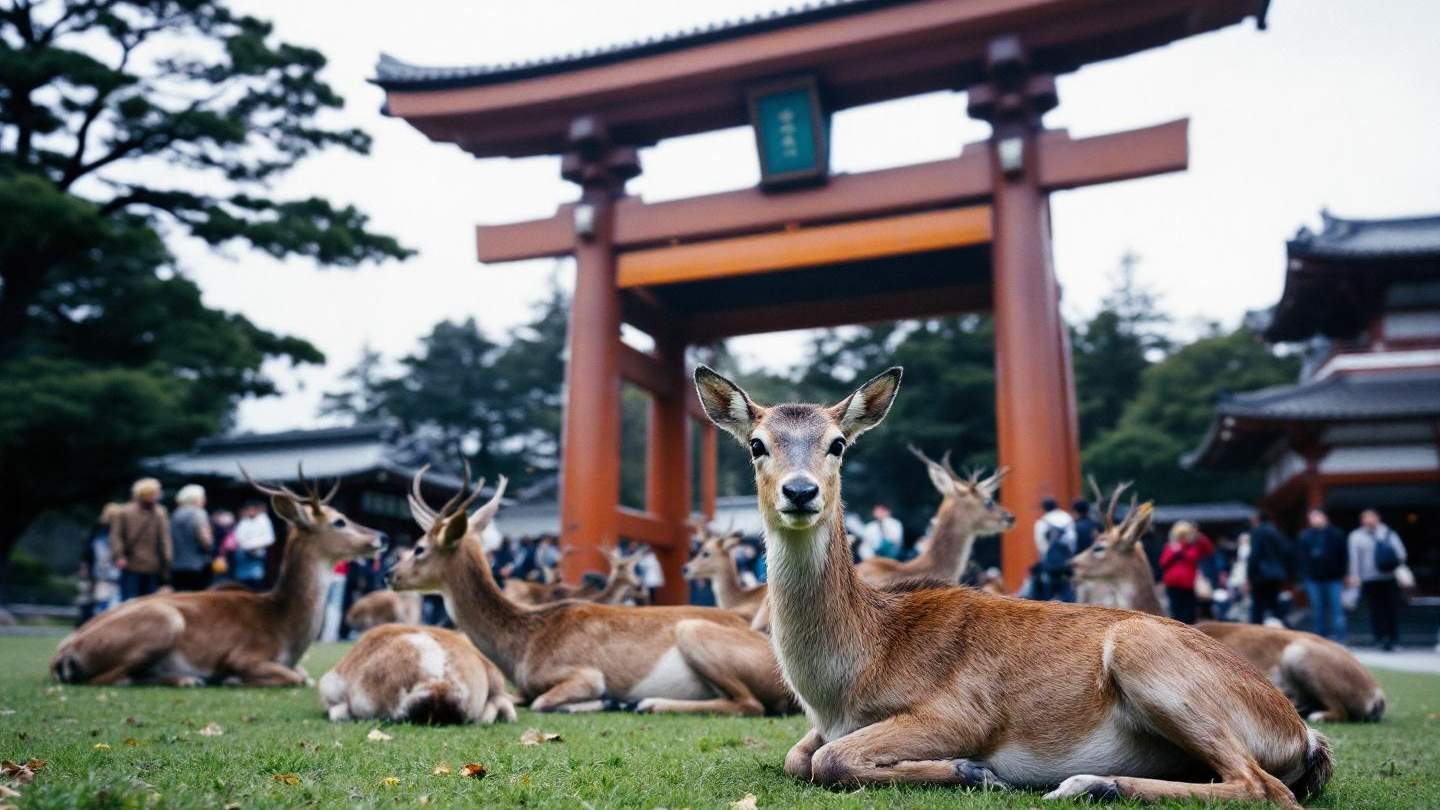
Nara
Complete Nara travel guide. Meet the famous deer, visit ancient temples, explore the first permanent capital of Japan, and plan the perfect day trip.
Quick Facts
- Best For
- Temples, Deer, History
- Days Needed
- 1 day (or overnight)
- Best Season
- Spring and Autumn
- Getting There
- 45 min from Kyoto/Osaka
- Getting Around
- Walking + buses
- Budget (per day)
- 4,000-10,000 yen
Why Visit Nara
This Nara travel guide covers the famous Nara deer park, the Great Buddha at Todai-ji, Kasuga Taisha shrine, things to do in Nara, where to stay in Nara, and the best time to visit Nara. Whether you’re planning a Nara day trip from Kyoto or an overnight stay, here’s everything you need.
Nara holds a singular place in Japanese history. For a brief but formative period from 710 to 784, it served as Japan’s first permanent capital — Heijo-kyo — and the religious and political heart of a young imperial state that was absorbing Buddhism, Chinese governance, and continental culture at a remarkable pace. The buildings and institutions that survive from this era are not just old; they represent the moment Japan decided what kind of civilization it would become.
Today, Nara is best known for its deer — around 1,300 of them, freely wandering through Nara Park, regarded as sacred messengers of the gods for over 1,200 years. But behind the Instagram photos of deer bowing for crackers lies a city with the highest concentration of ancient temples in Japan, a quiet old merchant quarter, and gardens of genuine beauty.
What makes Nara special among Japan’s historic cities is scale. Unlike Kyoto, where the sights are spread across a large urban area, Nara’s major temples and park are clustered within easy walking distance of each other. You can see everything significant in a single long day. And yet the city never feels rushed or crowded in the way Kyoto can. Even on a busy weekend, you will find corners of Nara Park where it is just you and a deer grazing under a pine tree.
Day Trip vs Overnight Stay
Day trip (from Kyoto or Osaka) is how most visitors experience Nara, and it works well. You can arrive by 9am, cover Todai-ji, Kasuga Taisha, Nigatsu-do, and the park itself, have lunch in Naramachi, and be back on the train by 4pm with a full experience.
Overnight allows a fundamentally different experience. The park empties completely after 5pm as day visitors leave. In the evening, the deer are more placid and the trees around Kasuga Taisha glow in lantern light. Naramachi’s restaurants come alive for dinner. The early morning — especially around Todai-ji before it opens at 7:30am — is extraordinarily peaceful. If you have the flexibility, one night in Nara is one of the better decisions you can make in the Kansai region.
Nara Park and the Deer
Nara Park covers 502 hectares and contains most of the city’s major shrines and temples within or adjacent to its boundaries. But the park’s real character is defined by its deer. These are sika deer (Cervus nippon), and they have roamed freely here since at least the 8th century, when they were designated divine messengers of Kasuga Taisha shrine. Killing a deer in Nara was once a capital offense.
Today the deer are wild but thoroughly habituated to humans. They have learned, genuinely learned, to bow their heads in a begging gesture when they want food — a behavior that emerged from tourists rewarding deer that dipped their heads, which led the deer to internalize the gesture as a food-getting strategy. It is charming and slightly unsettling in equal measure.
Deer Etiquette and Feeding Tips
Shika senbei (deer crackers) are sold throughout the park from vendors for 200 yen per packet of around 10 crackers. They are the only food you should offer the deer — human food, especially anything sweet, can harm them.
When you buy a packet, the deer will notice immediately. Hold the crackers at your side or behind your back, offer one at a time, and stay calm. If you wave the crackers above your head or show the packet openly, you will be mobbed. The deer are persistent, occasionally pushy, and sometimes nip at clothing or bags when they suspect food is hidden. This is especially true of males during rutting season (October–November).
Be cautious with children: The deer are large animals and will push. Young children should be supervised closely and should not hold crackers above the deer’s head level, which can cause the deer to lunge upward.
Fawns appear in May and June and are among the most photographed subjects in Japan. They tend to stay near the wooded edges of the park rather than the busy paths.
The deer genuinely roam throughout Nara — you will encounter them on shopping streets, at train stations, and occasionally inside convenience stores. It is one of Nara’s great pleasures.
Todai-ji: The Great Buddha Temple
Todai-ji is the centerpiece of Nara’s historical legacy and one of the most extraordinary buildings in Asia. The Great Buddha Hall (Daibutsuden) is the largest wooden structure in the world — a designation it holds even in its current form, which is actually two-thirds the size of the original 8th-century building, which burned twice and was last rebuilt in 1709.
Inside sits the Daibutsu: a bronze statue of Vairocana Buddha completed in 752, standing 15 meters tall with hands the size of a human torso. The statue has been repaired and partially recast over the centuries but retains much of its original bronze. Sitting beneath it is one of those scale-defying experiences where you keep recalibrating your sense of what is physically possible.
Flanking the Daibutsu are two large bodhisattva figures, and behind the statue you can see the original lotus petal from the massive bronze base. One of the hall’s interior columns has a hole at its base, popular legend saying that anyone who can squeeze through it will be granted enlightenment — and a stream of visitors, mostly children, attempt it daily.
Practical notes: Entry to the Daibutsuden is 600 yen. Opening hours are 7:30am–5:30pm (April–October), 8am–5pm (November–March). The surrounding Nandaimon Gate is free to enter and contains two enormous Nio guardian figures carved in the 13th century — some of the finest wooden sculptures in Japan. Allow yourself five minutes just to stand in front of these.
The approach to Todai-ji through the park, particularly through Nandaimon with deer grazing on either side, is one of the great approach sequences in Japanese architecture. Walk it slowly.
Kasuga Taisha
Kasuga Taisha was founded in 768 and is the tutelary shrine of the Fujiwara clan, the powerful noble family that dominated the imperial court for centuries. It is one of Japan’s most important Shinto shrines and a UNESCO World Heritage Site.
The shrine is famous for its lanterns — around 3,000 of them, suspended from the covered corridors and hanging as stone lanterns along the approach path through the forest. During the Setsubun Mantoro festival in early February and the Obon Mantoro festival in mid-August, all 3,000 are lit simultaneously, creating one of the most atmospheric events in the Kansai region.
Even outside festival time, the walk to Kasuga Taisha through the forest path from the park is beautiful. The approach is lined with hundreds of stone lanterns covered in moss, and sacred deer wander through the cryptomeria trees. Entry to the outer shrine grounds is free; entry to the inner covered corridor area costs 500 yen.
Isuien Garden
Isuien is a two-part landscape garden that uses the technique of shakkei (borrowed scenery) masterfully, incorporating the forested hills behind Todai-ji as part of its composition. The front garden dates from the 17th century; the rear garden from the Meiji era. Together they form one of the most carefully designed garden experiences in Nara.
Entry is 1,200 yen and includes access to the adjacent Neiraku Art Museum, which displays Chinese and Korean bronzes and ceramics in a compact, well-curated space. The garden is never heavily crowded and offers a quiet refuge after the busier temple grounds. Open 9:30am–4:30pm (closed Tuesdays).
Naramachi: The Old Town Quarter
Naramachi occupies the southern end of the historic core, where former merchants’ machiya townhouses have been converted into cafes, craft shops, galleries, and restaurants. The narrow lanes feel genuinely old in a way that heavily restored tourist districts often do not — many buildings date from the 17th to 19th centuries and are still in private use.
The area is most pleasant in the late morning or early afternoon when other tourists are concentrated at the temple area to the north. Look for the hanging red sacks (migawari-zaru) outside the machiya houses — small monkey figurines believed to take on illness on behalf of the household.
Highlights include the Naramachi Koshi-no-ie preserved merchant house (free entry), the Naramachi Museum, and numerous small craft workshops making traditional Nara crafts including akahada-yaki pottery and Nara ink sticks.
Yoshikien Garden
Just east of Isuien, Yoshikien is a smaller garden maintained by Nara Prefecture. It contains three distinct sections — a pond garden, a moss garden, and a tea ceremony garden — and is free for foreign visitors (normally 250 yen for Japanese visitors). This means it tends to be noticeably quieter than other Nara gardens despite being excellent.
The moss garden section is particularly beautiful after rain, and the tea house garden has a calm, geometric formality. Allow 30–45 minutes.
Mount Wakakusa
Mount Wakakusa (Wakakusayama) is a grassy 342-meter hill at the eastern edge of Nara Park, offering the best panoramic views over the city and toward Todai-ji. The hike to the summit takes about 25–30 minutes at a comfortable pace, and the slopes are covered in lawn-like grass rather than forest, giving it an open, almost pastoral quality unusual among Japanese mountain hikes.
Entry costs 150 yen (paid at the base gate). The hill is closed January through mid-March except during Yamayaki, the grass-burning festival held in late January when the entire hillside is set alight at night — a spectacular and ancient event.
Nara National Museum
The Nara National Museum sits at the western edge of the park, between Todai-ji and Naramachi, and contains one of the finest collections of Buddhist art in Japan. Two main buildings house thousands of objects — sculptures, paintings, metalwork, textiles — many from the Nara-period temples surrounding the park.
The permanent collection is excellent, but Nara National Museum is especially worth visiting during the annual Shosoin Exhibition in late October and early November, when artifacts from the 8th-century Shosoin treasure repository at Todai-ji are displayed to the public. These objects — silks, glassware, musical instruments, medicines — survived intact from the Tang Dynasty era and are among the most significant material artifacts of the ancient world.
Standard admission is 700 yen; special exhibitions cost more. Open 9:30am–5pm, closed Mondays.
Local Food: What to Eat in Nara
Kakinoha Sushi
Nara’s signature dish. Pressed sushi — mackerel or salmon over rice — wrapped in persimmon (kaki) leaves, which impart a subtle tannin fragrance and act as a natural preservative. The leaves are not eaten. Kakinoha sushi developed in the days before refrigeration, when fishermen from the coast would press-pack fish in salt and rice to transport inland to Nara. The result is umami-rich, lightly fermented, and deeply satisfying. Available at shops throughout Naramachi; a box of five pieces costs around 700–1,000 yen.
Mochi
Nara has a strong tradition of traditional mochi confectionery, and the covered arcade near Kintetsu Nara Station has several shops selling freshly pounded mochi of various types. Yomogi (mugwort) mochi and sakura mochi in spring are particularly good.
Warabi Mochi
Nara-style warabi mochi is softer and less sweet than versions sold elsewhere, made from bracken starch and served with kinako (roasted soybean flour) and black sugar syrup. Many cafes in Naramachi serve it as a light dessert.
Getting to Nara
From Kyoto
Nara is the most popular day trip from Kyoto, and the journey is quick and easy on either the Kintetsu Line or JR. If you’re combining Nara with Kyoto and Osaka — the classic Kansai combination — see our 7-day Japan itinerary. For Japan Rail Pass holders, the JR Nara Line is a convenient free option.
Kintetsu Line (Kintetsu Kyoto Line): The fastest and most convenient option. The Limited Express from Kintetsu Kyoto Station to Kintetsu Nara Station takes 35 minutes and costs around 1,160 yen (including limited express surcharge of 520 yen). Regular express trains take about 45–50 minutes and cost 640 yen with no surcharge. Kintetsu Nara Station deposits you directly at the edge of the park — this is the better arrival point for the major sights.
JR Nara Line: Takes about 45 minutes from Kyoto Station to JR Nara Station (a few minutes’ walk west of Kintetsu Nara Station) and is covered by the JR Pass. Cost without pass is 760 yen.
From Osaka
Kintetsu Line (Kintetsu Osaka Namba or Tsuruhashi): The Kintetsu Limited Express takes about 40 minutes from Osaka Namba to Kintetsu Nara Station (around 1,100 yen including surcharge). Regular express trains take about 50 minutes for around 570 yen.
JR Yamatoji Line: From Osaka or Tennoji, around 45–55 minutes to JR Nara Station. Covered by JR Pass; approximately 800 yen without.
From Tokyo
Take the Shinkansen to Kyoto (about 2 hours 15 minutes on the Nozomi) then connect to Nara. Or take the Shinkansen to Shin-Osaka and connect from there. Direct bus options exist but take 5–6 hours.
Getting Around Nara
The main temple and park area is genuinely walkable from both Kintetsu Nara Station and JR Nara Station. Todai-ji is about a 25-minute walk from Kintetsu Nara Station through the park. Kasuga Taisha is about 35–40 minutes walk from the station.
City Loop Bus: A tourist bus loops between the major sights for 120 yen per ride or 500 yen for a day pass. Useful if you want to visit Mount Wakakusa or Horyu-ji (further south) without walking.
Cycling: Rental bikes are available near Kintetsu Nara Station for around 1,000–1,500 yen per day. Useful for reaching Horyu-ji, Yakushi-ji, or other temples south of the park.
On foot: For the core park area — Todai-ji, Kasuga Taisha, Isuien, Yoshikien — walking is both practical and the most pleasurable option.
Best Time to Visit Nara
| Season | Months | Highlights | Crowds |
|---|---|---|---|
| Spring | Late Mar–early Apr | Cherry blossoms in the deer park | High |
| Early summer | May–Jun | Fresh greens, fewer tourists | Low |
| Autumn | Oct–Nov | Maple foliage; Shosoin Exhibition | Medium-high |
| Winter | Jan–Feb | Yamayaki fire festival; quiet | Very low |
Spring (late March to early April): Cherry blossoms in Nara Park with deer wandering beneath them is genuinely one of the great seasonal sights in Japan. The Omizutori water-drawing ceremony at Nigatsu-do (part of Todai-ji) in early March is also deeply impressive.
Autumn (October to November): The best season overall. Maple foliage in the park and around Kasuga Taisha turns brilliant red and orange. The Shosoin Exhibition opens at the National Museum. The deer are more active.
Summer: Hot and humid. The Mantoro lantern festival in August is exceptional if you can tolerate the heat. Avoid visiting on peak summer weekends.
Winter: The quietest time. Cold but rarely freezing. Yamayaki grass-burning festival on Mount Wakakusa in late January is unique and worth planning around.
Practical Tips
Arrive early: Todai-ji opens at 7:30am (8am in winter). The first hour has dramatically fewer visitors and the morning light through the hall is extraordinary. Tour groups typically arrive between 9 and 10am.
Deer crackers: Buy them after you arrive at the park, not at the station shops. Vendors near Nandaimon are most convenient.
Protect your belongings: The deer genuinely will steal maps, brochures, plastic bags, and anything they can reach. Keep bags zipped and papers put away when near groups of deer.
Temple fatigue: If you are coming from Kyoto, you may be experiencing temple overload. Nara’s strength is in just two or three major sites done properly, not a comprehensive checklist. Prioritize Todai-ji (with time to stand in front of Nandaimon), the park walk, and Naramachi, and you will leave satisfied.
Nigatsu-do Hall: Most visitors to Todai-ji skip this secondary hall on the hillside above the Daibutsuden, which is a mistake. A five-minute walk up the hill from the main complex brings you to an open wooden verandah overlooking the entire Nara plain — one of the best views in the city, and virtually always quiet.
For broader planning context, check our guide to planning a Japan trip, Japan travel budget guide, and best time to visit Japan. Nara fits naturally alongside Kyoto, Osaka, and Kobe in a 10-day or 14-day Japan itinerary. Our Japanese food guide covers the dishes you’ll encounter across Nara and the broader Kansai region.
Frequently Asked Questions About Nara
Is Nara worth visiting?
Absolutely. Nara is one of Japan’s most rewarding destinations, combining the world-famous Nara deer park with the magnificent Great Buddha at Todai-ji, ancient Kasuga Taisha shrine, beautiful gardens, and the charming old merchant quarter of Naramachi. Unlike Kyoto, which requires days to explore properly, Nara’s highlights are compact enough for a very satisfying Nara day trip. Yet the city has enough depth to reward an overnight stay too. Most visitors wish they had spent more time here.
How long should you spend in Nara?
One full day is enough to cover the essential things to do in Nara — Todai-ji and the Great Buddha, a walk through the deer park, Kasuga Taisha, and Naramachi. An overnight stay is recommended if you want the park to yourself in the early morning (extraordinary before 8am), a proper dinner in Naramachi, and time for Isuien Garden and Yoshikien without rushing. Most first-time visitors come as a day trip from Kyoto or Osaka, which works well; allow a full 7–8 hours if you can.
Are the deer in Nara dangerous?
The deer in Nara are wild animals and should be treated with respect, but serious incidents are rare. They are large (sika deer can weigh 50–70 kg) and will push, nip at bags, and aggressively seek food from anyone holding deer crackers (shika senbei). Young children should be supervised closely. Males can be more assertive during rutting season in October–November. Do not wave crackers in the air, do not tease them, and keep bags zipped. Feed them calmly one cracker at a time and most encounters are charming rather than alarming.
Is it better to visit Nara from Kyoto or Osaka?
Both work well. From Kyoto, the Kintetsu Limited Express takes 35 minutes (1,160 yen) and arrives at Kintetsu Nara Station, which puts you right at the park entrance — slightly more convenient. From Osaka, the Kintetsu Limited Express from Namba takes about 40 minutes (1,100 yen). If you are based in Osaka and haven’t yet visited Kyoto, Nara makes an excellent stand-alone day trip. The Kintetsu Tourist Pass covering both Nara and Kyoto from Osaka can save money if you’re doing multiple Kansai stops. See our Japan itinerary guides for routing ideas.
Is Nara free to visit?
Most of Nara Park is free — the deer wander throughout a large public space with no entry charge. The major sights have modest fees: Todai-ji’s Great Buddha Hall costs 600 yen, Kasuga Taisha’s inner corridor 500 yen, and Isuien Garden 1,200 yen. Yoshikien Garden is free for foreign visitors (a quiet gem that most people miss). The Nara National Museum costs 700 yen for the permanent collection. Overall, Nara is one of the more affordable major destinations in Japan — a full day covering all the top sites costs around 2,000–3,000 yen in entrance fees.