Best Things to Do in Kanazawa
Last updated: March 2026
Kanazawa was one of Japan’s richest feudal domains, controlled for three centuries by the Maeda clan — the only lords powerful enough that the Tokugawa shogunate considered them a potential rival. The wealth this generated went into art, craftsmanship, food culture, and performance arts at a level that rivaled Kyoto. Remarkably, Kanazawa was never bombed during World War II, leaving its historic fabric — samurai districts, geisha neighborhoods, feudal garden, and traditional craft studios — largely intact.
The result is a city of extraordinary depth: Japan’s best garden by many measures, two well-preserved historic districts, a world-class contemporary art museum, and a seafood market that locals will tell you (with full sincerity) beats Tokyo’s Tsukiji. The things to do in Kanazawa reward at least two full days — though many visitors discover they could use three.
Quick Reference
| Activity | Time Needed | Cost | Best For |
|---|---|---|---|
| Kenrokuen Garden | 1.5–2 hours | 320 yen | All visitors; essential |
| Kanazawa Castle Park | 45–60 minutes | Free (grounds) / 320 yen (interior) | History, architecture |
| 21st Century Museum of Contemporary Art | 1.5–3 hours | Free (exterior) / 1,200 yen (collection) | Contemporary art |
| Higashi Chaya geisha district | 45–60 minutes | Free (walking) / 700 yen (Shima teahouse) | Atmosphere, photography |
| Nagamachi Samurai District | 45–60 minutes | Free (walking) / 550 yen (Nomura Clan house) | History, architecture |
| Omicho Market | 45–90 minutes | Free (browsing), sushi from 1,000 yen | Seafood, atmosphere |
| D.T. Suzuki Museum | 45–60 minutes | 310 yen | Philosophy, Zen, architecture |
| Higashiyama Temple District | 1–2 hours | Free (most temples free) | Quiet, atmospheric walk |
| Kenroku-en in winter (yukitsuri) | 1.5 hours | 320 yen | Snow season spectacle |
| Nishiki-machi craft shopping | 1–2 hours | Free (browsing) | Gold leaf and Kutani crafts |
Kenrokuen Garden
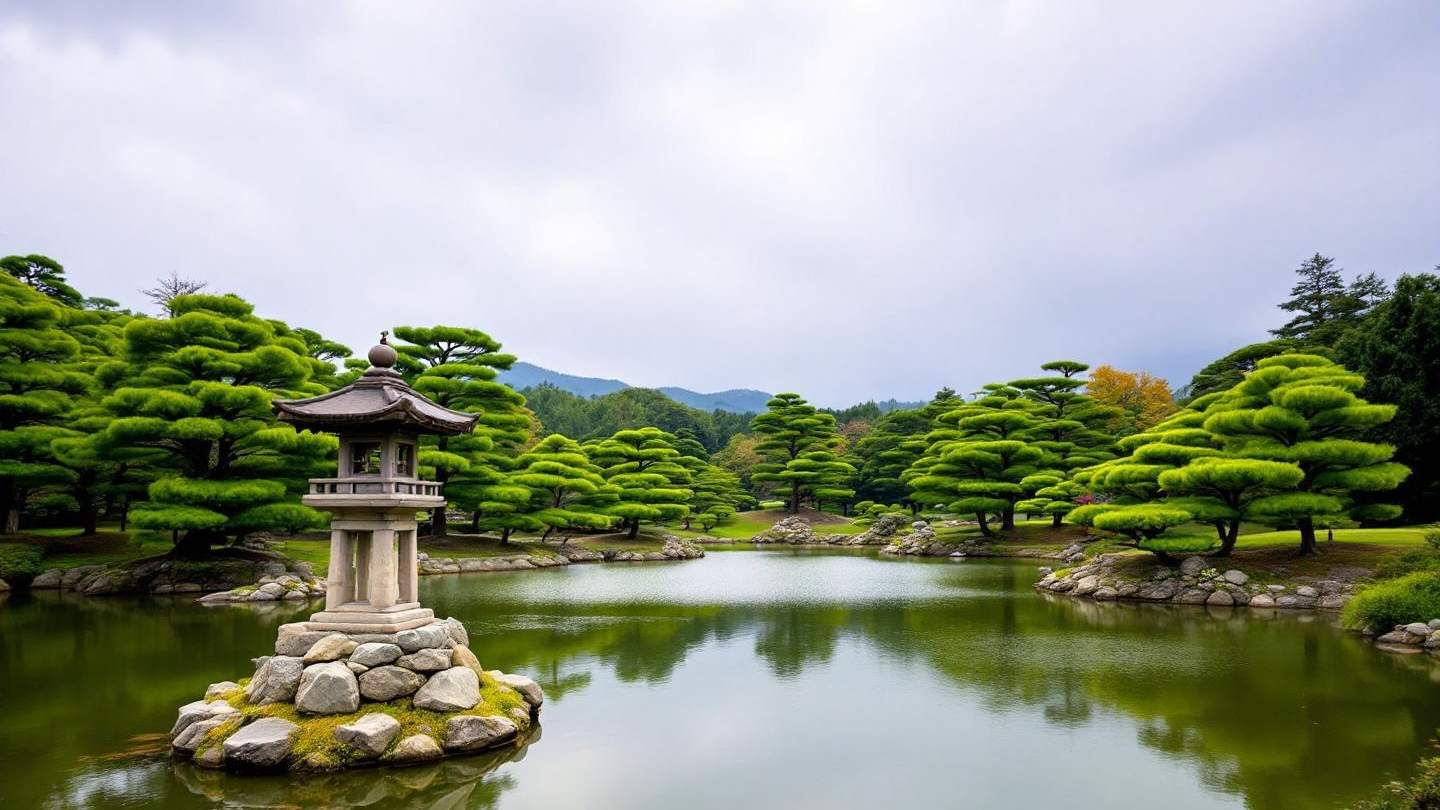
Kenrokuen (admission 320 yen) is consistently ranked among Japan’s three most beautiful gardens and is Kanazawa’s single essential experience. The name means “garden of six attributes” — spaciousness, seclusion, artificiality, antiquity, abundant water, and panoramic views — a classification from Chinese landscape theory that the garden deliberately embodies. Unlike many Japanese gardens that prioritize simplicity or Zen austerity, Kenrokuen is lush and full, with winding paths around two interconnected ponds, a stream, waterfalls, stone lanterns, pine trees trained over decades, and flowering trees for every season.
The Kotoji-toro lantern — a two-legged stone lantern standing in the pond — is the garden’s icon and one of Japan’s most photographed garden features. It is at its most beautiful in the early morning light before the gates fully open.
Kenrokuen has distinct seasonal identities:
- Spring: Cherry blossoms among the pines (late March to early April)
- Summer: Irises along the stream, water lilies in the ponds
- Autumn: Red maples throughout the garden (mid-November)
- Winter: Yukitsuri (straw rope supports protecting the pine trees from snow damage) — a visual spectacle unique to Kenrokuen, recognizable as a symbol of Kanazawa
Winter yukitsuri are erected annually in November and removed in late March. The sight of dozens of pine trees with rope supports spreading like umbrellas, photographed under a light snowfall, is one of Japan’s most distinctive seasonal images.
Open from 7am (March–October) or 8am (November–February). Most crowded between 10am and 3pm; arrive at opening for a significantly better experience.
Kanazawa Castle Park
Kanazawa Castle (park free; interior buildings 320 yen) sits immediately adjacent to Kenrokuen and is linked by a stone bridge. The original castle was home to the Maeda clan for three centuries; most of its buildings burned down over the years and the reconstructed Hishi-yagura turret and Gojikken Nagaya earthen wall give a sense of its original scale and construction.
The castle park grounds are free to enter and the wide open space with castle walls, moats, and mature trees is one of the city’s best spots for a morning or evening walk. The Gyokusen-en Garden (admission 700 yen), a smaller Edo-period garden tucked below the castle walls, is less visited than Kenrokuen and has a beautiful tiered waterfall design along a steep hillside.
21st Century Museum of Contemporary Art
The 21st Century Museum of Contemporary Art, Kanazawa (free to enter the communal zone; collection galleries 1,200 yen) is one of Japan’s most original museums — a circular, glass-walled building with no clear front or back entrance, designed by SANAA (Kazuyo Sejima and Ryue Nishizawa), creating a building that feels like a town square as much as an institution. Natural light enters from all directions; the boundary between inside and outside is deliberately blurred.
The permanent collection includes several large-scale installations. The most famous is Leandro Erlich’s Swimming Pool — a work that allows visitors above the pool surface to look down through the water at people apparently standing at the bottom, while visitors who enter through a separate below-ground entrance actually stand in a dry chamber looking up. It is a simple concept and a genuinely disorienting and joyful experience.
The museum’s communal zone (free) includes temporary installation spaces accessible without paying. Even without entering the paid galleries, the building and its public gardens are worth spending an hour exploring.
Higashi Chaya Geisha District
Higashi Chaya (East Teahouse District) is the largest and best preserved of Kanazawa’s three historic geisha districts — a street of two-story machiya buildings with distinctive wooden lattice facades that housed teahouses where geisha performed for the Maeda domain’s samurai class. The main street is pedestrianized and photogenic at any time of day; evening, when the lattices are lit from within, is the most atmospheric.
Shima (admission 700 yen) is a former teahouse preserved as a museum, with the original tatami rooms, sake cups, musical instruments, and decor of a 19th-century geisha establishment intact. The brief guided tour (available in English via printed materials) explains the function of each room and the etiquette of the teahouse world.
Several ground-floor shops in the district sell Kanazawa gold leaf products — the city produces 99% of Japan’s gold leaf (kin-paku) and applies it to everything from lacquerware and cosmetics to ice cream cones and cocktails. The gold leaf soft-serve ice cream (700–900 yen) at Hakuichi near the district is an Instagram-designed but genuinely attractive product.
Nagamachi Samurai District
Nagamachi (free to walk through) is a preserved samurai residential neighborhood on the opposite side of central Kanazawa from Higashi Chaya — a maze of earthen walls, narrow lanes, and stone-bridged streams that once divided the houses of mid-ranking samurai retainers of the Maeda domain.
The Nomura Clan Samurai House (admission 550 yen) is the most complete surviving samurai residence in the district, with original reception rooms, a garden, lacquered wood interior, and a collection of armor, weapons, and household objects. The garden is tiny and exquisite.
The Shinise Kinenkan (admission 100 yen), a reconstructed merchant house near Nagamachi, displays the history of Kanazawa’s traditional medicine and confectionery industries.
The walk from Nagamachi through the Katamachi entertainment district to the 21st Century Museum and Kenrokuen covers the essential geography of central Kanazawa in about 90 minutes.
Omicho Market
Omicho Market (free to enter, open from around 9am, most vendors closed by 4pm) is Kanazawa’s traditional food market — a covered arcade of approximately 170 vendors selling fresh fish, vegetables, pickles, and prepared foods. The fish selection reflects Kanazawa’s proximity to the Sea of Japan: enormous snow crabs (matsuba-gani, in season November to March), yellowtail (buri), sea bream, firefly squid, and sweet shrimp (ama-ebi) that are softer and sweeter than any version available far from this coast.
Sushi restaurants inside and above the market serve omakase (chef’s choice) sets using the morning’s catch for 3,000–8,000 yen per person. This is considered one of the best-value premium sushi experiences in Japan — significantly less expensive than Tokyo equivalents with comparable seafood quality.
The market is busiest in the morning from 10am to noon. On Sunday mornings, the surrounding streets around Omicho become a local farmer’s market selling regional produce, pickles, and preserved foods.
D.T. Suzuki Museum
Daisetz Teitaro Suzuki was the philosopher and Buddhist scholar from Kanazawa who is largely responsible for introducing Zen Buddhism to the Western world in the 20th century, writing over 100 books on Buddhism and Zen that influenced everyone from Alan Watts to John Cage. The D.T. Suzuki Museum (admission 310 yen), opened in 2011 and designed by Yoshio Taniguchi (also responsible for MoMA New York’s renovation), is a meditation on his ideas translated into architecture.
The museum’s centerpiece is the Contemplation Space — an interior room reflected in a perfectly still water garden, designed for precisely the kind of quiet awareness that Suzuki wrote about. It is one of the most affecting architectural spaces in Japan and routinely surprises visitors who come expecting a conventional museum. The exhibits on Suzuki’s life and ideas are excellent but secondary to the experience of sitting in the building.
Higashiyama Temple District
Higashiyama — the hillside neighborhood behind Higashi Chaya — is a 1-kilometer stretch of approximately 60 temples and small shrines packed side by side along a single lane, accessible via a short walk from the geisha district. Most temples are small and free to enter; the cumulative atmosphere of walking this unbroken series of wooden gates, stone lanterns, and quiet gardens is excellent.
Zencho-ji and Utatsu Hachiman-gu Shrine at the far end of the temple walk have views over the city. The entire walk takes about 45 to 60 minutes at a relaxed pace.
Best Time to Visit Kanazawa
| Season | Conditions | Highlights | Crowds |
|---|---|---|---|
| Spring (Mar–May) | 8–20°C | Cherry blossoms in Kenrokuen and Kanazawa Castle Park (early April) | Moderate; most pleasant weather |
| Summer (Jun–Aug) | 22–32°C, humid | Lush green garden, summer seafood (firefly squid season ends June) | Moderate |
| Autumn (Sep–Nov) | 12–24°C | Maple foliage in Kenrokuen (mid-November), winter crab season opens November | Moderate to high in November |
| Winter (Dec–Feb) | 0–8°C, heavy snow possible | Yukitsuri in Kenrokuen, snow crab at peak, quiet city | Low; excellent value; dramatic scenery |
Winter in Kanazawa, despite or because of the heavy snow from the Sea of Japan, is arguably the best season. Kenrokuen’s yukitsuri under snow, the snow crab at Omicho Market, and the city’s indoor culture (the 21st Century Museum, craft workshops) all work particularly well in the cold months when crowds are minimal.
Snow crab season (November through March) is when Kanazawa’s seafood culture is at its peak. A kaiseki dinner featuring matsuba-gani at one of Kanazawa’s traditional restaurants is one of Japan’s finest seasonal food experiences.
How to Get to Kanazawa
| Route | Travel Time | Cost | Notes |
|---|---|---|---|
| Hokuriku Shinkansen from Tokyo | 2.5 hours | ~14,000 yen | Direct since 2015; transforms accessibility |
| Hokuriku Shinkansen from Osaka (via Kanazawa, currently terminating at Tsuruga) | 2 hours (Osaka to Kanazawa via Thunderbird limited express and transfer at Tsuruga) | ~8,000 yen | Check current routing; Osaka–Kanazawa direct shinkansen planned for 2027 |
| Highway bus from Tokyo | 7–8 hours | 3,000–6,000 yen | Overnight option; budget travel |
| Flight from Tokyo (Haneda to Komatsu Airport) | 1 hour flying, plus transfer | From 8,000 yen | Komatsu to Kanazawa by express bus (40 min, 1,130 yen) |
The Hokuriku Shinkansen from Tokyo opened in 2015 and fundamentally changed Kanazawa’s accessibility — what was previously a 4+ hour journey is now 2.5 hours. The shinkansen is covered by the JR Pass (see the JR Pass guide for pass coverage details on this route).
Within Kanazawa, the Kanazawa Lorry Bus (100 yen per ride, all-day pass 500 yen) covers the main tourist circuit including Kenrokuen, Higashi Chaya, and Omicho Market. The compact geography also makes central Kanazawa excellent for cycling.
Practical Tips
Kanazawa is a city for slow exploration. The temptation to rush between Kenrokuen, the castle, and the 21st Century Museum in a single half-day leaves out everything that makes the city remarkable: the tea-house interiors, the market at its freshest in the morning, the craft workshops, and the quiet temple walk at Higashiyama. Two full days is the right minimum.
Gold leaf experiences are numerous and range from genuine craft workshops (applying gold leaf to lacquerware or ceramics, from around 2,000 yen) to the novelty gold leaf food products. The workshop experiences — available at several studios near the Higashi Chaya district — are worth doing for the technical fascination.
Kanazawa in rain (and rain is frequent, particularly in winter and spring) is not a problem. The major indoor attractions — the 21st Century Museum, the teahouse museums, Omicho Market — are excellent regardless of weather.
The Kanazawa City Guest Card (free from hotels and the tourism office) provides discounts at over 100 attractions, restaurants, and shops. Ask at your accommodation.
For visitors on an extended itinerary, the Kanazawa section fits naturally within a 14-day Japan circuit — see the 14 Days in Japan itinerary for a route that includes Kanazawa alongside Tokyo, Kyoto, and Hiroshima. The full city background is in the Kanazawa Travel Guide.
Kanazawa’s Traditional Crafts
Kanazawa’s three centuries of Maeda domain wealth produced one of Japan’s most concentrated craft traditions. The city remains an active center for multiple crafts that are either unavailable or significantly more expensive elsewhere.
Kanazawa gold leaf (kin-paku) accounts for over 99% of Japan’s total gold leaf production — the industry established in the Edo period under domain patronage. Today, approximately 60 artisan workshops continue the craft. Hakuza and Kanazawa Hakuichi are the two main brands with showrooms near Higashi Chaya, offering gold leaf workshops where participants apply actual gold leaf to small lacquered items. Workshops typically cost 2,000–3,000 yen and take about 30 minutes.
Kutani ware is Kanazawa’s distinctive ceramic tradition — typically characterized by bold geometric or naturalistic designs in five colors (green, yellow, red, purple, and navy blue) against a white ground. The style was developed in the Kaga domain in the mid-17th century and has produced some of Japan’s most recognizable tableware. Kutani pieces range from inexpensive decorative items (1,000–3,000 yen) to collector-grade pieces at 100,000 yen and above. Multiple galleries and shops around Kanazawa sell both contemporary and antique examples.
Kaga Yuzen dyeing is one of Japan’s five great silk dyeing traditions — a kimono fabric technique characterized by realistic depictions of natural subjects (flowers, birds, landscapes) with a distinctive pale outline outlining each motif. Kaga Yuzen workshops in Kanazawa allow visitors to try the dyeing technique on small fabric pieces under instruction (2,000–4,000 yen per session, advance booking recommended).
Wagashi (Japanese confectionery) is taken more seriously in Kanazawa than almost anywhere outside Kyoto — the Maeda clan’s tea ceremony culture demanded exceptional sweets, and the tradition persists. Long-established confectionery shops including Morihachi (founded 1625), Kanazawa Ujiie, and Tsuruki make seasonal wagashi using local ingredients including Noto Peninsula seafood-derived agar, local chestnuts, and wild mountain plants. Buying a box of seasonal wagashi to eat with tea is both a food experience and a craft purchase.
Day Trips from Kanazawa
Noto Peninsula is a long, thin peninsula extending into the Sea of Japan north of Kanazawa, with a rural, fishing-village character that is increasingly rare in Japan. The area produces exceptional Noto salt (harvested from ancient salt fields on the peninsula’s coast), jibuni (Kanazawa’s most famous local dish, a duck or chicken stew thickened with wheat flour and served with wasabi), and some of Japan’s finest oysters and seafood from the peninsula’s fishing villages. A rented car or day tour is required — public transport on the peninsula is limited.
Shirakawa-go (UNESCO World Heritage, 2 hours by expressway bus from Kanazawa, ~2,600 yen each way) is a preserved village of large thatched farmhouses (gassho-zukuri, meaning “hands in prayer” — the steep thatched roofs resemble praying hands) in a mountain valley. The village is most dramatic under winter snow or in early morning mist. Several farmhouses have converted to minshuku (family guesthouses), making overnight stays possible.
Eihei-ji Temple (1.5 hours by bus and train from Kanazawa, via Fukui) is one of Soto Zen Buddhism’s two head temples — an active training monastery founded in 1244 where resident monks still follow the same daily schedule of meditation, chanting, and manual labor prescribed by the founder Dogen. Visitors can walk through much of the complex freely (admission 500 yen). The atmosphere of hundreds of monks in training using a 780-year-old monastery as a functioning residence is unlike any museum recreation.