Kanazawa
Complete Kanazawa travel guide. One of Japan's best-preserved castle towns with stunning gardens, samurai and geisha districts, and world-class seafood.
Quick Facts
- Best For
- Gardens, History, Seafood
- Days Needed
- 1-2 days
- Best Season
- All seasons (beautiful year-round)
- Getting There
- 2.5h from Tokyo (Hokuriku Shinkansen)
- Getting Around
- Loop bus + walking
- Budget (per day)
- 6,000-18,000 yen
Why Visit Kanazawa
This Kanazawa travel guide covers everything from Kenrokuen Garden and the samurai and geisha districts to things to do in Kanazawa, where to stay, and the best time to visit Kanazawa by season. If you’re deciding between Kanazawa or Takayama, or wondering how to get to Kanazawa from Tokyo, read on.
There is a phrase used often in the marketing of Kanazawa — “the Kyoto of the Japan Sea coast” — that is both accurate and somewhat inadequate. Yes, Kanazawa has a preserved historic character that most Japanese cities lost to wartime bombing or postwar redevelopment. Yes, it has traditional arts and crafts of extraordinary quality, a geisha culture that continues into the present, a samurai district where 19th-century houses line earthen-walled lanes. But to call it the Kyoto of anywhere implies it is a lesser version of something else, which sells Kanazawa short.
Kanazawa is a great city in its own right. It was the seat of the Maeda clan — the most powerful feudal lords outside the Tokugawa shogunate itself — and for centuries it was the center of a prosperous, culturally ambitious domain. The Maeda poured resources into the arts: Noh theater, ceramics, lacquerware, textiles, and gold leaf. The city they built around their castle still exists in meaningful form today because Allied bombers spared it during World War II — it had no significant military industry.
The result is a city where you can walk for hours through historically layered neighborhoods, eat some of the finest seafood in Japan (the Japan Sea coast brings extraordinary winter crabs, snow crab, and yellowtail), and then step into a boldly contemporary art museum that would hold its own in any major city. Kanazawa rewards two full days and leaves most visitors wishing they had three.
Kenrokuen Garden: An Extremely Detailed Look
Kenrokuen is considered one of Japan’s three finest landscape gardens (alongside Korakuen in Okayama and Kairakuen in Mito) and by most measures is the best of the three. The name means “Garden of Six Qualities” — a reference to the classical Chinese ideal that a perfect garden combines spaciousness, tranquility, artfulness, antiquity, abundant water, and panoramic views. Kenrokuen is designed to possess all six simultaneously, and it largely succeeds.
The garden covers 11.4 hectares on the hillside adjacent to Kanazawa Castle and was developed over 180 years beginning in the 1620s as the private outer garden of the castle. The Maeda clan’s chief gardeners added to and refined it across multiple generations before it was opened to the public in 1874. Unlike gardens designed as single compositions, Kenrokuen has the layered, accretive quality of a place that grew organically — different areas feel different in character, unified by a consistent standard of care.
Entry: 320 yen. Opens at 7am (March–October), 8am (October–March). Last entry 30 minutes before closing. A full walk through the garden takes about 60–90 minutes; allow two hours if you plan to stop and sit.
The Central Pond and Kotoji Stone Lantern
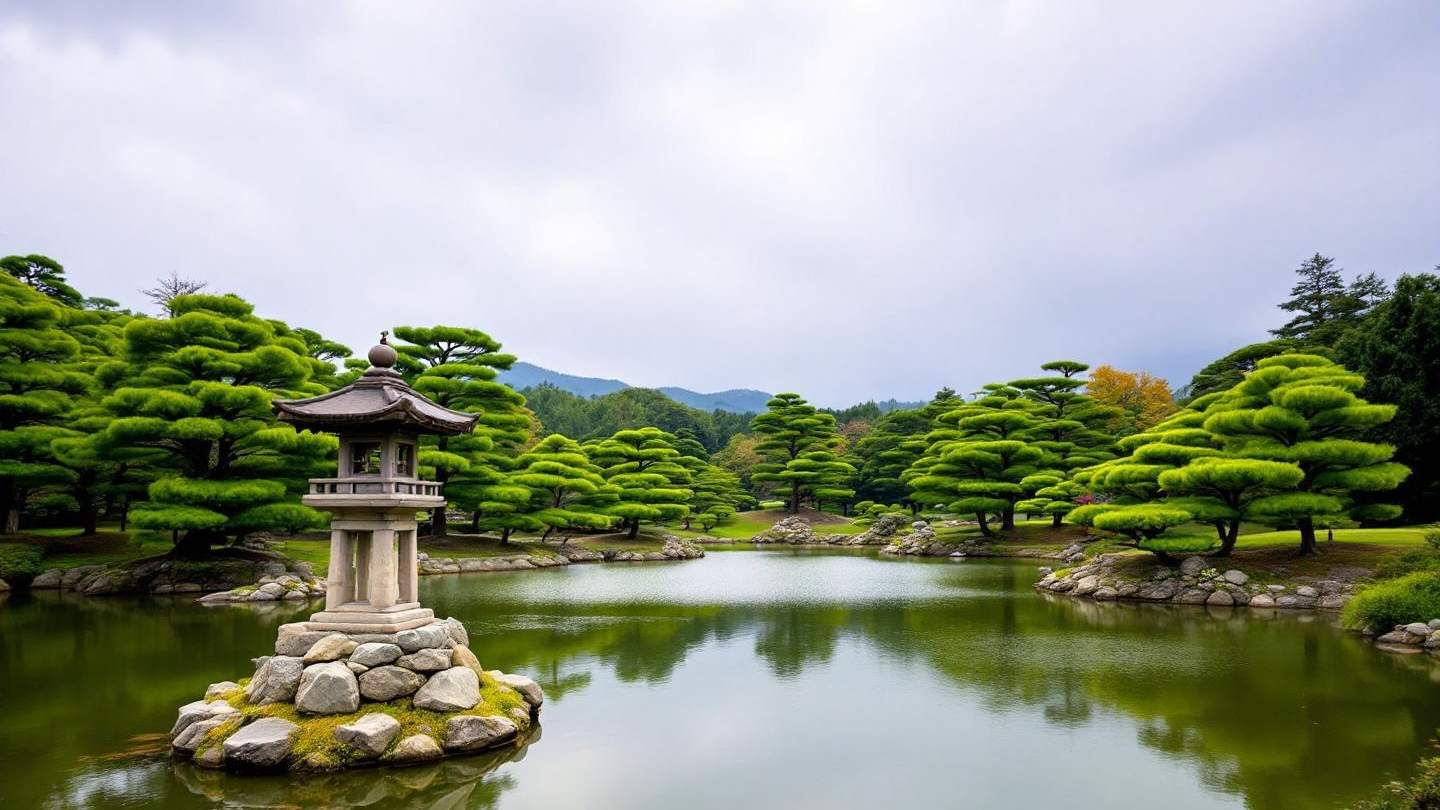
The iconic image of Kenrokuen is the Kotoji Stone Lantern (Kotoji-toro), a two-legged lantern standing at the edge of the central Kasumigaike Pond. The lantern’s asymmetrical legs — one shorter, braced against a rock in the pond — are shaped to suggest the bridge of a koto (traditional zither). It is one of the most photographed objects in Japan and appears endlessly on Kanazawa souvenirs.
Around the Kasumigaike Pond, the garden reveals its finest vistas: stone lanterns reflected in still water, mature pine trees with their lower branches artificially trained horizontal with wooden props (yukitsuri, the rope supports for winter snow), and the distant profile of Kanazawa Castle visible through the trees.
The Rinchi Pond Area
The eastern section of the garden contains the smaller Rinchi Pond surrounded by more informal plantings — a softer, more naturalistic area compared to the composed formality around Kasumigaike. A waterfall feeds this pond from the Midori-taki cascade; the water originates from the Tatsumi canal, an engineering marvel built in 1632 to supply water to the castle and garden from a mountain source 10 kilometers away.
Seasonal Highlights
Late February to mid-March: Plum blossoms (ume) open around the Ume-en section, filling the area with fragrance. This is Kenrokuen at its quietest and most intimate.
Late March to early April: Cherry blossom season. Around 400 cherry trees bloom throughout the garden, and Kenrokuen is one of the finest cherry blossom settings in Japan. The garden extends opening hours and evening illuminations during peak blossom.
May to June: Irises bloom along the garden streams in vivid purple and white.
Autumn (mid-October to late November): The maple trees along the garden paths turn brilliant red and orange. The yukitsuri rope supports for snow damage go up in early November — a visual signal that winter is approaching and one of Kanazawa’s most distinctive sights.
Winter (December to February): Snow on the garden is possibly Kenrokuen at its most beautiful, though not its most comfortable. The yukitsuri ropes form perfect conical shapes over the trees.
Kanazawa Castle
Kanazawa Castle Park surrounds the historic castle site adjacent to Kenrokuen (the two are connected and a combined ticket is available). The original castle built by the Maeda clan in the 16th century burned repeatedly and only the Ishikawa-mon gate and a storehouse (Sanjikken Nagaya) survived into the modern era. The Gyokuseninmaru garden adjacent to the castle was reconstructed in 2015 based on historical records and represents an attempt to show the garden as it existed in the Edo period.
The Hishi Yagura turret and Gojikken Nagaya storehouse reconstructions completed in 2001 are architecturally interesting for their use of traditional building techniques — lead tiles, wood joinery, and lime plaster walls — and the interior walkways give views over both the castle grounds and Kenrokuen. Entry to the castle park is free; the interior of the reconstructed buildings costs 320 yen.
Higashi Chaya: The Geisha District
Higashi Chaya (East Teahouse District) is the best-preserved of Kanazawa’s three historical chaya districts, where geisha entertainment has been provided since the early 19th century. The district was established officially in 1820 and its two main streets of two-storey lattice-fronted teahouses (chaya) are a UNESCO-recommended preservation area.
Unlike Kyoto’s Gion, where geisha sightings have become a contested tourist phenomenon, Higashi Chaya is quieter and less commercialized. The district is genuinely still in use — ozashiki (geisha banquet) entertainment continues at the teahouses — but a handful of buildings on the main street have been converted to cafes, craft shops, and one excellent museum.
Shima Teahouse (500 yen entry) is the most significant preserved chaya open to the public. Dating from 1820 and designated an Important Cultural Property, it preserves the original layout of a working teahouse: the tatami guest rooms where daimyo and wealthy merchants were entertained, the dressing rooms, the kitchen, the musical instrument storage, and the interior red-lacquered walls that are specific to Kanazawa chaya style. The guide materials (available in English) explain how ozashiki entertainment worked and continues to work.
The neighborhood is most atmospheric in the early morning before the shops open, and in the early evening when lantern light catches the latticed facades. Walking through at dusk feels genuinely historical.
Nagamachi Samurai District
On the western side of Kanazawa Castle, the Nagamachi district preserves the earthen-walled lanes and historic samurai residences of the middle-ranking Maeda retainers who once lived here. The distinctive feature is the dohei — ochre-colored earthen walls topped with roof tiles, lining the narrow canal-flanked streets. In winter, they are covered in straw matting to protect the earth from freezing; this covering goes up in late November and gives the district a particular textural quality.
Nomura Samurai House (550 yen entry) is the best house to enter: a 19th-century former samurai residence with a tatami reception room with decorated transoms, a tea ceremony garden considered one of the finest small gardens in Kanazawa, displayed weapons and armor, and a quiet veranda overlooking the garden. Allow 45–60 minutes.
The streets around Nomura House reward wandering — the canal running alongside Hyakumangoku-dori, the small bridges, the occasional surviving gate — and the neighborhood transitions naturally into the crafts district around Omicho Market.
21st Century Museum of Contemporary Art
The 21st Century Museum is one of the most visited and most discussed museums in Japan. Opened in 2004 and designed by SANAA (Kazuyo Sejima and Ryue Nishizawa), the building is a large, flat disc of glass and white steel — a deliberately horizontal, boundary-dissolving structure that sits in a public park with glass walls all the way around, visible from every direction. The building won the Pritzker Prize-contributing architects a significant portion of their fame.
The permanent collection is strong and thought-provoking. The most famous work is Leandro Erlich’s “The Swimming Pool” — visitors stand on a glass floor while a water-filled pool appears to be above them, and people standing underneath look up at you through the water. It is more affecting than description suggests.
Entry: The surrounding grounds and some permanent works are free. Paid entry to the main collection galleries is 1,000 yen. Open 10am–6pm Tuesday–Sunday, 10am–8pm Friday and Saturday. Closed Mondays.
The museum’s design means it engages in a genuine dialogue with the surrounding city — you can see the castle park through its glass walls, and the boundaries between inside and outside, museum and park, are intentionally blurred. Even visitors who are not normally interested in contemporary art tend to find it interesting.
Omicho Market
Omicho is Kanazawa’s covered food market, operating on the same site since the early 18th century. It contains around 180 stalls and small restaurants selling fresh seafood, vegetables, pickles, dried goods, and prepared foods. The market is primarily a working food market serving local restaurants and households, which means the quality is genuine and the prices are reasonable.
Best time to visit: Early morning (before 9am) when the market is at its most active and the fish stalls have their best selection. By 11am it is beginning to get crowded with visitors.
What to look for:
- Buri (yellowtail): The Japan Sea coast brings superb yellowtail in winter (December to February). The fish available here is dramatically better than what reaches Tokyo.
- Kano-gani (snow crab): In season from November to March, the snow crab at Omicho is some of the finest available in Japan. Whole crabs are sold raw for home cooking or can be eaten cooked at market restaurants.
- Nodoguro (blackthroat seaperch): A deep-sea fish prized for its extraordinarily rich, fatty flesh. Known as the “tuna of white fish,” nodoguro is expensive everywhere and exceptional at Omicho.
Several small restaurants on the upper floor of the market serve kaisendon (seafood rice bowls) using the morning’s catch. Expect to pay 2,000–4,000 yen for a good bowl. Arrive before 11am to avoid queues.
Myoryuji: The Ninja Temple
Myoryuji — popularly known as the Ninja Temple (Ninjdera) — is a 17th-century Buddhist temple that conceals extraordinary architectural complexity beneath its modest exterior. Built in 1643, the temple served as a fortified prayer hall for the Maeda clan and was designed with numerous defensive features: hidden staircases, trap doors, secret corridors, blind wells, a lookout tower disguised as an ordinary room, rooms that reveal themselves to have floors at unexpected levels. The temple has 29 staircases, 23 rooms, and what appears from outside to be a two-story building that is actually four stories plus a basement.
Crucially, entry is by guided tour only, available in Japanese with English handout, and must be booked in advance by phone or online. Tours run approximately every 30 minutes and last about one hour. Entry is 1,200 yen. Maximum group size means it never feels rushed.
The temple is not connected to ninja at all — the name comes from its location near the Nishi Chaya district and the popular association of hidden passages with ninja. The actual purpose was to give the Maeda clan a secret escape route and defensive position near their castle. The architecture is genuinely fascinating regardless of the ninja framing.
Booking: Essential. Same-day booking may be possible in the off-season but should not be assumed. Book at least a day in advance online.
D.T. Suzuki Museum
Daisetsu Teitaro Suzuki was one of the most significant figures in the transmission of Zen Buddhist thought to the West, and he was born in Kanazawa. The museum dedicated to his life and thought, designed by architect Yoshio Taniguchi (who also renovated MoMA in New York), opened in 2011.
The building is a masterpiece of contemplative architecture: a series of quiet rooms and corridors leading to a central “thinking space” — a room with a rectangular pool of still water open to the sky, where the sky’s reflection fills the surface. The architecture embodies Suzuki’s ideas about meditation and presence without illustrating them literally.
Entry is 310 yen. The museum is never crowded and is one of the most calming built spaces in Japan. Allow 45–60 minutes, more if you read the exhibition panels carefully.
Nishi Chaya District
Nishi Chaya (West Teahouse District) is smaller than Higashi Chaya but more intimate, occupying a short stretch of preserved teahouse facades in the Terashimachi area. It is walkable from Myoryuji and makes a natural combination with a visit to the Ninja Temple. One restored teahouse interior is open to the public free of charge.
Kanazawa Gold Leaf
Kanazawa produces over 98% of Japan’s gold leaf (hakuichi), a byproduct of the Maeda clan’s patronage of decorative arts and the skilled craft network that developed around the castle town. Gold leaf is applied to lacquerware, ceramics, cosmetics, sweets, and virtually every other surface that will hold it.
Hakuichi is the main gold leaf manufacturer and has shops throughout Kanazawa selling everything from gold-dusted soft serve ice cream (350 yen) to gold leaf face masks to genuinely beautiful decorative lacquerware. Their flagship shop near Higashi Chaya has a demonstration area showing the beating process.
The gold leaf ice cream (vanilla soft serve with a square of genuine gold leaf pressed over it) is one of those tourist things that is also genuinely good. Get one.
Local Food: Eating Well in Kanazawa
Seafood and Sushi
Kanazawa has a credible claim to being among the top three or four cities in Japan for sushi. The proximity to the Japan Sea, the direct supply chains from Omicho Market, and the long tradition of high-level food culture combine to produce a sushi scene that rivals Tokyo at a significantly lower price point.
Omakase sushi (chef-selected course) at a counter restaurant in Kanazawa runs 10,000–25,000 yen per person for what would cost considerably more in Tokyo. Nodoguro sushi in particular is exceptional here.
Kaisendon (seafood rice bowls) at Omicho Market or adjacent restaurants provide the same quality ingredients at accessible prices (1,500–3,500 yen).
Jibuni
Kanazawa’s signature simmered dish. Duck (or chicken) is coated in flour before being added to a broth of dashi stock, soy sauce, mirin, and sake, which thickens as the flour cooks into the liquid. The thickened broth clings to the meat and to the accompanying vegetables (fu wheat gluten, mizuna greens, shiitake mushrooms) in a way that is distinctive from ordinary nimono stewed dishes. The name is said to come from the sizzling sound (jibu jibu) the meat makes when added to the broth.
Jibuni appears on kaiseki menus throughout Kanazawa and at dedicated restaurants. At a traditional restaurant, it is served in lacquerware with rice, pickles, and miso soup for around 1,500–2,500 yen at lunch.
Crab (November to March)
Snow crab season transforms Kanazawa into a pilgrimage destination for Japanese food lovers. Male snow crab (zuwaigani) is served steamed, as crab shabu-shabu (thin slices swished in hot broth), or broken down and used in kaiseki courses. A whole crab at Omicho Market costs 5,000–15,000 yen depending on size and grade; a kaiseki course built around crab will run 15,000–30,000 yen per person.
How to Get to Kanazawa from Tokyo
Hokuriku Shinkansen from Tokyo: The cleanest option. The Kagayaki service (non-stop) runs from Tokyo Station to Kanazawa in 2 hours 28 minutes; the Hakutaka (making more stops) takes about 3 hours. Standard fare is around 14,380 yen (unreserved) to 15,000 yen (reserved). The JR Pass covers this journey.
From March 2024, the Hokuriku Shinkansen extended further to Tsuruga, with eventual connection to Osaka planned. The extended section (Kanazawa to Tsuruga) opened in March 2024 and makes Kanazawa accessible from Kyoto and Osaka via a combination of shinkansen and limited express.
From Kyoto/Osaka: The journey involves taking the Hokuriku Shinkansen from Tsuruga (connected to Kyoto by the Thunderbird limited express — note this service changed with the 2024 shinkansen extension; check current timetables). Total journey from Kyoto is approximately 2 hours 15 minutes.
Getting Around Kanazawa
Kanazawa Loop Bus: The tourist loop bus (Kenroku-en Shuttle and the main Loop bus) connects all major sights — Kanazawa Station, Kenrokuen, Higashi Chaya, Omicho Market, the 21st Century Museum, and Nagamachi. A day pass costs 500 yen and is excellent value.
Walking: The historic core (Kenrokuen, the castle, Higashi Chaya, Omicho, the 21st Century Museum) is walkable in a day, though the distances add up. The Nagamachi and Nishi Chaya areas are about 20–25 minutes walk from Kenrokuen.
Taxis: Available throughout the city. Kanazawa is not large and most fares within the city are 700–1,200 yen.
Cycling: Bike rental is available near Kanazawa Station for around 1,000 yen per day. The city is reasonably flat in the central area and cycling works well for covering the historic districts.
Best Time to Visit Kanazawa
Kenrokuen is beautiful in every season — one of the few destinations in Japan where this is genuinely true rather than promotional language.
| Season | Highlights | Kenrokuen Feature | Crowds |
|---|---|---|---|
| Spring (Apr) | Cherry blossoms | 400 cherry trees bloom for 2–3 weeks | High |
| Early summer (May–Jun) | Irises, comfortable temps | Stream-side iris beds; green foliage | Low |
| Autumn (Oct–Nov) | Maples, seafood season begins | Yukitsuri ropes go up in November | Medium |
| Winter (Dec–Feb) | Snow, crab season peak | Snow on yukitsuri — most beautiful sight | Low |
Kanazawa is genuinely beautiful in all seasons, which is unusual among Japanese cities.
Spring (April): Cherry blossoms in Kenrokuen are spectacular, and the garden’s multiple cherry varieties mean the bloom extends for two to three weeks. Crowds are significant but not overwhelming.
Early summer (May–June): Irises in Kenrokuen, fresh greens, comfortable temperatures, and significantly fewer visitors than spring or autumn.
Autumn (October–November): Kenrokuen’s maple and ginkgo trees turn gold and red; the yukitsuri rope supports go up in early November. The seafood season begins. Many consider this the finest time to visit.
Winter (December–February): Snow on Kenrokuen is one of the most beautiful winter scenes in Japan. The yukitsuri ropes draped over the trees under snow are iconic. Crab season is at its peak. Hotels are less expensive. Cold but manageable with appropriate clothing.
Where to Stay
Near Kanazawa Station: Most practical for shinkansen arrivals, with a cluster of business hotels and the excellent Kanazawa Tokyu Hotel. Budget 8,000–15,000 yen per night.
Near Kenrokuen (Katamachi area): Central, walkable to most sights, with more character than the station area. Several mid-range hotels and traditional ryokan.
Ryokan: Several traditional ryokan in Kanazawa and in the nearby Yamashiro and Yamanaka onsen areas (40 minutes by bus) offer kaiseki dinners and hot spring baths. Prices from 15,000–35,000 yen per person including two meals.
Practical Tips
Two days is right: One day is enough to see the headline sights (Kenrokuen, Higashi Chaya, the 21st Century Museum) but two days lets you slow down, do Nagamachi properly, visit Omicho Market in the morning, see the Ninja Temple (advance booking required), and eat the way Kanazawa deserves.
Book the Ninja Temple in advance: Tours fill up, especially on weekends and during autumn. This is not optional if the Ninja Temple is on your list.
Seafood timing: The best Kanazawa seafood is available October–March, with crab season November–March being the absolute peak. Summer visits are still excellent — nodoguro and buri are available year-round — but the winter seafood is remarkable.
Combine with Shirakawa-go: Kanazawa is an excellent base for a day trip to Shirakawa-go, the UNESCO World Heritage village of thatched-roof gassho-zukuri farmhouses in the mountains to the east. Buses run from Kanazawa Station in about 75 minutes (2,500 yen one way). In winter, the snow-covered farmhouses are among the most iconic scenes in Japan.
Kanazawa sits well within a broader Japan itinerary alongside Kyoto, Osaka, and Tokyo. For routing ideas, see our 10-day Japan itinerary and 14-day Japan itinerary. Useful guides: how to use trains in Japan, Japan travel budget, best time to visit Japan, and Japanese food guide — essential for understanding Kanazawa’s exceptional seafood culture.
Frequently Asked Questions About Kanazawa
Is Kanazawa worth visiting?
Kanazawa is one of the most rewarding cities in Japan and consistently surprises visitors who weren’t sure what to expect. The combination of Kenrokuen (Japan’s finest landscape garden), the Higashi Chaya geisha district, the Nagamachi samurai quarter, the 21st Century Museum of Contemporary Art, and an extraordinary seafood culture makes it a destination with genuine depth. It avoided wartime bombing, so the historic districts feel authentically old rather than reconstructed. Two days here leave most visitors wishing they had booked a third night.
How many days do you need in Kanazawa?
Two days is the ideal amount of time in Kanazawa. Day one covers Kenrokuen (morning, early), Kanazawa Castle, Higashi Chaya in the afternoon, and a seafood dinner. Day two covers Nagamachi samurai district, Omicho Market (morning), the 21st Century Museum of Contemporary Art, and the Ninja Temple (if booked in advance). One day is enough to see the major sights but feels rushed; a third day opens up the D.T. Suzuki Museum, Nishi Chaya, and a day trip to Shirakawa-go.
Is Kanazawa better than Takayama?
Kanazawa and Takayama are different enough that the comparison depends on your interests. Kanazawa is a larger city with more varied attractions: Kenrokuen, geisha districts, world-class contemporary art, and exceptional sushi and seafood. Takayama is a smaller, more intimate historic merchant town with a preserved old town quarter, morning markets, and easy access to the Hida Folk Village and Japanese Alps. Many visitors to central Japan visit both — they are about 1.5 hours apart by limited express train (2,400 yen). If forced to choose one, Kanazawa has more to do; if you want mountain scenery and a quieter, more rural atmosphere, Takayama wins. Our 10-day Japan itinerary covers how to combine both.
What is the best season for Kenrokuen?
Every season has its case, but most visitors name autumn (October–November) as the finest time for Kenrokuen. The maple and ginkgo trees turn gold and red, the yukitsuri rope supports go up in early November (a visually distinctive Kanazawa tradition), and the seafood season begins. Cherry blossom season (April) is a close second — 400 trees bloom across the garden with extended evening illuminations. Winter with snow on the yukitsuri-draped trees is possibly the single most beautiful scene in the garden, but requires tolerating cold. May–June is the least-crowded window for those who prioritize quiet over peak seasonal drama.
How do you get to Kanazawa from Tokyo?
From Tokyo to Kanazawa, the fastest route is the Hokuriku Shinkansen (Kagayaki service) from Tokyo Station, which arrives in 2 hours 28 minutes. Standard fares are around 14,380–15,000 yen for reserved seats; the JR Pass covers this route, making it excellent value for pass holders. The slower Hakutaka service stops at more stations and takes about 3 hours but uses the same track and cost. From Kyoto or Osaka, the journey involves a combination of Shinkansen and limited express train, taking about 2 hours 15 minutes from Kyoto. For current timetables given the 2024 Hokuriku Shinkansen extension, check JR’s online booking system.