7 Days in Japan
Last updated: March 2026
Who This Itinerary Is For
Seven days in Japan is tight, but it is absolutely doable — and for many first-time visitors, it delivers everything they came for. This route covers the so-called Golden Route: Tokyo, Hakone, Kyoto, Nara, and Osaka. These five destinations give you a compressed but genuinely rich experience of what Japan is: the neon-and-skyscraper energy of a world city, the ancient temple culture of the imperial heartland, a serene mountain and volcanic landscape, and a port city famous for its food and streetlife.
The pace here is moderate. You will not be sleeping on overnight buses or racing between five attractions before noon. Each day has a clear focus, a realistic set of sights, and time built in for wandering, eating, and the kind of accidental discovery that defines the best travel days. If you are the type who researches every opening hour and queues for the best ramen shop — this itinerary gives you structure to hang that enthusiasm on. If you prefer a looser approach, each day section tells you what is non-negotiable and what you can drop.
This itinerary works well for first-time visitors, couples, solo travelers, and small groups of friends. It is not the ideal template if you are traveling with young children (see the variation section at the end) or if you need a very slow pace. Budget-wise, it sits in the moderate range: mid-range hotels, a mix of casual and sit-down restaurants, and standard transport. The budget section at the end gives you real numbers.
Before you start booking, read our how to plan a trip to Japan guide and our Japan travel budget guide for the full financial picture.
One important note on timing: Japan has peak seasons that significantly affect accommodation prices and crowd levels. Cherry blossom season (late March to mid-April) and autumn foliage season (mid-November) are the most congested. Golden Week (late April to early May) should be avoided entirely if possible. Outside these windows, the route is manageable even without booking far in advance.
Transport Between Cities
| Journey | Method | Duration | Cost |
|---|---|---|---|
| Tokyo → Kyoto | Shinkansen Hikari | 2h 40min | ¥13,850 (or free with JR Pass) |
| Tokyo → Hakone-Yumoto | Odakyu Romancecar | 85 min | ¥2,470 + ¥910 surcharge |
| Kyoto → Nara | JR Nara Line (Rapid) | 45 min | ¥720 |
| Kyoto → Nara | Kintetsu Nara Line | 35 min | ¥680 |
| Kyoto → Osaka | JR Special Rapid | 29 min | ¥580 |
| Nara → Osaka Namba | Kintetsu Nara Line | 40 min | ¥680 |
| Narita Airport → Shinjuku | N’EX | 90 min | ¥3,250 |
| Haneda Airport → Central Tokyo | Keikyu / Monorail | 30 min | ¥600–¥700 |
For everything you need to know about Japan’s train system, read our trains in Japan guide.
Day 1: Arrival in Tokyo and Shinjuku
Getting In
Most international flights land at Narita International Airport or Haneda Airport. Haneda is closer to central Tokyo (30–40 minutes by train) and is preferred if you have a choice. Narita is further (60–90 minutes) but has excellent rail links.
From Narita, the Narita Express (N’EX) runs directly to Shinjuku Station in about 90 minutes and costs ¥3,250. A round-trip ticket (valid 14 days) costs ¥4,070 and is worth buying at the airport. From Haneda, the Keikyu Line or Tokyo Monorail gets you to central Tokyo for around ¥600–¥700 in 30 minutes.
Pick up your IC card (Suica or Pasmo) at the airport on arrival. This rechargeable contactless card works on virtually every train, subway, and bus in Tokyo, and can also be used at convenience stores, vending machines, and many restaurants. Load 2,000–3,000 yen to start. If you have an iPhone or compatible Android phone, you can add Suica to your mobile wallet before you land.
Check In and Recover
Day 1 is an arrival day. Even if your flight lands in the morning, jet lag and the stimulation of arriving in a new country will tire you out faster than you expect. Check in, leave your heavy luggage at the hotel, and start slow.
Stay in Shinjuku for your Tokyo nights. It is not the most characterful neighborhood, but it is one of the best transit hubs in the city and puts you within easy reach of everywhere you want to go. Good mid-range options cluster around the east exit of Shinjuku Station, around Kabukicho, and near the south exit. Expect to pay 10,000–18,000 yen per night for a double room at a business hotel.
Shinjuku Afternoon
Once you have checked in, take a walk east of the station toward Kabukicho and the broader entertainment district. You do not need a plan — just walk. The contrast of a busy Tokyo street with a quiet side alley is part of the experience. Pop into a convenience store (7-Eleven, FamilyMart, or Lawson) and buy something — onigiri, a hot canned coffee, a sandwich. Convenience stores in Japan are legitimately good and are worth experiencing early. For a full rundown of Tokyo neighborhoods and what to do, see our Tokyo things to do guide.
In the late afternoon, visit the Tokyo Metropolitan Government Building (Tocho). The north observation deck is free and open until 10:30 pm on most nights. The view from the 45th floor encompasses the full spread of Tokyo — on clear days, including Mount Fuji to the southwest. Go before sunset, stay through twilight, and watch the city light up.
Golden Gai for Dinner
Golden Gai is a tiny enclave of roughly 200 micro-bars tucked into six narrow alleyways just east of Kabukicho. Each bar seats perhaps six to ten people, each has its own personality — jazz bars, horror-themed bars, bars dedicated to a single manga series — and each is run by a different owner. It is one of the most distinctive nightlife experiences in the world, and it survived multiple redevelopment attempts over the decades entirely because of community resistance.
Walk in, pick a bar that appeals to you, check the entry charge (most have a 500–1,000 yen cover), and sit down. Order a beer or a whisky highball. Talk to whoever is there. This is a good first night in Tokyo.
Dinner can be eaten at any of the many ramen shops, izakayas, or conveyor-belt sushi restaurants around Shinjuku. Budget 1,000–2,000 yen per person for a casual meal.
Day 2: Asakusa, Ueno, Akihabara, and Shibuya
Morning: Asakusa
Start early at Asakusa — ideally before 9 am. Sensoji Temple, the oldest temple in Tokyo, is stunning in the early morning before the tour groups arrive. Walk the full length of Nakamise-dori, the shopping street leading to the main gate (Kaminarimon), then continue to the main hall. Light incense, wash your hands at the purification fountain, draw an omikuji (fortune slip) for 100 yen. The five-storied pagoda behind the main hall is one of the most photographed structures in Japan.
From Asakusa, walk or take the subway one stop to Ueno. The area around Ueno Park contains several excellent museums, a zoo, and a large park popular with Tokyoites. The Tokyo National Museum (1,000 yen entry) is the largest in Japan and holds extraordinary collections of Japanese art, armor, ceramics, and textiles. Even if museums are not your priority, the main hall is worth a 45-minute walk-through.
Afternoon: Akihabara
Akihabara is 15 minutes by JR Yamanote Line from Ueno. The Electric Town that emerged here in the postwar era has morphed into the global capital of anime, manga, gaming, and electronics culture. Even if you have no interest in any of these things, the visual spectacle is remarkable: multi-storey buildings wrapped floor to ceiling in anime graphics, blinking electronics shops, maid cafes with costumed staff handing out flyers.
For electronics, Yodobashi Camera (the enormous building just outside the station) has everything from cameras to adapters to portable battery packs at competitive prices. For anime merchandise, the six-floor Animate store and the sprawling Akihabara Radio Kaikan building are the main destinations. Retro game shops occupy multiple buildings along the main Chuo Dori street and its side alleys.
Evening: Shibuya
Take the Yamanote Line south from Akihabara to Shibuya — about 25 minutes. The famous Shibuya Scramble Crossing is best experienced from street level first: stand on the corner and wait for the walk signal. When it goes green, you walk diagonally across with hundreds of other people from all directions simultaneously. It is chaotic and somehow also perfectly orderly. Then go upstairs to the Mag’s Park observation area, the Starbucks on the second floor above the scramble, or the dedicated Shibuya Sky observation deck (2,000 yen) for the aerial view.
Dinner in Shibuya can be as simple as ramen at Ichiran (the famous solo-booth ramen restaurant, around 1,000 yen) or as elaborate as a booking at one of the area’s many acclaimed restaurants. The Shibuya Stream and Shibuya Hikarie buildings contain good mid-range restaurant floors if you want options.
Day 3: Harajuku, Meiji Shrine, and Omotesando
Morning: Meiji Shrine
Meiji Shrine sits inside a forested park in the middle of one of the world’s densest cities. The contrast — stepping from the noise of Harajuku Station into a 70-hectare woodland — is immediate and calming. The shrine is dedicated to Emperor Meiji and Empress Shoken and is one of the most important Shinto shrines in Japan. Admission is free. Allow 45–60 minutes to walk the main gravel path, enter the inner precinct, and observe the ritual practices of visiting worshippers.
Adjacent to the shrine is Yoyogi Park, a large public green space that comes alive on weekends with picnicking families, musicians, and informal sports. In cherry blossom season, it is one of the best hanami (flower viewing) spots in Tokyo.
Mid-Morning: Harajuku’s Side Streets
From the shrine, walk south toward Takeshita Street, the pedestrianized lane famous for youth fashion subcultures, crepes, and candy floss. It is crowded, narrow, and frankly overwhelming — but it is also a specific kind of Tokyo that you will not see elsewhere. The crepes from Marion Crepes or Angel Heart (around 600–900 yen) are genuinely worth the queue.
The more interesting shopping is in the backstreets west of Omotesando, in the area called Ura-Harajuku or Cat Street. This is where independent boutiques, vintage stores, and concept shops cluster. Allow an hour to wander.
Afternoon: Omotesando
Omotesando is Tokyo’s most architecturally distinguished shopping street. The zelkova-lined boulevard is home to flagship stores designed by Tadao Ando (Omotesando Hills), SANAA, Herzog and de Meuron, and other significant architects. Even if you are not shopping, it is worth walking slowly and looking at the buildings.
Omotesando Hills mall has a pleasant internal ramp structure and contains a good range of restaurants for lunch. Expect to pay 1,500–2,500 yen for a sit-down lunch in this area.
Optional: teamLab Borderless or Planets
teamLab operates two major digital art spaces in Tokyo. teamLab Planets in Toyosu (1-hour subway ride from Omotesando) is smaller, more intimate, and considered by most visitors to be the stronger experience. teamLab Borderless has recently relocated to a new venue in Azabudai Hills. Both require advance booking (3,200 yen at Planets, 3,800 yen at Borderless). If you are interested, book before your trip — tickets sell out weeks in advance.
An evening visit to either is a reasonable option on Day 3 if you want to keep your mornings free for outdoor sightseeing.
Day 4: Hakone Day Trip
The Romancecar
The Odakyu Romancecar is a private limited express train that departs from Shinjuku Station and arrives at Hakone-Yumoto in 85 minutes. It costs around 2,470 yen (plus a 900-yen Romancecar surcharge) and is significantly more comfortable than the slower local alternative. The observation seats at the front and rear of the train have unobstructed forward-facing views. Book in advance through the Odakyu website or at the Odakyu ticket counter in Shinjuku.
Alternatively, if you have a JR Pass, you can take the shinkansen to Odawara and connect from there — but this is not significantly faster than the Romancecar and involves a transfer.
The Hakone Loop
Hakone is best explored via its famous loop: a combination of local train, cable car, ropeway, pleasure boat, and bus. This loop is covered by the Hakone Free Pass (4,600 yen from Shinjuku, valid 2 days), which includes the Romancecar surcharge and unlimited use of all loop transport plus discounts at many attractions.
The recommended loop runs: Hakone-Yumoto Station — Hakone-Tozan Railway to Gora — Cable Car to Sounzan — Ropeway over the volcanic Owakudani to Togendai — Pleasure Boat across Lake Ashi to Moto-Hakone — Bus back to Hakone-Yumoto.
Key stops along the loop:
Owakudani is the active volcanic area halfway along the ropeway. Sulfurous steam vents, boiling pools, and black eggs (kuro-tamago, hard-boiled in the volcanic springs, 600 yen for five eggs) make this one of the most memorable stops. On clear days, Mount Fuji looms directly ahead. The ropeway sometimes closes in high wind — check conditions in advance.
Lake Ashi (Ashinoko) provides the most iconic view in Hakone: the red torii gate of Hakone Shrine rising from the lake with Fuji behind it. The pleasure boat crossing takes about 30 minutes. The gate is accessible by a short walk from Moto-Hakone pier.
Hakone Open Air Museum sits along the Tozan Railway and is one of Japan’s best sculpture parks. It contains works by Picasso, Rodin, Henry Moore, and many others in an outdoor setting with mountain views. Entry is 1,600 yen. Allow 90 minutes.
Onsen
Hakone is one of the premier onsen destinations in Japan. After the loop, return to Hakone-Yumoto or your accommodation and soak in a bath fed by the volcanic springs. Day-use onsen facilities are available throughout the area for 1,000–1,500 yen. Tenzan Toji-kyo is a reliable, well-regarded option near Hakone-Yumoto. If you have booked a ryokan with its own onsen, use that.
Return to Shinjuku on the Romancecar (last train around 8:30 pm from Hakone-Yumoto).
Day 5: Travel to Kyoto, Fushimi Inari, Gion
Tokyo to Kyoto by Shinkansen
The Tokaido Shinkansen between Tokyo Station and Kyoto Station takes 2 hours 15 minutes on the Nozomi (not covered by JR Pass) or 2 hours 40 minutes on the Hikari (covered by JR Pass). The Hikari is perfectly fine — the time difference is small. Fares without a pass are 13,850 yen one way. Book a window seat on the right-hand side (D or E seat) going west for the best views of Mount Fuji, which appears about 40 minutes into the journey.
Leave Tokyo no later than 9 am to make the most of the day. Luggage forwarding (takuhaibin) from your Tokyo hotel to your Kyoto hotel is strongly recommended — for 1,500–2,000 yen per bag, your luggage arrives the next morning and you travel unencumbered.
Fushimi Inari Taisha
Fushimi Inari is non-negotiable on a Kyoto visit. The shrine at the base of Inari Mountain is famous for its thousands of vermillion torii gates lining the hiking path up the mountain. The gates were donated by businesses and individuals over centuries — each carries the donor’s name and date. For Kyoto’s full attractions lineup, see our Kyoto things to do guide.
The full hike to the summit and back takes 2–3 hours. Most visitors only go to the Senbon Torii (the two parallel corridors of gates below the first shrine) and turn back — this takes about 30 minutes. A better compromise is to walk to the Yotsutsuji intersection (about 45 minutes up), which has a panoramic view of southern Kyoto, and then descend. This gives you a genuine experience of the mountain without the full commitment.
Fushimi Inari is free to enter and open 24 hours. It is best visited early in the morning (before 8 AM) to avoid crowds, or in the evening when the gates are lit. From Kyoto Station, take the JR Nara Line to Inari Station (2 stops, 5 minutes, ¥150).
Gion Evening
After Fushimi Inari, take the train back toward central Kyoto and walk through Gion — Kyoto’s historic geisha district — in the late afternoon and evening. The main street of Hanamikoji is lined with traditional machiya townhouses, preserved teahouses, and the occasional glimpse of a maiko (apprentice geisha) hurrying to an appointment.
Nishiki Market, the narrow covered market street north of Gion, is excellent for dinner ingredients and snacks — grilled skewers, fresh tofu, pickles, tamagoyaki (rolled omelette). Many stalls close by 6 pm, so visit before dinner rather than after.
Dinner in Gion: kaiseki restaurants in this area are among the finest in Japan but require reservations weeks in advance and cost 15,000–50,000 yen per person. For a first-time visit at moderate budget, a mid-range restaurant along Kiyamachi-dori (the canal street nearby) serves excellent food at 2,000–4,000 yen per person.
Day 6: Arashiyama, Kinkaku-ji, Nishiki Market
Morning: Arashiyama
Arashiyama is Kyoto’s most atmospheric western district, best reached by the Randen tram (Keifuku Electric Railway) from central Kyoto or by the JR Sagano Line to Saga-Arashiyama Station. Arrive before 9 am if possible.
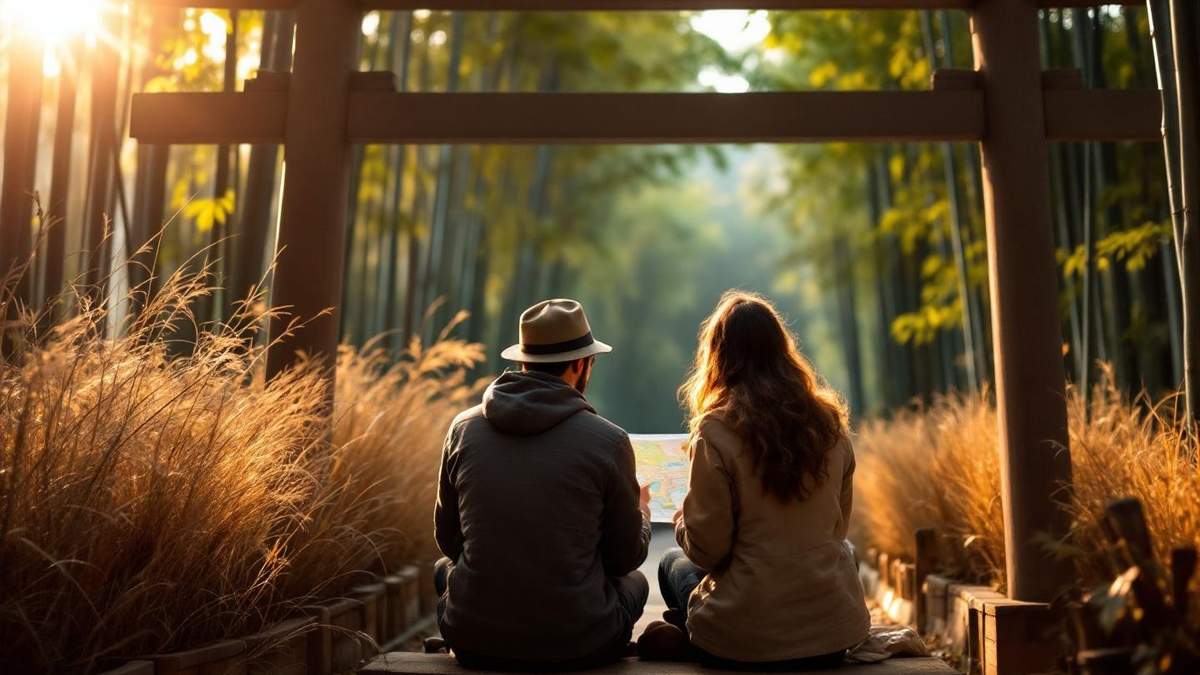
Bamboo Grove: The famous bamboo corridor behind Tenryu-ji is about 500 meters long and takes 10 minutes to walk through. It is dramatically beautiful and dramatically crowded by mid-morning. Go early.
Tenryu-ji: A UNESCO World Heritage Zen temple with a pond garden designed in the 14th century. Entry to the garden is 500 yen; entry to the main hall is an additional 300 yen. The garden is one of the finest in Japan.
Okochi Sanso: The hilltop villa of a 1920s movie star, with layered gardens and exceptional views over the Oi River valley. Entry costs 1,000 yen and includes a bowl of matcha and a wagashi sweet. Allow 45–60 minutes and walk the full circuit.
Monkey Park Iwatayama: A 20-minute hike up the hillside to a sanctuary where you can feed wild Japanese macaques from inside a cage (the humans are caged; the monkeys roam free). Entry is 600 yen. Excellent for a quick detour if you enjoy wildlife.
Arashiyama boat rental: Flat-bottomed boats are available for rent on the Oi River for 1,500–2,000 yen per hour. Rowing gently under the Togetsu-kyo bridge with Arashiyama hill behind you is a genuinely pleasant way to spend an hour.
Afternoon: Kinkaku-ji
Kinkaku-ji, the Golden Pavilion, is Kyoto’s most visited site and deserves its reputation. The three-storied structure covered in gold leaf, reflecting in the mirror pond around it, is extraordinary. Entry costs 500 yen. You cannot enter the pavilion — you walk a prescribed path around the pond and view it from various angles. Allow 30–45 minutes. It is worth coming even though it is crowded.
From Kinkaku-ji, nearby Ryoan-ji (600 yen) contains the most famous karesansui (dry landscape rock garden) in Japan: fifteen rocks arranged in a bed of raked gravel such that no matter where you stand, one rock is always hidden from view. The meaning is famously debated. Spend 20–30 minutes here.
Evening: Nishiki Market and Pontocho
Return to central Kyoto in the late afternoon. Walk through Nishiki Market (the covered food market on Nishiki-koji Street) before the stalls close — this is a good place to buy Japanese pickles, dried snacks, or street food for the evening.
Pontocho Alley, a narrow lane running parallel to the Kamo River between Sanjo and Shijo streets, is one of Kyoto’s most atmospheric dining streets. It is lined with restaurants serving everything from traditional kaiseki to casual yakitori. In summer, many restaurants extend onto wooden platforms (kawayuka) over the river. Choose a restaurant with an open kitchen or a menu you can read by photograph — staff at most places speak enough English to help you order. Budget 3,000–5,000 yen per person for dinner here.
Day 7: Nara Day Trip and Osaka Evening
Morning: Nara
Nara is 45 minutes from Kyoto by the JR Nara Line (690 yen) or by the Kintetsu Nara Line (760 yen, slightly faster). Leave by 8:30 am to arrive early.
Nara Park is home to approximately 1,200 free-roaming sika deer, which Shinto tradition regards as sacred. The deer are used to human contact and will approach you for shika senbei deer crackers (200 yen per pack from vendors throughout the park). They bow when they want food — a behavior learned over generations from observing visitors’ bowing attempts to get them to bow first. Do not be alarmed when they nudge, nibble your clothes, or ignore you entirely. They are gentle in the morning; they can be more pushy in the afternoon.
Todai-ji Temple: The main hall of Todai-ji is the largest wooden structure in the world and contains a colossal bronze Buddha (Daibutsu) standing 15 meters tall. Entry costs 600 yen. The Buddha’s nostril-sized hole in a nearby column, through which visitors attempt to crawl (said to guarantee enlightenment), is genuine and delightful.
Kasuga Taisha: A 15-minute walk east from Todai-ji, this 8th-century shrine is famous for its hundreds of bronze and stone lanterns. Entry to the inner precinct is 500 yen. The forested setting is beautiful.
Naramachi: The preserved merchant district south of Nara Park, with machiya townhouses converted into cafes, craft shops, and small museums. A good place for lunch — try kakinoha-zushi (mackerel or salmon sushi pressed in persimmon leaves, a Nara specialty) at one of the local shops. Budget 1,000–1,500 yen for lunch.
Afternoon: Travel to Osaka
From Nara, take the Kintetsu Nara Line to Kintetsu Namba Station in Osaka (about 40 minutes, 680 yen). Check in to your Osaka accommodation — Namba or Shinsaibashi are the best areas for a one-night stay focused on food and nightlife.
Evening: Dotonbori
Dotonbori is the pulsing commercial heart of Osaka — a canal-side street district of enormous illuminated signs, takoyaki stands, kushikatsu restaurants, karaoke halls, and the giant Glico Running Man neon sign that has been photographed approximately one billion times. It is loud, dense, and completely alive.
Osaka is Japan’s food city, and this evening is your best chance to eat your way through the local specialties:
Takoyaki: Octopus-filled batter balls, cooked in a special round mold, topped with sauce, mayonnaise, bonito flakes, and aonori. The definitive Osaka street food. Expect to pay 400–700 yen for eight pieces.
Kushikatsu: Breaded and deep-fried skewers of meat, vegetables, and seafood. The golden rule in Osaka is no double-dipping in the communal sauce. A full kushikatsu meal at a standing bar or casual restaurant costs 1,500–2,500 yen.
Okonomiyaki: Savory pancakes cooked on a griddle, loaded with cabbage, pork, squid, or whatever variant you prefer. Osaka-style is mixed in a batter and cooked flat (versus Hiroshima-style, which is layered). Around 900–1,400 yen per pancake at a casual restaurant.
Walk along Dotonbori Canal, cross Ebisu Bridge for the classic photograph, wander through the Shinsaibashi arcade — the longest covered shopping street in Japan — and into the Amerika-mura district for a look at Osaka’s streetwear scene.
If you are flying out of Osaka the next morning, Kansai International Airport (KIX) is 60 minutes from Namba by the Nankai Limited Express (1,430 yen). If you are heading home through Tokyo, take the Shinkansen from Shin-Osaka Station.
Practical Logistics
Is the JR Pass Worth It?
For this exact 7-day route, the math is borderline. See our JR Pass guide for a full breakdown with a route-specific calculator. The main JR Pass costs ¥50,000 for 7 days (2026 prices). Your main covered segments would be:
- Tokyo to Kyoto (Hikari): 13,850 yen each way
- Kyoto to Osaka (JR Rapid): 560 yen one way
That is roughly 28,260 yen in shinkansen costs for the key intercity leg. The pass does not cover the Romancecar (you pay the supplement regardless), most Tokyo metro travel, or the Kintetsu line to Nara. The 7-day pass does not pay off on this route unless you are making additional JR trips.
Better approach: Buy individual shinkansen tickets. Use your Suica card for local transport. Consider the Osaka-Kyoto-Nara region Kintetsu Rail Pass (2 or 3 day options from 1,500 yen) for the Kansai end of the trip.
Where to Stay
- Tokyo (3 nights): Shinjuku, Shibuya, or Asakusa. Budget 10,000–18,000 yen per night for a comfortable business hotel double room.
- Kyoto (2 nights): Central Kyoto near Shijo or Sanjo stations, or around Kyoto Station. Same price range. Booking a ryokan for at least one night in Kyoto is strongly recommended for the experience — budget 20,000–40,000 yen per person with dinner and breakfast.
- Osaka (1 night): Namba or Shinsaibashi area. Slightly cheaper than Tokyo — 8,000–15,000 yen per night.
Luggage Forwarding
Use Yamato Transport’s takuhaibin service to forward your luggage between cities. Drop your bags at the hotel front desk or a convenience store before noon; they arrive at your next destination the following morning. Cost is approximately 1,500–2,000 yen per bag. This service transforms train travel in Japan — you walk through Kyoto unencumbered rather than dragging a suitcase up temple steps.
Budget Estimate
For a full breakdown of Japan costs at all budget levels, see our Japan travel budget guide.
Daily Budget Estimate
| Category | Budget Traveler | Mid-Range | Comfortable |
|---|---|---|---|
| Accommodation | ¥3,000–¥5,000 (hostel) | ¥8,000–¥15,000 (business hotel) | ¥20,000–¥40,000 (good hotel/ryokan) |
| Meals (3 meals + snacks) | ¥2,000–¥3,000 | ¥3,000–¥5,000 | ¥6,000–¥12,000 |
| Local transport | ¥400–¥700 | ¥500–¥1,500 | ¥1,000–¥3,000 |
| Attractions | ¥500–¥1,000 | ¥1,000–¥3,000 | ¥2,000–¥5,000 |
| Miscellaneous | ¥500–¥1,000 | ¥1,000–¥2,000 | ¥2,000–¥5,000 |
| Daily total | ¥6,400–¥10,700 | ¥13,500–¥26,500 | ¥31,000–¥65,000 |
Per person per day (moderate budget):
- Accommodation: ¥8,000–¥15,000
- Meals (3 meals + snacks): ¥3,000–¥5,000
- Transport (local): ¥500–¥1,500
- Attractions: ¥1,000–¥3,000
- Miscellaneous: ¥1,000–¥2,000
Total daily: ¥13,500–¥26,500 per person
Major one-off costs:
- Shinkansen Tokyo to Kyoto (one way): ¥13,850
- Hakone Free Pass: ¥4,600
- Luggage forwarding (2 transfers): ¥3,000–¥4,000
7-day total estimate (moderate): approximately ¥140,000–¥200,000 per person (roughly $950–$1,350 USD at 2026 exchange rates), excluding international flights and travel insurance.
Variations
Traveling With Kids
- Replace Golden Gai on Day 1 with an early dinner and an evening walk through the illuminated Shinjuku area.
- On Day 2, prioritize Ueno Zoo (600 yen) over the museum. The National Museum is optional.
- Hakone on Day 4 is excellent for kids — the Romancecar train, the ropeway, and the black eggs are genuinely exciting.
- In Kyoto, swap Pontocho dinner for an earlier, more casual meal to accommodate earlier bedtimes.
- Nara’s deer are a highlight for children of any age. Allow extra time.
Rainy Day Alternatives
Japan in rain is not a disaster — many of the best sights are temples and covered markets. However, some specific swaps:
- Rainy Hakone: skip the ropeway if visibility is poor (you will see nothing) and spend extra time at the Hakone Open Air Museum or Hakone Kowakien Yunessun spa complex.
- Rainy Arashiyama: the bamboo grove and forested temple gardens are actually beautiful in light rain. Carry an umbrella, not a rain jacket.
- Rainy Tokyo days: teamLab, the Mori Art Museum, the Edo-Tokyo Museum (when open), or a multi-floor shopping complex like Shibuya Hikarie or Tokyu Hands.
Luxury Upgrades
- Accommodation: One or two nights at a high-end ryokan (particularly the Tawaraya in Kyoto or Gora Kadan in Hakone) transforms the experience. Budget 50,000–100,000 yen per person per night.
- Dining: Book one kaiseki dinner in Kyoto in advance. Kikunoi Honten (Higashiyama) is approachable for first-timers and excellent. Expect 15,000–20,000 yen per person.
- Transport: The Shinkansen Gran Class compartment is not meaningfully better than Green Car for a 2-hour journey, but a private transfer from the airport (10,000–15,000 yen) is worth it if you arrive late with heavy luggage.
- Hakone: Stay one night at a ryokan with private onsen (kashikiri) instead of doing Hakone as a day trip. This is one of the most memorable experiences Japan offers and is worth the extra night and cost.
If Cherry Blossom Season
If your trip falls in late March to mid-April:
- Add Shinjuku Gyoen (500 yen entry, one of the best hanami parks in Tokyo) to Day 1 or Day 3.
- In Kyoto, Maruyama Park (free, open 24 hours) near Gion has the famous weeping cherry tree that is illuminated at night. Build this into the Day 5 evening.
- Arashiyama cherry blossoms along the Oi River are world-class. Day 6 will be extraordinary.
- Book all accommodation at least 3–4 months in advance for cherry blossom season. Prices will be 30–50% higher than normal.