Best Day Trips from Hiroshima
Last updated: March 2026
Day Trips from Hiroshima — Overview
Hiroshima sits at one of the best day-trip hubs in western Japan. Within one to two hours in any direction, you can reach a sacred island with a floating torii gate, a cycling town with some of the finest preserved canal streets in Japan, an island overrun with friendly wild rabbits, a castle town with a wooden bridge that has stood for centuries, and the start of one of the world’s great cycling routes.
Most travelers stay in Hiroshima for two to three nights. With two nights, you can do Miyajima as a full day and one other destination as a half or full day. With three nights, you can comfortably hit three or four day trips without rushing any of them.
Before reading this guide, the Hiroshima travel guide covers the city itself — the Peace Memorial Park, Hiroshima Castle, and the best places to eat okonomiyaki — so you know how to divide your time. For a broader itinerary context, the 10 days in Japan itinerary includes Hiroshima and Miyajima as a core section. JR Pass holders can access most of these day trips for free — the JR Pass guide explains exactly what is covered on this part of the San’yo route.
Day Trips Quick Reference
| Destination | Distance | Best Transport | Journey Time | Best For |
|---|---|---|---|---|
| Miyajima Island | 30 km | JR + Ferry | 60 min total | Torii gate, hiking, oysters |
| Onomichi | 80 km | JR San’yo Line | 60–75 min | Cycling, cat alleys, temple walk |
| Okunoshima (Rabbit Island) | 90 km | JR + Ferry | 90 min | Unique experience, rabbits, history |
| Iwakuni | 45 km | JR San’yo Line | 35–45 min | Kintai Bridge, castle, white snake |
| Shimanami Kaido (start) | 70 km | JR to Onomichi | 60–75 min | Cycling, island-hopping |
| Kurashiki | 150 km | JR Shinkansen | 45 min | Bikan Historical Quarter, art |
Day Trip 1: Miyajima Island
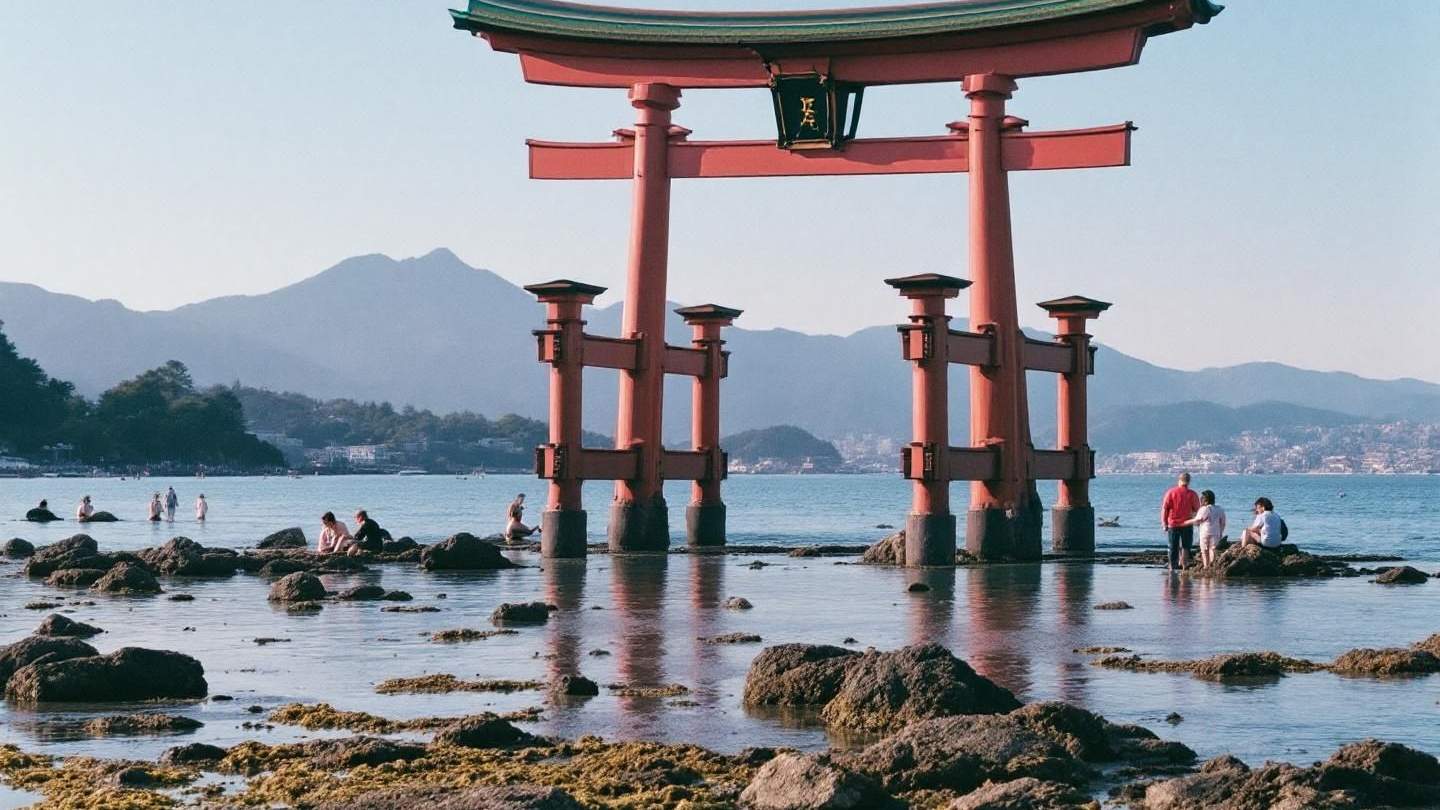
Miyajima (officially Itsukushima) is the single most visited day trip from Hiroshima and one of Japan’s three officially designated scenic views (Nihon Sankei). The island’s most iconic sight — the O-torii gate of Itsukushima Shrine appearing to float on the water at high tide — is among the most photographed images in Japan.
Getting There
From Hiroshima Station: Take the JR San’yo Line or the Hiroshima Electric Railway (tram) to Miyajima-guchi, then the JR ferry or Matsudai ferry to the island.
- JR train to Miyajima-guchi: 26 minutes, 410 yen
- JR ferry (Miyajima-guchi to Miyajima): 10 minutes, 200 yen
JR Pass holders: The JR ferry is included in the JR Pass — the whole journey (train + JR ferry) is free.
Total journey time: Approximately 60 minutes door to island from central Hiroshima.
What to Do on Miyajima
Itsukushima Shrine is the main attraction — a UNESCO World Heritage Site, the shrine is built on stilts over the tidal waters of the inlet. Check tide times before you go. At high tide, the shrine’s corridors appear to float on the sea and the O-torii stands with water around its base. At low tide, you can walk out to the torii on the exposed seafloor. Both experiences are worth seeing. Most visitors time their visit to see both in one day.
O-torii Gate: The current gate dates to 1875 (the original was erected in 593 AD). The structure is 16 meters tall and made of camphor wood. It is free to view from the shore.
Mount Misen: The 535-meter peak behind the shrine can be reached by ropeway (1,840 yen round trip) or on foot (1.5–3 hours depending on trail). From the summit, views extend across the Seto Inland Sea to Hiroshima and beyond. The forest below is a primeval old-growth forest — one of the last in western Japan.
Daisho-in Temple: A complex of atmospheric Buddhist temples and pagodas on the slopes below Misen, with spinning prayer wheels, moss-covered stone lanterns, and small Jizo statues wearing red bibs. Less crowded than the shrine and genuinely beautiful.
Oysters: Miyajima is renowned for its kaki (oysters), farmed in the sheltered waters of the Seto Inland Sea. The oyster farms visible from the ferry are real working farms supplying Hiroshima’s restaurants. On the island itself, multiple vendors sell grilled oysters directly off the shell for 200–400 yen each. Eat several. They are exceptional.
Momiji manju: The island’s signature sweet — small cake shaped like a maple leaf, filled with red bean paste (or custard, matcha, chocolate). Every shop sells them. They are made fresh and eaten warm; buy from a shop where you can see them being made.
Deer: Like Nara, Miyajima has semi-wild sika deer wandering freely among visitors and temple buildings. They are bolder than you expect and not above investigating your bags. Keep snacks secured.
Practical Tips
- Avoid weekends and Japanese holidays unless you arrive very early — the island gets genuinely crowded.
- The last ferry back to the mainland runs around midnight; you are not stuck if you stay late.
- Several hotels and ryokan operate on the island itself — staying overnight gives you the island in early morning before day visitors arrive, which is transformative. The Miyajima Island guide covers accommodation in detail.
Day Trip 2: Onomichi
Onomichi is a small port city 80 kilometers east of Hiroshima, built across steep hillsides above the Seto Inland Sea. It is famous for its temple walk (a chain of 25 temples connected by a winding path up the hillside), its narrow alleys full of cats, and as the western starting point of the Shimanami Kaido cycling route. It is also one of those towns in Japan that feels genuinely lived-in rather than curated for tourists — a welcome contrast to Miyajima.
Getting There
Transport: JR San’yo Line from Hiroshima Station to Onomichi Station. Time: Approximately 65–75 minutes on limited express; 90 minutes on local. Cost: 1,520 yen (free with JR Pass for the express services).
What to Do
The Temple Walk (Onomichi Sando): A 2.5-kilometer trail linking 25 temples along the hillside, including Senkoji Temple at the top (also reachable by ropeway for 280 yen). The full walk takes 2–3 hours at a gentle pace, passing through narrow stone lanes, old wooden merchant houses, and viewpoints over the harbor.
Cat Alley: Onomichi has an unusually high density of semi-feral cats, and the alleyways around the hillside are known as the unofficial territory of the “Onomichi cats.” This is not a managed attraction — just cats being cats in a very atmospheric setting. If you like cats, you will like Onomichi.
Cycling: From Onomichi Station, you can rent a bicycle and take the ferry to Mukaishima Island — the first island in the Shimanami Kaido chain (see Day Trip 5 below for the full cycling route). Even doing just the first island and back gives you a feel for the route.
Onomichi Ramen: The local ramen style uses a chicken and small dried fish (niboshi) broth topped with pork back fat. It is rich, savory, and unique to this area. Chin Chin is the most famous shop; expect a queue on weekends.
Nishino-cho and the old town: The streets along the harbor and immediately below the hillside temples are lined with old wooden buildings, small cafes, antique shops, and galleries. Onomichi has a quietly thriving arts scene — numerous artists have moved here for the cheap rent and beautiful setting.
Day Trip 3: Okunoshima (Rabbit Island)
Okunoshima (大久野島), also known as Rabbit Island, is a small island in the Seto Inland Sea between Hiroshima and Onomichi that is home to approximately 700 semi-wild rabbits and almost no human residents. It is one of the most genuinely unusual experiences in Japan.
The rabbits are the descendants of animals released on the island after World War II. They are tame enough to approach and crowd around you the moment they sense pellets — vendors at the ferry terminal sell rabbit food bags specifically for this purpose.
Getting There
Transport: JR San’yo Line from Hiroshima to Tadanoumi Station, then the Okunoshima Ferry. Time to Tadanoumi: About 80 minutes on local trains, 50 minutes on rapid. Ferry crossing: 13 minutes, 310 yen each way. Total journey time: Approximately 90 minutes from Hiroshima.
The ferry runs approximately every 30–60 minutes. Check the current schedule at Tadanoumi Station.
What to Do
Feed rabbits. This is genuinely the main attraction and it is more enjoyable than it sounds. The rabbits are not contained — they roam freely across the island’s meadows, beaches, and campgrounds. In the late afternoon, they gather near the ferry terminal.
Poison Gas Museum: Okunoshima has a dark history — it served as a secret chemical weapons production facility during the 1920s–1940s, producing mustard gas and other agents. A small museum documents this history with artifacts and information about the wartime operation, most of which has been partially demolished. The museum is not large but provides important historical context to the island.
Cycling and walking: The island perimeter is about 4 kilometers and easily walkable or cyclable in a half day. Bicycle rentals are available at the resort hotel on the island.
Resort hotel: The Kyukamura Okunoshima hotel has accommodation, a restaurant, and public hot spring baths. Day-tripper bathing access is available for a fee — an unusual option on a rabbit island.
Day Trip 4: Iwakuni and the Kintai Bridge
Iwakuni (岩国市) is a small city 45 kilometers southwest of Hiroshima, most famous for the Kintai Bridge (錦帯橋) — a five-arch wooden covered bridge built in 1673 across the Nishiki River. The bridge survived for 276 years until a typhoon destroyed it in 1950; it was reconstructed in 1953 using traditional joinery techniques, and a second faithful reconstruction was completed in 2004.
Getting There
Transport: JR San’yo Line from Hiroshima to Iwakuni Station, then bus or taxi to Kintai Bridge. Time: 35–45 minutes by rapid express (510 yen; free with JR Pass). The bus from Iwakuni Station to the bridge takes about 15 minutes.
Alternatively, take the Nishikigawa Railway from Shin-Iwakuni Station (on the San’yo Shinkansen) — this is less convenient but an option for Shinkansen pass holders.
What to Do
Kintai Bridge: The bridge itself is a toll (310 yen to cross) but worth it — the five ascending arches are a beautiful and unusual structure. Walk across and back. Cherry blossom season (late March to early April) is the most popular time to visit Iwakuni, when the riverside trees are in full bloom and the bridge and blossom combination is exceptional.
Iwakuni Castle: A reconstructed castle on the hilltop above the bridge, accessible by ropeway (540 yen round trip) or a hiking trail. The views from the castle over the Nishiki River and surrounding mountains are excellent.
White Snake Center: Iwakuni has a local population of albino ratsnakes, considered sacred and a symbol of good luck. A small museum and viewing facility houses examples of these rare snakes. Unusual but very Iwakuni.
Kikko Park: The park surrounding the bridge has a traditional garden, a samurai residence museum (Mekata House), and seasonal flowers.
Day Trip 5: Shimanami Kaido — Japan’s Greatest Cycling Route
The Shimanami Kaido is a 70-kilometer cycling and walking route connecting Onomichi (near Hiroshima) to Imabari (on Shikoku) across six islands via a series of suspension bridges. It consistently ranks among the world’s greatest cycling routes and is one of the few places where you can cycle from Japan’s main island of Honshu to the island of Shikoku.
As a day trip from Hiroshima, you obviously cannot cycle the full route (allow 2 full days for that, or overnight in Onomichi or on one of the islands). But you can do a meaningful portion:
Half-Day Cycling Option
Travel to Onomichi (60–75 minutes from Hiroshima), rent a bicycle at the Onomichi Cycling Terminal (available from 7 am, 1,000–2,000 yen per day for a standard bicycle; higher for e-bikes), take the short ferry to Mukaishima Island, and cycle the bridge and first island segment. Return to Onomichi by ferry and take the train back to Hiroshima.
This gives you the experience of the route — the bridge approaches, the Seto Inland Sea views, the citrus groves of Mukaishima — without committing a full day.
Full-Day Cycling Option
Hiroshima → Onomichi by train (morning) → Cycle to Innoshima Island or Ikuchijima Island (2–3 hours cycling depending on pace) → Explore one island (Ikuchijima has Kosanji Temple, a fantastically ornate complex often called the “Nikko of the West”) → Cycle back to Onomichi → Hiroshima by train (evening).
Cycling distance for Onomichi to Ikuchijima and back: approximately 50 kilometers round trip. This is achievable in a day for moderately fit cyclists.
Bicycle rental at Onomichi: GiantStore Onomichi has high-quality road bikes and hybrids. The Cycling Terminal near the ferry pier has basic bikes at lower prices.
Day Trip 6: Kurashiki
Kurashiki (倉敷市) is a historic merchant city 150 kilometers east of Hiroshima, famous for the Bikan Historical Quarter — a preserved 17th-century canal district of white-walled kura (warehouse) buildings that once stored rice and cotton for shipping.
Getting There
Transport: JR San’yo Shinkansen from Hiroshima to Okayama (30 minutes, about 5,000 yen; free with JR Pass on Kodama or Sakura), then JR San’yo Line local to Kurashiki (17 minutes, 240 yen). Total time: About 50 minutes each way from Hiroshima.
What to Do
Bikan Historical Quarter: The canal district is compact — about 500 meters of canal lined with willow trees and white-plastered warehouse buildings. Walking through it in the morning before tourist crowds arrive is genuinely beautiful. Rickshaw rides are available; boat trips along the canal run seasonally.
Ohara Museum of Art: Japan’s first Western art museum (opened 1930), housing works by El Greco, Monet, Renoir, Rodin, and Picasso alongside exceptional Asian art collections. One of the most surprising museums in Japan — the quality of the collection is world-class for a city of Kurashiki’s size.
Kurashiki Ivy Square: A former cotton mill complex converted into a hotel, restaurants, and cultural facilities. The ivy-covered red-brick buildings and central cobblestone plaza are attractive and pleasant for an afternoon wander.
Craft shopping: The Bikan Quarter has dozens of small shops selling Bizen pottery, Ainu crafts, Kurashiki canvas goods, and local sweets. More artisanal and less touristy than equivalent shopping streets in larger cities.
Planning Your Day Trips
With two nights in Hiroshima: Miyajima (full day) + Onomichi or Iwakuni (half day).
With three nights in Hiroshima: Miyajima (full day) + Rabbit Island (half day) + Onomichi or Kurashiki (full day).
JR Pass holders: Miyajima ferry, Onomichi, Rabbit Island (train portion), Iwakuni, and Kurashiki are all fully or mostly covered by the JR Pass. See the JR Pass guide for coverage details.
Getting around on day trips: Navigating Japan’s train system becomes intuitive quickly — the how to use trains in Japan guide explains IC cards, ticket machines, and transfers so you can move confidently between stations.
Heavy luggage: If you are continuing from Hiroshima to another city, consider sending your suitcases ahead by takkyubin the morning you do your day trips. The Japan luggage forwarding guide explains exactly how to do this from convenience stores and hotel front desks.
Cherry blossom timing: Iwakuni is exceptional in late March to early April. Miyajima also has sakura along the approach to the shrine. See the cherry blossom Japan guide for precise timing by region.
Cycling enthusiasts: Combine an Onomichi day trip with the first section of Shimanami Kaido — it is one of the best day trip combinations in Japan.