Hiroshima
Visit the Peace Memorial, ferry to Miyajima island, explore local cuisine, and discover a city of hope and resilience.
Quick Facts
- Best For
- History, Peace, Culture
- Days Needed
- 1-2 days + Miyajima
- Best Season
- Spring and Autumn
- Getting There
- 4h from Tokyo by Shinkansen
- Getting Around
- Tram (streetcar) network
- Budget (per day)
- 6,000-15,000 yen
Why Visit Hiroshima
This Hiroshima travel guide covers everything you need to plan a meaningful visit — from the Peace Memorial Park to Miyajima island, where to stay in Hiroshima, the best food to try, and practical tips on getting there. Whether you’re wondering how many days in Hiroshima you need or planning a Hiroshima day trip from Osaka or Kyoto, this guide has you covered.
Most visitors come to Hiroshima knowing the history — the atomic bomb of August 6, 1945, the devastating loss of life, the shadow the city left on the 20th century. What surprises almost everyone is how powerfully alive the city feels today. Hiroshima is not a monument or a museum frozen in time. It is a thriving, modern Japanese city that has chosen to carry its history forward as a message to the world rather than a wound to hide.
The Peace Memorial Park sits at the hypocenter of the blast and is among the most moving public spaces in Japan. Standing before the A-Bomb Dome at dusk, watching paper cranes catch the fading light near the Children’s Peace Monument, you understand something about human resilience that no documentary can fully convey. The experience is sobering and ultimately uplifting in equal measure.
Beyond the history, Hiroshima rewards visitors with great food — the city’s layered okonomiyaki is a meal that deserves your full attention — a compact and walkable city center, and the nearby island of Miyajima, home to one of Japan’s most iconic views. If you have two days here, you will leave wishing you had three.
How Many Days to Spend
One full day is the practical minimum. You can cover Peace Memorial Park, the A-Bomb Dome, the museum, and Hiroshima Castle comfortably, and still have dinner at an okonomiyaki restaurant on Okonomimura.
Two days is the sweet spot. Spend your first day on the Peace Memorial and city sights, your second on a ferry to Miyajima. This pacing gives you time to actually absorb the museum rather than rushing through it, and lets you spend a couple of hours on Miyajima after the day-tripper crowds thin out in late afternoon.
Three days if you want to add Shukkeien Garden without rushing, explore Nagarekawa entertainment district properly, or day-trip to the Onomichi cycling route along the Seto Inland Sea.
Hiroshima Day Trip: Is It Possible?
Yes — Hiroshima as a day trip from Osaka (about 1 hour 15 minutes by Shinkansen) or Kyoto (about 1 hour 30 minutes) is entirely feasible. You can cover the Peace Memorial Park, the museum, and the A-Bomb Dome in a focused day. However, most visitors who do this wish they had stayed overnight to also visit Miyajima. If you can add even one night, the trip becomes dramatically richer. See our Japan itinerary guides for ideas on how to fit Hiroshima into a longer trip.
Peace Memorial Park
The Peace Memorial Park occupies 12 hectares at the northern tip of Nakajima-cho, the area directly beneath the atomic explosion. The park opened in 1954 and was designed by architect Kenzo Tange as an axis of memory and hope. Every element is intentional: standing at the cenotaph, you look through its arched frame toward the A-Bomb Dome, with the Motoyasu River between them. The alignment is not accidental.
Plan at least 90 minutes in the park itself, longer if the weather is fine and you want to read every monument. There are dozens of memorial structures dotting the grounds, each representing a different group — Korean atomic bomb victims, mobilized students, the bomb survivors (hibakusha), physicians who died trying to treat the wounded. The most visited is the Children’s Peace Monument, honoring Sadako Sasaki, a girl who died of leukemia a decade after the bombing and folded over a thousand origami cranes, believing it would grant her a wish to recover. Today, thousands of colorful paper cranes are left at the monument every year, sent from schoolchildren across Japan and the world.
Practical notes: The park is open at all hours and admission is free. The cenotaph and surrounding memorials are most atmospheric in the early morning when tour groups have not yet arrived. The annual Peace Memorial Ceremony takes place on August 6th and draws world leaders as well as a deeply quiet crowd of ordinary visitors.
Hiroshima Peace Memorial Museum
The Hiroshima Peace Memorial Museum is divided into two buildings connected by an elevated walkway. Budget at least 90 minutes; two hours if you read carefully. The entrance fee is 200 yen for adults — an almost embarrassingly small amount for what is arguably the most important museum in Japan.
The East Building provides historical context: Japan’s militarization in the 1930s, the Pacific War, the decision to use atomic weapons, and the role Hiroshima played as a military headquarters city. It is factual and measured, and it asks you to understand the city before August 6, 1945.
The Main Building is where the emotional weight falls. The exhibits document the bombing in precise, unflinching detail: the heat ray (surface temperatures reached an estimated 3,000 to 4,000 degrees Celsius at the hypocenter), the blast wave, the fires. Personal belongings fill cases — a child’s lunchbox, a melted tricycle, a watch stopped at 8:15. Photographs and testimonies from survivors describe injuries and the weeks that followed. The museum does not look away, but it is not gratuitous. Every choice of object and wording serves understanding.
The final rooms contain testimonies and photographs of hibakusha (survivors). Many recorded their memories specifically because they were aging and feared the human memory of nuclear war would fade. These are the rooms that stay with you.
Practical notes: Audio guides are available in English for 300 yen, and the English explanations throughout the museum are excellent. The museum opens at 8:30am daily (closing times vary seasonally, typically 6pm in summer, 5pm in winter). Book timed-entry tickets online in advance during peak season — summer crowds can mean a 30–45 minute wait without one.
The A-Bomb Dome
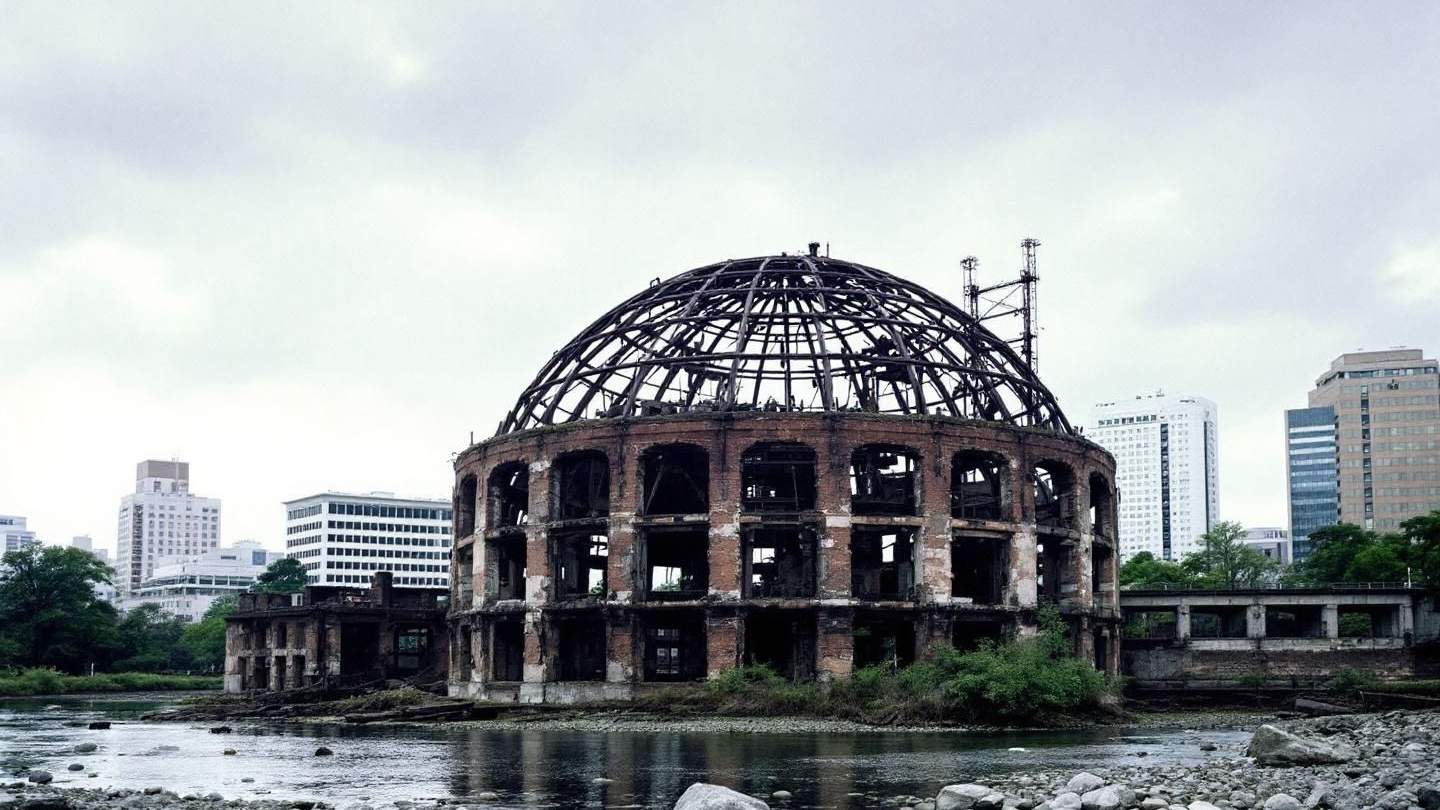
The Genbaku Dome — now designated a UNESCO World Heritage Site — is the skeletal remains of the former Hiroshima Prefectural Industrial Promotion Hall, which stood almost directly beneath the bomb’s hypocenter. The building’s iron frame and thick stone walls were strong enough to partially survive the blast that destroyed virtually everything within two kilometers. Preservation work has been ongoing since 1967 to prevent further decay.
Seeing it in photographs does not prepare you for the physical presence of the structure. It sits at the edge of the park along the Motoyasu River, and people tend to go quiet in front of it. Across the river, the city is entirely modern and rebuilt — which makes the dome’s survival all the more striking.
There is no entrance fee and no entry into the ruin itself. You walk around the perimeter at river level. The best viewing points are from the riverbank directly in front of the dome, and from the Peace Memorial Bridge looking east. At night, the dome is lit with subtle uplighting that makes it even more poignant.
Shukkeien Garden
Shukkeien is one of those gardens that rewards a slow visit. Built in 1620 by feudal lord Asano Nagaakira, the name translates roughly as “shrunken scenery garden,” referring to the way the garden’s designers miniaturized famous landscapes into a compact space. A central pond is crossed by several bridges and surrounded by teahouses, stone lanterns, irises, and carefully pruned pine trees.
The garden was nearly completely destroyed by the atomic bomb — it was 1.5 kilometers from the hypocenter — and survivors sheltered here in the aftermath. Remarkably, it was restored to its pre-war design using old records and photographs, and today it looks much as it did three centuries ago.
Entry is 260 yen. The garden is at its finest during cherry blossom season in late March and early April, and again in June when the irises bloom around the central pond. It opens at 9am and closes at 6pm (5pm in winter). Allow at least 45 minutes.
Hiroshima Castle
Hiroshima Castle, also known as Rijojo or “Carp Castle,” was built in the 1590s by feudal lord Mori Terumoto. The original five-storey keep was another casualty of the atomic bomb; the current structure is a faithful 1958 concrete reconstruction. The interior functions as a museum of feudal-era Hiroshima, with displays on samurai culture, weapons, armor, and the city’s history as a castle town.
The keep is worth the 370 yen admission primarily for the views from the top floor, which look out over the modern city and Peace Memorial Park. The surrounding moat and reconstructed turrets give you a sense of how dominant the castle once was in the city’s layout.
The castle grounds are free to enter and pleasant to wander through. In spring, the moat-side cherry trees are spectacular.
Hiroshima Budget Guide
Planning how much to spend in Hiroshima depends on your travel style. Here’s a breakdown of typical daily costs:
| Category | Budget | Mid-range | Comfortable |
|---|---|---|---|
| Accommodation | 3,000–5,500 yen (hostel) | 8,000–14,000 yen | 15,000–25,000 yen |
| Meals | 1,500–2,500 yen | 3,000–5,000 yen | 6,000–10,000 yen |
| Attractions | 200–600 yen | 600–1,500 yen | 1,500–3,000 yen |
| Transport (city) | 180–700 yen (tram) | 700–1,500 yen | 1,500+ yen |
| Daily total | ~6,000 yen | ~10,000–15,000 yen | ~20,000+ yen |
Note: The Peace Memorial Museum (200 yen) and the Peace Memorial Park (free) keep Hiroshima’s attraction costs very low compared to other major Japanese cities.
Local Food: What to Eat in Hiroshima
Hiroshima-Style Okonomiyaki
This is the dish that will change your understanding of okonomiyaki if you have only eaten the Osaka version. Where Osaka-style mixes all ingredients into the batter before cooking, Hiroshima-style is built in distinct layers directly on a flat iron griddle (teppan): a thin crepe-like pancake base, a mountain of shredded cabbage and bean sprouts, pork belly slices, then a nest of yakisoba noodles, and finally an egg cracked and spread underneath to bind it all together. The result is tall, crispy at the edges, soft and complex inside, and finished with a sweet-savory okonomiyaki sauce, mayonnaise, dried bonito flakes, and aonori seaweed.
Where to go: Okonomimura (“Okonomiyaki Village”) in central Hiroshima is a five-storey building housing around 25 small okonomiyaki restaurants, each barely larger than a counter with eight stools. It is the best place in the city for a casual, atmospheric meal. Expect to pay 900 to 1,200 yen per pancake. The most famous standalone restaurants — Micchan (the original, founded 1950) and Hassho — often have queues but move fast.
Hiroshima Oysters
Hiroshima Prefecture produces around 60% of Japan’s oysters, and the Seto Inland Sea’s calm, nutrient-rich waters produce oysters that are plump, briny, and remarkably sweet. From October through March, they appear everywhere: raw on ice, grilled in the shell with ponzu or garlic butter, deep-fried as kaki furai, or layered into rice as kaki meshi.
The restaurant area near the Peace Memorial Park and the seafood section of Orizuru Tower both serve excellent oysters. Budget around 150–250 yen per oyster raw, or around 1,200 yen for a plate of kaki furai at a casual restaurant.
Tsukemen (Dipping Ramen)
Hiroshima has a strong local tsukemen culture, particularly the thick-brothed style pioneered by the Hiroshima chain Sanzou. Cold or room-temperature noodles arrive alongside a rich, spicy dipping broth. You dip each mouthful of noodles rather than eating it in soup. It is intensely flavored, and popular with locals as a late-night meal. A bowl runs 900 to 1,100 yen.
Day Trip to Miyajima
Getting from Hiroshima to Miyajima is simple and one of the best short excursions in Japan. No visit to Hiroshima is complete without a half-day on Miyajima (formally called Itsukushima), the sacred island 30 kilometers west of the city. The island’s most famous image — the great torii gate of Itsukushima Shrine appearing to float above the water at high tide — is among the most reproduced photographs in Japan, and it genuinely looks as beautiful in person.
The ferry to Miyajima takes about 10 minutes from Miyajimaguchi pier, which you reach by JR train (about 25 minutes from Hiroshima Station) or tram. The ferry is included in the JR Pass. A visitor tax of 100 yen per person is collected at the pier.
Itsukushima Shrine is built on stilts over the tidal flats and is best visited close to high tide when the water fills beneath it. Check tide times before you go (easily found online). Entry is 300 yen. The vermilion corridors, lantern-lined walkways, and stage where traditional bugaku court dances are performed are stunning in any light.
The torii gate is currently undergoing intermittent restoration work. Check current status before your visit, as access to the gate on foot at low tide may be partially restricted. Even during restoration, the gate is visible and photographs beautifully.
Other highlights: Daisho-in temple complex is one of the most elaborate Buddhist temples in western Japan, and the 30-minute walk up to it is well worth the effort. Senjokaku pavilion (100 yen entry) is a 16th-century unfinished wooden hall with a quiet, moss-covered atmosphere.
Deer on Miyajima: Like Nara, Miyajima has freely roaming deer. Unlike Nara’s deer, which are used to crowds, Miyajima’s deer will boldly steal maps, brochures, and shopping bags. Keep your belongings close.
Food on Miyajima: The island is famous for momiji manju — small maple-leaf-shaped cakes filled with anko (sweet red bean paste), cream, or chocolate. Fresh-from-the-oven versions are sold on the main shopping street for around 100–150 yen each.
Getting to Hiroshima
If you’re planning a wider Japan trip, Hiroshima connects naturally with Kyoto, Osaka, and Fukuoka. See our 10-day Japan itinerary for a suggested route that includes Hiroshima. A JR Pass is worth considering if you’re traveling between multiple cities. For background on how to use trains in Japan, our dedicated guide covers everything you need.
By Shinkansen: The fastest and most convenient option. From Tokyo, the Nozomi shinkansen takes approximately 4 hours and costs around 18,000–19,000 yen (not covered by JR Pass). The Hikari, which stops at Hiroshima and is JR Pass-eligible, takes about 4 hours 20 minutes. From Kyoto, it is about 1 hour 30 minutes; from Osaka, about 1 hour 15 minutes; from Hakata (Fukuoka), about 55 minutes.
By Air: Hiroshima Airport serves flights from Tokyo (Haneda/Narita), with a journey time of about 1 hour 20 minutes by air plus around 45 minutes by airport limousine bus to the city.
By Bus: Night buses from Tokyo and Osaka are available for budget travelers, with journey times of 9–12 hours and prices from around 3,500 yen.
Getting Around Hiroshima
Hiroshima has one of Japan’s most functional and charming streetcar (tram) networks. The six lines connect Hiroshima Station with Peace Memorial Park, Hiroshima Castle, Shukkeien Garden, and the ferry terminal for Miyajima. A single ride costs 180 yen (flat fare); a one-day pass costs 700 yen and pays for itself after four rides.
The city center is also very walkable. From Peace Memorial Park to Hiroshima Castle is about a 20-minute walk through the rebuilt city grid. Most major sights cluster within about 2 kilometers of the park.
Taxis are plentiful but not essential given the excellent tram network.
Best Time to Visit Hiroshima
| Season | Months | Weather | Crowds | Highlights |
|---|---|---|---|---|
| Spring | Late Mar–Apr | Mild, 14–20°C | High | Cherry blossoms over the Motoyasu River |
| Summer | Jul–Aug | Hot, humid, 28–33°C | Very high | Peace ceremony Aug 6; paper lanterns |
| Autumn | Oct–Nov | Cool, 15–22°C | Medium | Best weather; Miyajima autumn foliage |
| Winter | Dec–Feb | Cool, 5–12°C | Low | Oyster season peak; quieter sights |
Spring (late March to early April): Cherry blossoms make Peace Memorial Park particularly beautiful, with petals drifting over the Motoyasu River and around the cenotaph. This is also the park’s most crowded period.
Autumn (October to November): Arguably the best season. The crowds are smaller than spring, the weather is crisp and clear, and the maples around Shukkeien Garden turn brilliant red. Miyajima is especially dramatic in autumn foliage.
Summer (July–August): The Peace Memorial Ceremony on August 6th draws significant crowds. Hiroshima is hot and humid in summer. The paper lanterns floated on the Motoyasu River on the evening of August 6th are deeply moving if you can be there for it.
Winter (December–February): Quieter, occasionally cold, but oyster season is at its peak. A perfectly valid time to visit.
Practical Tips
Museum timing: Go to the Peace Memorial Museum first thing in the morning (doors open at 8:30am). By 10am it fills up considerably and the emotional weight of the experience is better absorbed in relative quiet.
Emotional preparation: Many visitors find the museum more affecting than they expected. Allow yourself time afterward — sitting in the park with a coffee, watching the river — before moving on.
Combination pass: The Hiroshima Sightseeing Loop Bus (Meipuru-pu) covers major sights including Shukkeien and Hiroshima Castle for 400 yen per ride or 700 yen for a day pass, and includes a tram day pass in some combinations.
August 6th: If you visit on the anniversary of the bombing, be respectful. The memorial ceremony at 8:15am is moving and open to the public, but it is a solemn occasion, not a tourist event.
Language: English signage throughout Peace Memorial Park and the museum is excellent. Restaurant menus often have photos; point-and-order works well at okonomiyaki counters.
Where to Stay in Hiroshima
Choosing where to stay in Hiroshima largely comes down to whether you prioritize convenience (near the station) or atmosphere (near the park). Here’s an overview:
Near Hiroshima Station: Most convenient for early-morning shinkansen departures. Business hotels including Dormy Inn and APA Hotel cluster here. Budget 8,000–14,000 yen per night.
Near Peace Memorial Park (Naka-ku): The most atmospheric location, putting you within walking distance of the park for early-morning visits. The Rihga Royal Hotel Hiroshima and several mid-range hotels are here. Budget 10,000–20,000 yen.
Budget: Several good guesthouses and hostels operate near Hiroshima Station and in the entertainment district around Nagarekawa. Expect 3,000–5,500 yen per dorm bed or 7,000–9,000 yen for a private room.
For Miyajima: Staying overnight on Miyajima itself — at a traditional ryokan or the popular Iwaso Ryokan — is expensive (30,000 yen and up) but allows you to experience the island after day-trippers leave, when the deer wander through empty shopping streets in the dark and the lit shrine reflects on the water. Worth it for a special occasion. For more guidance on ryokan stays, see our ryokan guide.
For broader trip planning, see how to plan a trip to Japan, our Japan travel budget guide, and the best time to visit Japan. Hiroshima pairs naturally with Nara, Kyoto, and Osaka on a 14-day itinerary.
Frequently Asked Questions About Hiroshima
Is Hiroshima worth visiting?
Absolutely. Hiroshima is one of the most meaningful destinations in Japan and one of the most moving in the world. The Peace Memorial Park, the A-Bomb Dome, and the museum together create an experience that is sobering and ultimately uplifting — a testament to resilience and the power of choosing hope over bitterness. Beyond the history, the city has excellent food (especially Hiroshima-style okonomiyaki and oysters), a compact and walkable center, and the beautiful island of Miyajima just 30 minutes away. Almost everyone who visits wishes they had stayed longer.
How many days do you need in Hiroshima?
Two days is the ideal amount of time in Hiroshima. Day one covers the Peace Memorial Park, the museum, the A-Bomb Dome, Hiroshima Castle, and dinner at Okonomimura. Day two is best spent on a full half-day trip to Miyajima island, with the afternoon back in the city to explore Naramachi or Shukkeien Garden. One day is the minimum if you’re tight on time; three days lets you breathe more and add Onomichi or the Seto Inland Sea cycling route.
Can you do Hiroshima as a day trip?
Yes, a Hiroshima day trip from Osaka or Kyoto is possible. From Osaka it’s about 1 hour 15 minutes by Shinkansen; from Kyoto about 1 hour 30 minutes. A focused day gives you enough time for the Peace Memorial Park, the museum, and the A-Bomb Dome. The limitation is that you likely won’t have time for both Hiroshima’s city sights and a visit to Miyajima. If you can manage an overnight stay, you’ll have a far richer experience. See our 7-day Japan itinerary for suggestions.
Is the Peace Memorial Museum free?
The Peace Memorial Museum is not free, but it costs only 200 yen for adults — one of the lowest admission prices for any major museum in Japan. The Peace Memorial Park itself, including the A-Bomb Dome, cenotaph, and Children’s Peace Monument, is completely free to visit at any hour.
How do you get from Hiroshima to Miyajima?
Getting from Hiroshima to Miyajima takes about 35–40 minutes total. From Hiroshima Station or the Peace Memorial Park tram stop, take the JR San-yo Line or the tram to Miyajimaguchi (about 25 minutes by JR, 45 minutes by tram). From Miyajimaguchi pier, the ferry to Miyajima Island takes about 10 minutes. The ferry is included in the JR Pass. A visitor tax of 100 yen per person is collected at the pier. For a full guide to the island, see our Miyajima guide.