Hakone
Complete Hakone travel guide. Hot springs, Mount Fuji views, Lake Ashi, art museums, and the famous Hakone loop — just 90 minutes from Tokyo.
Quick Facts
- Best For
- Onsen, Mt. Fuji views, Nature
- Days Needed
- 1-2 days
- Best Season
- Autumn (best Fuji views)
- Getting There
- 90 min from Tokyo (Romancecar)
- Getting Around
- Hakone Freepass
- Budget (per day)
- 8,000-30,000 yen
Why Visit Hakone
This Hakone travel guide covers everything you need — from Hakone onsen options to Mount Fuji views, the Hakone Freepass, the best Hakone day trip routes from Tokyo, and where to stay in Hakone for every budget. Whether you’re planning a quick day out from Tokyo or a proper overnight ryokan stay, read on.
Hakone is the easiest answer to a question many Tokyo visitors ask after three or four days in the city: where can I get some air? Ninety minutes from Shinjuku by express train, this volcanic mountain resort has been a retreat from urban life since the Edo period, when merchants and officials rested at hot spring inns along the old Tokaido road. Today it occupies a peculiar position in Japanese travel — simultaneously a world-class destination and a genuinely functional day trip.
The appeal is layered. Hakone sits inside a vast volcanic caldera, and the geothermal activity that makes the area slightly sulphurous also feeds dozens of excellent hot spring baths. Lake Ashi fills part of the caldera, and on clear days — more reliable in autumn and less so in summer — Mount Fuji rises dramatically above the lake’s western shore. A rotating cable car crosses an active volcanic valley. Serious art museums sit in forests. Ryokan offer multi-course kaiseki dinners and private outdoor baths.
Whether you come for a day or stay overnight, Hakone rewards the visit. The day trip version is entirely satisfying. The overnight version is restorative in a way that few places close to a major city can manage.
Day Trip vs Overnight
Day trip: Entirely feasible and practiced by tens of thousands of visitors every week. Leave Shinjuku by 8am on the Odakyu Romancecar, complete the Hakone Loop (see below), and return by 6 or 7pm. You will not have time for a long onsen soak or a slow ryokan dinner, but you will see Lake Ashi, Owakudani, and the Open Air Museum.
Overnight (strongly recommended): Staying in a ryokan or hotel with an onsen fundamentally changes what Hakone is. You arrive in the afternoon when day-tripper crowds are thinning, soak in a hot spring before dinner, have a multi-course kaiseki meal at your inn, wake up for an early-morning bath, and then have the morning sights largely to yourself. This is the version of Hakone that people remember for years.
Budget 15,000–40,000 yen per person per night at a mid-range ryokan including two meals. Upper-end ryokan with private outdoor baths (rotenburo) cost 30,000–60,000 yen and up.
The Hakone Loop: The Classic Route
The “Hakone Loop” is a clever circuit that uses five different forms of transport — train, mountain railway, cable car, ropeway, boat, and bus — to navigate the caldera. Most visitors do it in one direction only. Here is the full clockwise route from Hakone-Yumoto, which is the best direction for logistics and views.
Step 1: Odakyu Romancecar to Hakone-Yumoto (90 min from Shinjuku)
The Romancecar is Odakyu’s limited express service, with reserved seating, large observation windows, and no standing passengers. It runs from Shinjuku and costs 900 yen in limited express surcharge on top of the base fare. Advance booking is recommended on weekends. The Hakone Freepass includes this surcharge on the outbound journey.
Step 2: Hakone Tozan Railway to Gora (45 min)
From Hakone-Yumoto, the mountain railway switchbacks up the steep hillside through dense forest, achieving over 400 meters of elevation gain through a series of reverse zigzags. In late June, the hydrangea that line the tracks bloom in purple, blue, and white — this is actually one of the most beloved seasonal events in Hakone.
Step 3: Hakone Open Air Museum (60-90 min)
Get off at Chokoku-no-Mori Station (one stop before the end of the Tozan Railway line) for the Open Air Museum. This is the first and still one of the best open-air sculpture parks in Japan, with over 120 sculptures by Henry Moore, Rodin, Miro, Calder, Picasso, and Japanese artists spread across beautifully landscaped grounds with mountain views. The Picasso Pavilion alone contains around 300 works. Entry is 1,600 yen.
Step 4: Hakone Ropeway from Sounzan to Togendai (25 min)
From Gora, a funicular takes you up to Sounzan, where you transfer to the ropeway — a gondola cable car system that crosses over Owakudani volcanic valley and continues to Lake Ashi at Togendai. This is the most dramatic transport segment, especially the crossing above Owakudani.
Note: The ropeway section over Owakudani closes frequently due to volcanic activity. Check current status before your visit. When it closes, a replacement bus runs the same route.
Step 5: Owakudani Volcanic Valley (45 min)
At the midpoint ropeway station, you can disembark at Owakudani (Large Boiling Valley), an active volcanic area where steam vents, sulphurous gases, and bubbling pools give the landscape an otherworldly quality. The famous product here is kuro tamago — hard-boiled eggs cooked in the mineral-rich volcanic spring water, which turns the shells black. Local legend claims eating one extends your life by seven years. They taste like regular hard-boiled eggs. A bag of five costs 500 yen.
The views of Mount Fuji from Owakudani, when clear, are exceptional because of the elevation (around 1,044 meters). The smoking vents and snow-capped peak together create one of Hakone’s most dramatic scenes.
Step 6: Lake Ashi Cruise (30 min)
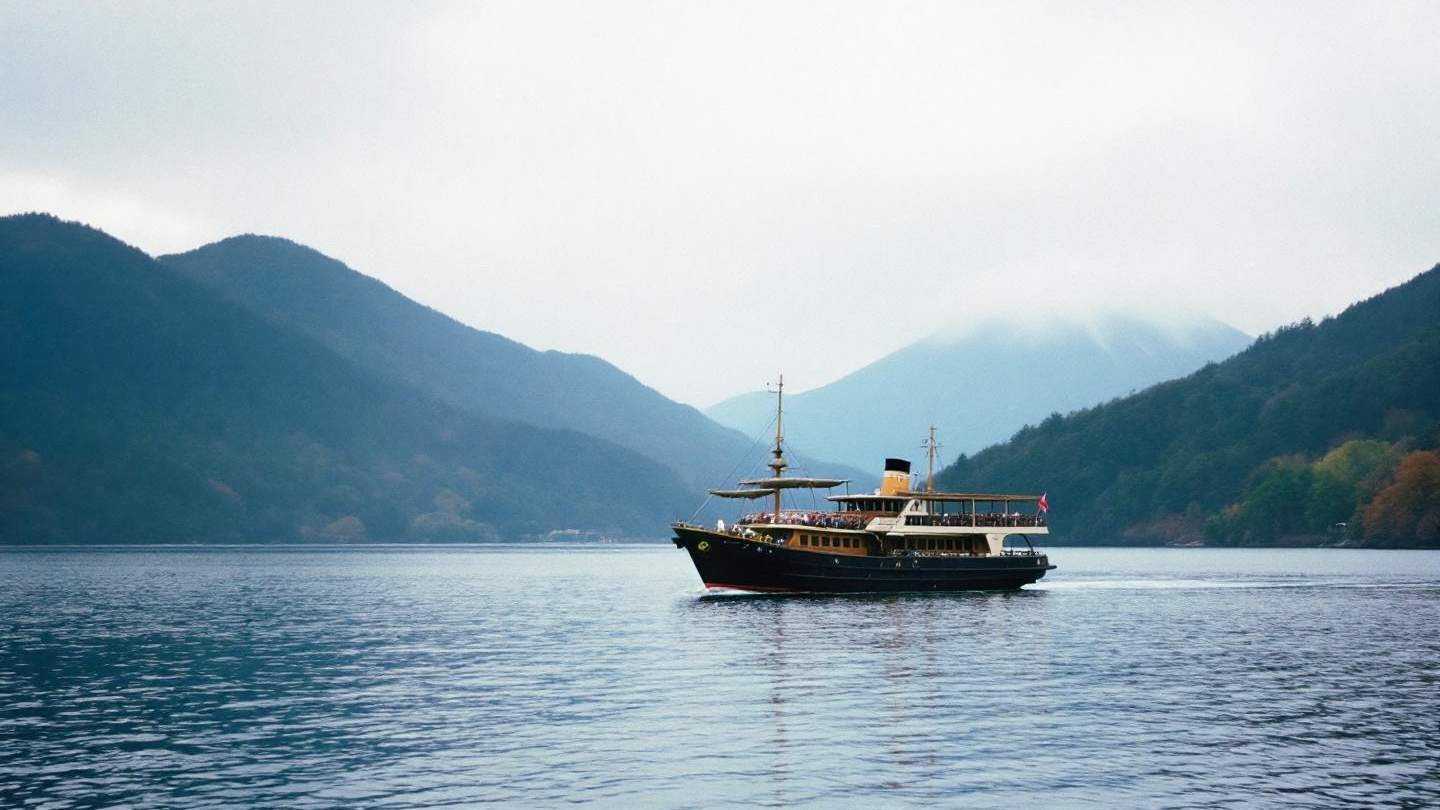
At Togendai on the lakeshore, sightseeing boats cross Lake Ashi to Moto-Hakone or Hakone-machi. The boats run as replica pirate ships (a very Japanese choice of theme) and the crossing gives good views of Mount Fuji above the western shore — with the famous silhouette of Hakone Shrine’s torii gate partially in the water along the southern lakeshore.
The lake is 7 kilometers long and sits at 725 meters elevation. On a clear autumn day with Fuji reflecting on the water, it is genuinely spectacular.
Hakone Shrine
Hakone Shrine (Hakone Jinja) sits on the forested southern shore of Lake Ashi and is reached either by boat or by a short bus ride from Moto-Hakone. Founded in 757, it is one of the major shrines of the Tokaido road and has been a pilgrimage site for over a millennium.
The approach through a cedar forest lined with stone lanterns is atmospheric in any weather. The shrine’s famous red torii gate stands in the lake itself, visible from the water and from the shoreline path — the image is particularly stunning in morning mist. Entry to the shrine is free; the treasure museum on the grounds costs 500 yen.
Pola Museum of Art
The Pola Museum is one of the best art museums in Japan outside of Tokyo and one of the finest in Asia by any standard. Opened in 2002, it occupies a glass-and-steel structure set into a forest hillside near Sengokuhara, with the collection including Monet, Renoir, Cezanne, Van Gogh, Picasso, and a superb collection of Japanese and Western decorative arts. The building itself is designed so that natural light filters through the forest into the galleries.
The permanent collection alone justifies the 1,800 yen admission. Budget two hours. The museum cafe has excellent views over the treetops and serves good food — the lunch menu is a worthwhile stop if your timing allows.
Getting there requires a bus from Hakone-Yumoto or Odawara; it is somewhat off the main loop route and best combined with a longer stay in Hakone.
Onsen Guide: Bathing in Hakone
Hakone is divided into several onsen resort areas (onsen-chi), each fed by different springs with different mineral compositions and slightly different therapeutic reputations. The main areas are:
Hakone-Yumoto: The oldest and most accessible, right at the bottom of the mountain. The water here is sodium chloride, clear and mildly salty. Many day-trippers use the large public bathhouses here. The Tenzan Tohji-kyo bathhouse complex is one of the best public onsen in the area, with multiple indoor and outdoor baths and a beautiful natural setting (entry around 1,300 yen).
Miyanoshita: A historic resort town midway up the mountain, home to the landmark Fujiya Hotel (Japan’s oldest Western-style resort hotel, opened 1878). The hot spring water here is slightly acidic sulphate.
Gora and Kowakidani: The mid-mountain resort hub. Many ryokan and hotels here offer private rotenburo (outdoor baths) with forest views. The Hakone Kowakien Yunessun water park offers onsen experiences including a wine bath, green tea bath, and sake bath — unusual and fun, most popular with families.
Sengokuhara: The quietest and most rural area, in the broad plain inside the caldera. Some of Hakone’s finest ryokan are here, and the Susuki (silver grass) fields in late September and October are among the most beautiful autumn landscapes in the region.
Onsen Etiquette Basics
Remove all clothing before entering the bath — swimwear is not permitted at traditional onsen. Wash thoroughly at the shower stations before entering the communal pool. Tie back long hair. Small hand towels can be carried but should not touch the water. Most importantly: relax. Hot spring bathing is meant to be slow.
Visitors with tattoos should check each facility’s policy in advance. Many traditional onsen ban tattoos; some more progressive establishments permit them or offer private bath rental options.
Mount Fuji Views: When and Where
Hakone’s central attraction for many visitors is the possibility of seeing Mount Fuji. Here is what you actually need to know:
Fuji is visible roughly 80–100 days per year from Hakone. Clear views are most likely in autumn (October and November) and winter, when cold, dry air reduces haze. Summer (July–August) is the worst season for visibility — cloud and humidity obscure Fuji on most summer days.
Best viewpoints:
- Lake Ashi: From the ropeway boat on the lake, or from the Hakone-machi lakeshore looking northwest
- Owakudani: Elevated views of the peak from the ropeway station
- Sengokuhara: Open fields give panoramic views in good conditions
- Fuji-Hakone-Izu area: Driving or cycling toward Gotemba gives closer, lower-angle views
The honest advice: Do not build your entire Hakone trip around a guaranteed Fuji view. The mountain is a bonus. Hakone has more than enough to offer — onsen, the ropeway, the Open Air Museum, Lake Ashi — regardless of whether Fuji shows itself. On a clear day it is one of the most beautiful sights in Japan; on a cloudy day you will still have an excellent trip.
The Hakone Freepass: Detailed Explanation
The Hakone Freepass is sold by Odakyu Railways and is the most economical way to visit Hakone from Tokyo. It comes in two versions:
2-day Freepass: 6,100 yen from Shinjuku. Covers unlimited use of all Hakone transport within the resort area (Hakone Tozan Railway, Hakone Tozan Bus, Hakone Ropeway, Lake Ashi cruise, Hakone Tozan Cable Car), plus the Odakyu Romance Car surcharge on the outbound journey (you pay the base rail fare separately). Valid from any Odakyu station.
3-day Freepass: 6,500 yen. Adds a day for those staying two nights.
The pass also provides discounts (typically 10–20%) at many major attractions including the Open Air Museum, Pola Museum, Owakudani, and numerous restaurants and onsen.
Is it worth it? Run the numbers for your specific itinerary. If you are doing the full loop (ropeway, cable car, boat) plus visiting one or two museums, the 2-day pass typically saves 1,500–2,500 yen over paying individually, plus the transport convenience eliminates the hassle of buying separate tickets at each stage.
Buy it: At any Odakyu station ticket window in Tokyo, including Shinjuku (the main departure point). The machines do not sell the Freepass — you need a staffed window.
Hakone Freepass vs Paying Separately
| Transport | Individual Price | Covered by Freepass |
|---|---|---|
| Romancecar surcharge (Shinjuku–Yumoto) | 900 yen | Yes (outbound) |
| Hakone Tozan Railway (full line) | ~700 yen | Yes |
| Hakone Ropeway (Sounzan–Togendai) | 1,500 yen | Yes |
| Lake Ashi cruise | 1,200 yen | Yes |
| Hakone Tozan Cable Car | 450 yen | Yes |
| Open Air Museum discount | 1,600 yen → ~1,350 yen | Discount |
| Total without pass | ~5,350+ yen | — |
| 2-day Freepass | 6,100 yen | All above |
The Hakone Freepass breaks even after the ropeway + boat + cable car combination and saves significantly when you factor in museum discounts.
Getting to Hakone
Hakone is one of the most popular day trips from Tokyo. It connects naturally with visits to Tokyo or as a stop on the way toward Kyoto or Osaka. If you’re using a JR Pass, see the Shinkansen option below. For general train travel tips in Japan, see our guide to using trains in Japan.
Odakyu Romancecar from Shinjuku: The standard and recommended option. Limited express trains depart multiple times per hour. Journey to Hakone-Yumoto takes 85–90 minutes. Book the Romancecar reserved seats online or at the Odakyu Shinjuku ticket counter. Cost is around 2,290 yen total (base fare plus Romancecar surcharge), included in the Hakone Freepass.
JR + Shinkansen to Odawara then local train: Faster total journey if you take the Shinkansen to Odawara (35 minutes from Tokyo, around 3,070 yen, covered by JR Pass), then the Hakone Tozan Railway from Odawara Station to Hakone-Yumoto (15 minutes). This is the better option for JR Pass holders.
Getting Around
Within Hakone, the Hakone Freepass covers all transport you need. The network of trains, buses, ropeway, cable car, and boats is well-connected and clearly signed in English. Allow for transfer times — the full loop takes a full day at a comfortable pace.
A taxi is sometimes useful for reaching specific ryokan or for the Pola Museum if bus timings do not align well.
Best Time to Visit Hakone
| Season | Months | Fuji Visibility | Highlights | Crowds |
|---|---|---|---|---|
| Autumn | Oct–Nov | Excellent | Foliage, clearest skies | High (book early) |
| Spring | Apr–May | Good | Cherry blossoms, mild temps | Medium-high |
| Hydrangea | Late Jun | Poor | Train-side hydrangea blooms | Medium |
| Winter | Dec–Feb | Excellent | Onsen feel best; snow possible | Low |
| Summer | Jul–Aug | Poor | Humid; Fuji rarely visible | Very high |
October to November: The single best period. Autumn foliage transforms the mountain slopes, the air is clear and cool, and Mount Fuji views are at their most reliable. Book accommodation well in advance — ryokan fill up months ahead for October weekends.
April to May: Second best. Cherry blossoms in early April around Lake Ashi. Clear spring air. Comfortable temperatures.
Late June: Hydrangea bloom along the Hakone Tozan Railway — genuinely beautiful and worth timing for.
Summer: Very popular with Japanese families. Hot, humid, frequently misty. Fuji rarely visible. Not recommended for first-time visitors.
Winter: Quietest and coldest. Fuji views are excellent on clear days. Onsen feel most rewarding when it is cold outside. A lesser-visited but underrated season.
Where to Stay in Hakone
Choosing where to stay in Hakone is the single most important decision you’ll make for this trip. A good ryokan transforms the experience. For more guidance on ryokan stays generally, see our ryokan guide.
Budget (6,000–10,000 yen per person): Business hotels and guesthouses around Hakone-Yumoto. The area has several comfortable options and you can use the public bathhouses for your onsen experience.
Mid-range ryokan (10,000–20,000 yen per person with 2 meals): The best value category. Ryokan in Gora, Miyanoshita, and Sengokuhara offer tatami rooms, yukata robes, and communal onsen baths. Meals are the highlight — multi-course kaiseki dinners using local seafood, wagyu beef, and mountain vegetables.
Luxury ryokan (25,000–70,000 yen per person with 2 meals): Properties like Gora Kadan, Hakone Ginyu, and Ryuguden offer private rotenburo attached to rooms, butler service, and kaiseki meals that rank among the finest dining experiences in the Kanto region.
Practical Tips
Ropeway closures: The ropeway section between Owakudani and Ubako closes frequently due to volcanic activity. Always check the Hakone Freepass website for current operation status before your visit. Buses substitute when the ropeway is closed.
Weekday visit: Hakone is enormously popular with Tokyo residents on weekends. Visiting on a weekday — particularly Monday through Wednesday — gives you a fundamentally more relaxed experience, especially at Owakudani and on the ropeway.
Weather app: Check the weather forecast for Hakone (not Tokyo) before your visit. Conditions in the mountains can differ significantly from the city. Rain in Hakone, while atmospheric, means no Fuji views and potentially less enjoyment of outdoor elements.
Ryokan check-in: Most ryokan check-in between 3 and 5pm and serve dinner at 6 or 7pm. Arrive on time — the kaiseki meal is the centerpiece of the evening and timing is fixed.
Hakone connects naturally with Tokyo as part of a broader Kanto itinerary. For ideas on fitting it into a longer Japan trip, see our 7-day Japan itinerary or 10-day Japan itinerary. Useful broader guides: Japan travel budget, best time to visit Japan, and Japan etiquette (especially useful before a ryokan stay).
Frequently Asked Questions About Hakone
Is Hakone worth visiting?
Yes, Hakone is absolutely worth visiting — it is one of the best easy escapes from Tokyo in Japan, combining hot spring onsen, dramatic volcanic scenery, the possibility of Mount Fuji views, excellent art museums, and world-class ryokan dining. Even if you only have one day, the Hakone day trip experience is genuinely satisfying. If you can stay overnight at a ryokan with an onsen, you’ll leave with one of your most memorable Japan experiences.
Can you see Mount Fuji from Hakone?
Yes, but it depends entirely on the weather and season. Mount Fuji is visible from Hakone on roughly 80–100 days per year. Autumn (October–November) and winter offer the clearest skies and best odds. Summer is the worst season for Fuji views — heat haze and clouds obscure the mountain on most days from July through August. The best viewpoints are Lake Ashi (from the cruise or lakeshore), Owakudani (elevated, dramatic foreground), and the open plains at Sengokuhara. Do not build your entire Hakone trip around seeing Fuji — the destination has plenty to offer regardless.
Is the Hakone Freepass worth it?
For most visitors doing the full Hakone loop, yes, the Hakone Freepass is worth it. The 2-day pass costs 6,100 yen from Shinjuku and covers the Tozan Railway, Ropeway, Lake Ashi cruise, Cable Car, and buses — plus discounts at museums. If you use the ropeway (1,500 yen alone), the cruise (1,200 yen), and visit even one museum, you’re already close to break-even. JR Pass holders should consider the Shinkansen to Odawara instead, since the pass doesn’t cover Odakyu trains.
What is the best onsen in Hakone?
The best onsen in Hakone depends on what you’re looking for. For a public bathhouse day experience, Tenzan Tohji-kyo in Hakone-Yumoto is one of the finest, with multiple indoor and outdoor baths in a natural setting (around 1,300 yen entry). For a ryokan onsen with private rotenburo, the Sengokuhara area has some of Hakone’s top properties — Gora Kadan and Hakone Ginyu are consistently rated best in class. The Yunessun water park at Kowakidani offers unusual themed baths (wine, green tea, sake) for a fun family-oriented alternative.
Should you do Hakone as a day trip or stay overnight?
Both work, but staying overnight in Hakone is strongly recommended if your budget allows. A Hakone day trip gives you the loop circuit (Ropeway, Lake Ashi, Open Air Museum) without time for a proper onsen soak or ryokan dinner. Overnight means arriving in the afternoon to a warm spring bath before a multi-course kaiseki dinner, then an early-morning soak before the day-trippers arrive. This version of Hakone — quiet, restorative, deeply Japanese — is the one people remember for years. Mid-range ryokan with two meals run 10,000–20,000 yen per person; luxury options from 30,000 yen. See our ryokan guide for what to expect.