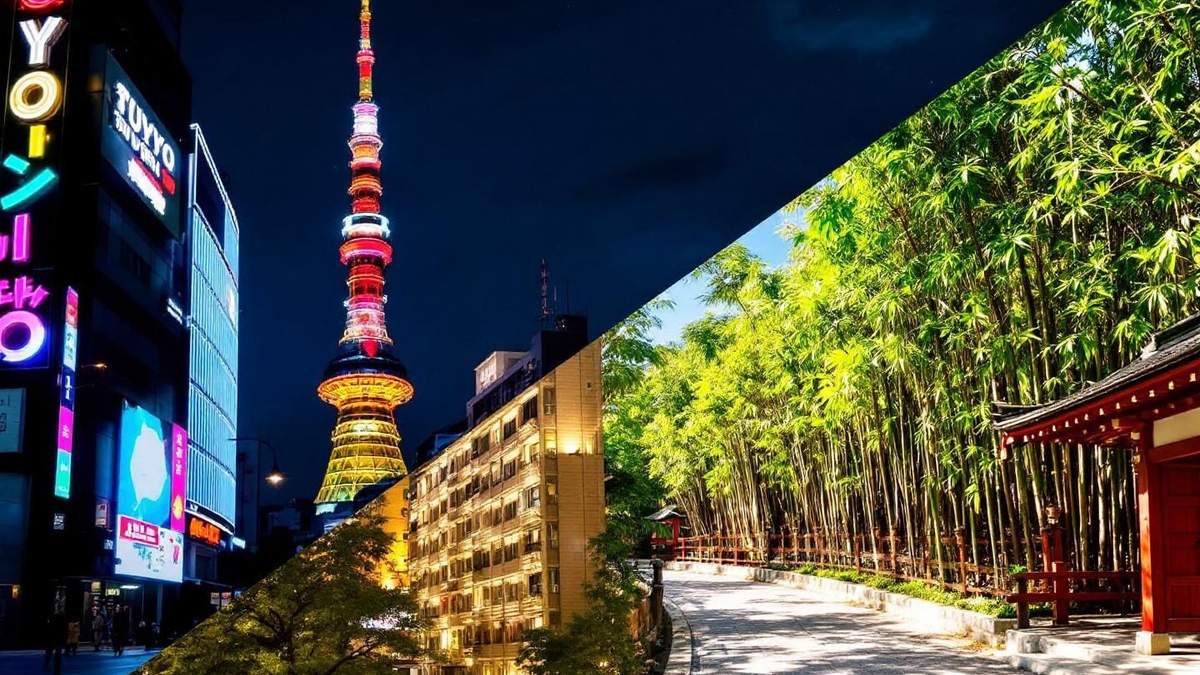
Kyoto vs Tokyo: Which Should You Visit?
Last updated: March 2026
Every Japan first-timer eventually confronts the question: if time or budget forces a choice, which city? Tokyo or Kyoto? It is a false dilemma in most cases — the two cities are 2.5 hours apart by Shinkansen and most visitors see both. For timing advice, see the best time to visit Japan guide — but the question reflects a real underlying truth: Tokyo and Kyoto are so different from one another that they represent almost opposite visions of what Japan is.
This comparison does not declare a winner. Both cities are extraordinary. What it does is give you the framework to understand each city’s character, who tends to prefer which, and how to get the most from either — or both.
The Essential Character of Each City
Tokyo
Tokyo is one of the great cities of the modern world. Not just of Japan — of the world. It is relentlessly contemporary, vast, layered, and inexhaustible. The population of Greater Tokyo approaches 37 million people. The subway system has 285 stations. The city has more Michelin-starred restaurants than any other city on earth. There are neighbourhoods dedicated entirely to anime, to electronics, to jazz vinyl, to vintage clothing, to nightlife, to financial services.
Tokyo is a city of the present tense — constantly building, renovating, evolving, absorbing and transforming influences from within Japan and across the world. History exists in Tokyo — the Imperial Palace grounds, Asakusa’s Senso-ji temple, the few prewar streets that survived the 1923 earthquake and the 1945 firebombing — but it coexists with contemporary life rather than defining the city’s character.
If you arrive in Tokyo expecting a vision of traditional Japan, you will need to look carefully and in the right places. But if you arrive expecting one of the world’s most energetic, diverse, and surprising cities, you will not be disappointed.
Kyoto
Kyoto served as Japan’s imperial capital from 794 until 1869, and the weight of that history is present everywhere. The city has more than 1,600 Buddhist temples, over 400 Shinto shrines, dozens of traditional gardens, and seventeen UNESCO World Heritage Sites. In Gion, the geisha district, the streets look essentially as they did in the Meiji period. The food culture — kaiseki high cuisine — was shaped over centuries of imperial patronage. The crafts (Nishijin textiles, Kiyomizu pottery, Kyoto lacquerware) are living traditions with unbroken lineages measured in generations.
Kyoto’s character is one of accumulated depth. The present city is layered on centuries of cultural production in ways that Tokyo, repeatedly destroyed and rebuilt, is not. Walking Kyoto requires a different kind of attention — not the fast-twitch, neon-stimulated engagement of Shinjuku at midnight, but a slower, more contemplative orientation that rewards patience and careful looking.
This does not make Kyoto slow or boring. It has excellent restaurants, good nightlife, creative contemporary art and design scenes, and the energy of a city of 1.5 million people. But its finest experiences are rooted in the historical, the traditional, and the artisanal.
Side by Side: Key Categories
Temples, Shrines, and Historical Culture
Kyoto wins decisively. This is not a close contest. Kyoto’s temple culture — Fushimi Inari’s thousands of torii gates, the gold-leafed reflection of Kinkaku-ji, the Zen rock garden of Ryoan-ji, the mossy seclusion of Kokedera, the vertiginous wooden stage of Kiyomizu-dera — represents one of the world’s finest concentrated collections of Buddhist and Shinto sacred architecture. Nowhere else in Japan, and arguably nowhere else in the world, has this density of sites of this quality.
Tokyo has Senso-ji in Asakusa and several good shrines — Meiji Jingu, Yasukuni — but they serve a different function in the city: relief and greenery amid urban density, rather than the primary reason for visiting.
Food
This is a draw, with different styles.
Tokyo has more Michelin stars than any city on earth and extraordinary depth across every cuisine: Japanese, French, Italian, Chinese, Indian, and everything else. Ramen in Tokyo is world-class. The morning sushi experience at the Tsukiji outer market is one of the finest food moments available to a traveller anywhere. The department store basement food halls (depachika) are culinary worlds in their own right.
Kyoto invented kaiseki — the multi-course seasonal tasting menu that represents Japan’s highest culinary form. Kaiseki in Kyoto is an encounter with centuries of tradition expressed through current-season produce, presented on ceramics chosen to complement each dish. The casual food culture around Nishiki Market and the izakaya of Pontocho are also excellent.
If your priority is breadth and experimental cuisine, Tokyo. If your priority is the deepest possible engagement with Japanese culinary tradition, Kyoto.
Nightlife and Entertainment
Tokyo wins clearly. Tokyo’s nightlife scale is incomprehensible to anyone who has not experienced it. Shinjuku’s Golden Gai — 200 tiny bars each seating eight to ten people — is a universe of night culture compressed into one block. Roppongi for international club culture. Shimokitazawa for jazz and indie music venues. Nakameguro for sophisticated bar hopping. Shibuya for the full spectrum at every price point. Tokyo operates at night without diminishment; the city after midnight is fully alive.
Kyoto has good drinking culture — Pontocho’s riverside lantern-lit alleys are beautiful at night, and the izakaya around Gion are atmospheric and sometimes extraordinary — but it does not rival Tokyo’s scale or variety.
Shopping
Tokyo wins by volume; Kyoto wins by craft quality.
Tokyo has everything: the world’s most extraordinary department store basement food halls, Harajuku’s global fashion scene, Akihabara’s electronics and anime goods, Shimokitazawa’s vintage clothing, Ginza’s luxury retail. There is no category of shopping that Tokyo does not serve at the highest level.
Kyoto’s shopping excellence is specific: traditional crafts. Nishijin textiles, Kiyomizu-yaki pottery, lacquerware, Japanese paper (washi), matcha products, hand-dyed fabric. The shops around Nishiki Market and the Higashiyama temple districts sell crafts that cannot be found with the same authenticity elsewhere. For genuinely Japanese gifts and crafts with real cultural provenance, Kyoto’s speciality stores are better than anything in Tokyo.
Nature and Green Space
This is a draw, with different characters.
Tokyo has Shinjuku Gyoen (one of Japan’s finest gardens), the Imperial Palace East Gardens, Yoyogi Park, Ueno Park, and Hamarikyu Gardens. For a city of its scale, Tokyo has significant and very well-maintained green space.
Kyoto has the Arashiyama bamboo grove and river valley, the Philosopher’s Path along the Biwa Lake Canal, Fushimi Inari’s cedar-forested mountain, and easy access to the Kitayama mountains north of the city. The relationship between Kyoto and its surrounding nature is more integrated — you can walk from a temple garden into a forested mountain path without transition.
Day Trips
Tokyo wins by range and volume.
Hakone, Kamakura, Nikko, Kawagoe, Yokohama, the Fuji Five Lakes area, Chichibu, Enoshima, Mount Takao — the variety and quality of day trips from Tokyo is unmatched by any other city in Japan.
Kyoto’s day trips are outstanding but fewer in number: Nara (30 minutes by train, essential), Osaka (15 minutes by shinkansen for a day of food and energy), Hiroshima and Miyajima (90 minutes, mandatory), and smaller destinations like Amanohashidate, Kibune, and Ohara.
Ease of Navigation
Tokyo and Kyoto present roughly equal challenges, but of different kinds.
Tokyo’s subway system appears overwhelming at first but is logically organised, colour-coded, and excellently sign-posted in English. The sheer size of the city is the challenge — journey times of 30 to 45 minutes between areas are normal, and getting lost in the wrong direction can consume an hour.
Kyoto is smaller and more navigationally manageable, but the bus system is often frustratingly slow in tourist traffic. Renting a bicycle — genuinely practical in Kyoto in a way it is not in most of Tokyo — is the recommended transport solution for anyone staying more than two days. The city’s grid layout makes cycling intuitive.
Accommodation Value
Kyoto is generally better value at mid-range and above. The traditional machiya (townhouse) accommodation and ryokan options in and around Kyoto offer cultural experiences unavailable in Tokyo at comparable prices. Tokyo’s business hotels and hostels are excellent value, but the premium accommodation market is priced at international-city rates that reflect the city’s global status.
Who Should Prioritise Which City
Tokyo First If You…
- Are visiting Japan for the first time and want maximum variety in a single city
- Love food from multiple cuisines, not just Japanese
- Are interested in contemporary culture, design, technology, or fashion
- Enjoy nightlife and entertainment options at genuine scale
- Want to feel the full force of a major global city operating at peak efficiency
- Are travelling with children who want theme parks and interactive experiences
Kyoto First If You…
- Are primarily interested in Japanese history, Buddhism, traditional culture, or Shinto
- Want to experience kaiseki, geisha culture, and traditional crafts in their authentic context
- Are on a return visit and have already seen Tokyo’s highlights
- Prefer a more contemplative, slower-paced travel experience
- Are deeply interested in Japanese food tradition specifically
- Want to stay in a traditional ryokan in a culturally rich and historically resonant setting
The Answer for Most People: See Both
The honest answer is that most visitors to Japan should see both. A week in Tokyo and four to five days in Kyoto (with day trips to Nara, Osaka, and Hiroshima) is a minimum to do justice to both cities. A 7-day Japan itinerary can help you plan your route. Three days in each city is the absolute minimum — enough to see the most important things but not enough to understand either.
The standard two-week itinerary — four to five days in Tokyo, one day in transit with day trips, four days in Kyoto, two days in Osaka, one day in Hiroshima and Miyajima — exists because it works. The contrast between Tokyo and Kyoto is not a weakness of this itinerary but its greatest strength. No two cities on a 2.5-hour train ride offer a more complete picture of what a single country can contain.
How to Maximise Each City
Getting the Most from Tokyo
Tokyo rewards neighbourhood exploration more than landmark-ticking. The big sights — Senso-ji, Shibuya crossing, Shinjuku — are worth seeing, but Tokyo’s character emerges more fully in the spaces between: a jazz bar in Shimokitazawa, a depachika in Ginza, a standing ramen counter at 11pm in Shimbashi, an early morning temple visit before anyone else arrives.
Give yourself at least one day without an itinerary. Get on a train to a neighbourhood you have not planned to visit. Tokyo is designed to reward aimless walking more than almost any other city, because every few streets reveal something unexpected: a shop selling one highly specific product, a shrine squeezed between office buildings, a covered shotengai (shopping arcade) that has changed imperceptibly since the 1970s.
Getting the Most from Kyoto
Kyoto’s great mistake, made by most visitors, is attempting to see too much too fast. The temples blur into each other. The gardens look similar. The torii gates lose their power through repetition.
The antidote is selection and time. Choose five or six sites across your visit and spend an hour or more at each, rather than photographing the entrance of twenty. Visit popular sites as early as possible — Fushimi Inari before 7am is a completely different experience from Fushimi Inari at 10am. Rent a bicycle and explore a neighbourhood rather than following a prescribed route.
The finest Kyoto experiences are quiet ones: an empty rock garden at 8am, a tea house in a walled garden, the back streets of Nishiki where residents still live and shop, the Philosopher’s Path before the tourists arrive.
The Deeper Question
The Tokyo versus Kyoto debate often reflects a deeper preference: do you want Japan to show you its future or its past? Do you want the country to be new, or to be old?
Japan, uniquely, offers both answers fully and without compromise. Tokyo’s answer to modernity is as confident and complete as any city has ever given. Kyoto’s answer to tradition is as deeply considered and carefully preserved as any city has ever managed.
The traveller who sees only one is working with half a picture. The traveller who sees both — and allows the contrast to complicate and enrich their understanding — comes significantly closer to understanding what Japan actually is.