10 Japanese Etiquette Rules That Are Actually Myths
Last updated: March 2026
Japan has a reputation for strict, formal etiquette — a reputation that causes significant anxiety among first-time visitors. For the full picture, read the Japan etiquette guide. Travel blogs amplify this anxiety with lists of rules to memorise, taboos to avoid, and cultural landmines to sidestep. The reality, in most cases, is considerably more relaxed.
There are genuine etiquette rules in Japan, and some of them matter quite a lot. But many of the “rules” circulating online are exaggerated, misapplied to situations where they do not apply, outdated, or simply incorrect. Here are ten of the most common.
Myth 1: You Must Accept a Business Card with Both Hands and Treat It with Reverence
This rule exists and applies — in formal Japanese business settings. The meishi (business card) exchange ceremony is real, and in a corporate or formal professional context, receiving a card with both hands, glancing at it respectfully before setting it on the table in front of you (not stuffing it in your back pocket), is good professional practice.
However, most tourists never encounter a formal business card exchange. If you receive a card from a hotel clerk, a tour guide, a restaurant manager, or a shop owner, the rules are considerably more relaxed. A two-handed receipt is polite; a one-handed receipt is not offensive. The ceremony is a professional norm, not a universal social requirement.
The real rule: In formal professional settings, treat business cards with care. Everywhere else, be respectful but do not perform a ceremony.
Myth 2: You Must Finish Everything on Your Plate
The “clean plate” norm in Japan is mixed and context-dependent. In home dining contexts, finishing your plate does signal appreciation and that the host provided the right amount. In a restaurant, leaving food on your plate is entirely acceptable — it is your food, you paid for it, and Japanese restaurant staff will not take offence.
In kaiseki dining, leaving small amounts of rice in your rice bowl (signalling you have had sufficient) is the traditional way of indicating you are done and do not want more. Finishing it completely sometimes signals you want a refill.
The real rule: Finishing food in someone’s home is polite. In restaurants, eat what you want.
Myth 3: Tipping Is Extremely Offensive and Will Cause a Scene
Tipping in Japan is indeed not practised, and in high-end restaurants or traditional hotels, offering a cash tip to a server might cause confusion or awkward refusal. But the consequences are almost never the dramatic offence that travel writers suggest. A server who receives a tip from a well-meaning foreign visitor will typically politely refuse or leave the money at the counter — there will not be a scene.
The reason not to tip is not primarily that it is offensive. It is that the service model in Japan is built on the principle that good service is simply part of the job, not a discretionary effort rewarded with additional payment. The price is the price, and service is included.
The real rule: Do not tip in restaurants, hotels, or taxis. Not because refusing it will cause drama, but because the system does not operate that way.
Myth 4: You Cannot Eat or Drink While Walking
Japan has cultural norms around eating on the move, but the reality varies significantly by location and food type. Eating ice cream from a shop while walking away from the shop is entirely normal. Street food sold specifically for eating immediately — takoyaki, grilled skewers, taiyaki — is eaten while standing or walking. The Japanese food guide explains what to eat and where. Festival food exists specifically to be consumed on the street.
What is accurate: eating a full meal from a convenience store on a crowded commuter train is considered poor form. Sitting on the ground in a public place to eat is unusual (except during hanami cherry blossom viewing, when it is the entire point). The norm is more about context and tidiness than a blanket prohibition on eating while mobile.
The real rule: Street food is eaten on the street. The fuller the meal and the more formal the setting, the more appropriate it is to eat seated.
Myth 5: You Must Bow Deeply and Constantly
Bowing is central to Japanese social interaction, and not bowing when it is clearly appropriate is rude. But the specifics that foreign visitors worry about — the correct angle, the number of times, who goes first — are far less precisely executed in everyday life than in etiquette guides.
For a tourist, a slight bow of acknowledgement (15 degrees, head down briefly) when greeting, thanking, or taking leave of someone is appropriate and appreciated. You do not need to execute a perfect 30-degree bow held for three seconds with arms flat at your sides. Japanese people will not expect or demand precision from a foreign visitor. A genuine, simple bow shows awareness and respect.
The bow does not need to be reciprocated or escalated. Do not get into a bowing competition (this does happen — two people bowing repeatedly to each other, each waiting for the other to stop) with staff.
The real rule: Bow when greeting, thanking, and taking leave. A natural, modest bow is sufficient. Perfection is not required.
Myth 6: You Must Be Completely Silent on All Trains
The norm on Japanese trains — particularly in reserved carriages and quieter commuter trains — is considerably quieter than public transport in most Western countries. Talking on the phone is genuinely frowned upon; have phone calls before you board. Very loud conversations disturb other passengers.
But quiet conversation between travel companions is entirely acceptable. Children who make noise are tolerated with the patience that Japanese adults extend to children. Eating on long-distance trains (Shinkansen) is normal. Using headphones to listen to music is fine. The standard is “relatively quiet” not “absolute silence.”
The real rule: Keep noise levels moderate, avoid phone calls, and be considerate of the space you share. This is reasonable social behaviour on public transport anywhere.
Myth 7: Pointing Is Rude
Pointing directly at a person with a single extended finger is considered rude in Japan, as it is in many cultures. But pointing at objects — a menu item you want to order, a product on a shelf you want to ask about, a location on a map — is not rude and is commonly done by both Japanese people and tourists.
When indicating direction or drawing attention to something in conversation, Japanese people often use their full open hand rather than a single finger. This is the polite form. But failing to do so while pointing at a piece of sashimi you want to order will not cause offence.
The real rule: Do not point at people. Point at objects as needed, ideally with an open hand.
Myth 8: You Should Never Wear Shoes Indoors Anywhere
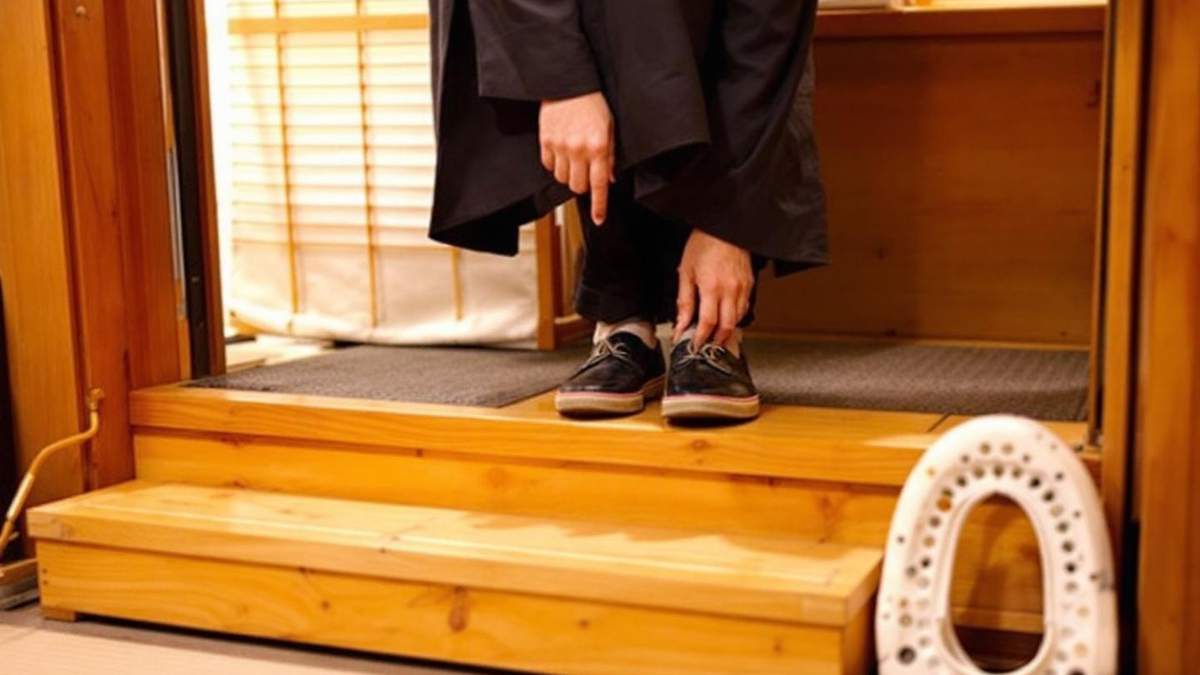
The shoe removal rule applies in specific contexts: entering a home, putting on slippers in ryokan hallways, removing shoes at the entrance of certain traditional restaurants, taking off shoes before entering the tatami-floored area of a temple. These are real and should be followed.
The rule does not apply to modern hotels, shopping centres, department stores, most restaurants, office buildings, convenience stores, or any building with a standard Western-style entrance. The marker is the genkan (entry area with step-up) or a floor mat/shoe rack at the entrance. If this threshold marker exists, shoes come off. If it does not, they stay on.
The real rule: Remove shoes when a physical or visual threshold signals it. Modern spaces do not require shoe removal.
Myth 9: Speaking Loudly Is Always Rude
Japan’s indoor culture is relatively quiet by international standards, and in certain contexts — temples, traditional inns, quiet restaurants — speaking softly is appropriate and considerate. The contrast with the outdoor festival culture, where noise and energy are embraced, is sharp.
But Japan is not uniformly quiet. Pachinko parlours are deafeningly loud. The Japanese food guide also has tips on dining etiquette. Baseball stadiums are extremely noisy. Izakaya are often raucous. Roppongi nightclubs are extremely loud. The streets of Kabukicho at midnight are far from quiet. The culture is context-sensitive rather than uniformly reserved.
The real rule: Match the ambient noise level of your environment. Some spaces are quiet; others are not. Read the room.
Myth 10: You Must Learn Japanese or You Will Insult People
Making no effort to communicate in the local language is not ideal in any country. But the anxiety that some visitors carry — that attempting Japanese poorly will cause offence, that getting a phrase wrong is worse than not trying — is the wrong way around.
Japanese people respond warmly and with genuine appreciation to any effort to use their language, however imperfect. A mangled “sumimasen” and a gesticulated question beats a confident English demand. The occasional mishap — accidentally saying something wrong or mispronouncing in a confusing way — is usually met with gentle amusement rather than offence.
English capability among Japanese people varies widely. In tourist areas and major hotels, English communication is possible. Elsewhere, a combination of slow English, pointing, translation apps, and genuine goodwill from both sides navigates most situations successfully.
The real rule: Learn a handful of essential phrases (sumimasen, arigatou, onegaishimasu), use a translation app for complex situations, and approach communication with patience and good humour.
The Underlying Point
The etiquette anxiety that many visitors bring to Japan exceeds what the situation requires. For a comprehensive overview, see the Japan etiquette guide. Japanese people are aware that foreign visitors come from different cultural frameworks. They do not expect perfection. They are not waiting to catch you out. What they do appreciate is genuine respect — attention to context, sensitivity to others, and a willingness to follow the lead of those around you when you are unsure.
The single most useful etiquette framework for Japan is: pay attention to what the people around you are doing and do the same. This handles most situations better than any list of rules.
Etiquette Rules That Actually Do Matter
To be balanced, here are the etiquette norms that are real, consistently observed, and worth following:
Noise on trains: The general quiet on commuter trains and Shinkansen is genuine and widely observed. Keep phone calls for off-train or between-carriage spaces. Keep conversations at moderate volume. This is not a myth.
Shoe removal: When there is a genkan threshold and a step-up, or a clear shoe rack or mat indicating the boundary, remove your shoes. This applies at homes, ryokan, many traditional restaurants, and some temple interiors. This is real.
Queue discipline: Japan’s queue culture is exceptionally orderly. People queue for trains, taxis, restaurants, and attractions in straight lines and wait patiently. Cutting queues is deeply rude and will produce visible discomfort among the people you pass. This is real.
Waste disposal: There are very few public rubbish bins in Japan — a legacy of security concerns following the 1995 Tokyo subway attack. The expectation is that you carry your rubbish until you find a bin (at convenience stores, train stations, or in your accommodation). Littering is rare and noticeably antisocial.
Bathing etiquette at onsen: Washing before entering the bath, keeping towels out of the water, not running, and generally maintaining the calm of the bathing environment are genuine expectations that other bathers do notice and care about. Read more about onsen rules and tattoos in Japan. This is real.
Eating and drinking while walking in certain contexts: This is genuinely frowned upon in some specific situations — eating while walking past a shrine or temple, eating from one shop while standing in another shop’s doorway, consuming food brought from outside at an event or venue that sells its own food. The context-sensitivity is real even if the blanket prohibition is not.
The gap between the anxiety that visitors carry into Japan and the reality they encounter is almost universally in the same direction: Japan is less strict, more forgiving of foreigners, and more focused on genuine intent than the etiquette guides suggest. Arrive with good manners, observe those around you, and you will navigate Japanese social life very well.