Solo Travel in Japan: Everything You Need to Know
Last updated: March 2026
Japan is, by most measures, the best country in the world for solo travel. Our Japan for first-timers guide has everything you need to get started. The safety record is exceptional, the public transport system is so reliable and well-signed that navigation is rarely stressful, solo dining is completely normal and well-catered for, and the country rewards the kind of spontaneous wandering that is only possible when you are accountable to no one else’s itinerary. Yet many people approach a solo trip to Japan with anxiety, concerned about language barriers, social isolation, or the logistics of navigating a very different culture alone. Almost universally, those concerns evaporate within the first day or two of arrival.
This guide addresses the real questions solo travellers ask before and during a Japan trip.
Safety: The Reality
Japan is consistently ranked among the safest countries on earth for visitors, and that reputation is earned. Violent crime rates are extremely low. Theft is rare to the point of being genuinely notable when it occurs — stories of wallets and phones being handed in to lost-and-found rather than pocketed are not urban legends but routine experiences. Women travelling alone report feeling far more comfortable in Japan than in most other countries they visit. The social norms that govern public behaviour in Japan produce a consistently civil, orderly, predictable environment.
That said, safety is not the same as zero risk.
Night Safety
Japanese cities are safe late at night in a way that Western cities simply are not. Walking alone at midnight through Shinjuku, Osaka’s Namba, or Kyoto’s Gion district is a routine, unremarkable activity. The main nuisances you might encounter are aggressive touts at certain bar and restaurant districts — particularly around Kabukicho in Shinjuku and Dotombori in Osaka — who will try to usher you into their establishments. These can be declined firmly and are not physically threatening.
Solo Female Travel
Japan is widely considered one of the safest destinations in the world for women travelling alone, and the general experience bears this out. There are, however, two specific issues worth knowing about.
Train groping (chikan) is a documented problem on packed commuter trains during rush hour. Most major cities have introduced women-only carriages — typically the front or rear carriage — during morning rush hours. Use these if crowds are severe. If an incident occurs, speaking loudly prompts social intervention, which is effective in Japan.
Entertainment districts containing hostess bars and host clubs may generate unwanted attention. Being direct about non-interest is sufficient. These areas are not dangerous but can be uncomfortable to linger in alone.
Natural Hazards
Japan is one of the world’s most seismically active countries. Earthquakes are a real consideration. On arrival, note the emergency exit procedures at your accommodation. Download the Japan Meteorological Agency’s earthquake and tsunami warning app, or confirm that your phone receives J-Alert emergency broadcasts. Most earthquakes are minor; significant ones are rare in any individual travel window. But being informed takes thirty seconds and is worth doing.
Getting Around Alone
Japan’s train network has multilingual signage in Japanese, English, Chinese, and Korean. Station names are announced in English on all major urban and intercity services. Google Maps works accurately and in real time on Japanese rail networks. The combination of a Suica IC card and Google Maps navigation handles 95 percent of your transport needs without requiring you to speak any Japanese or ask for help.
When You Get Lost
You will occasionally get lost, especially in dense city centres or when navigating to small guesthouses in traditional neighbourhoods. The solution is simple: ask anyone at a convenience store, police box (koban), or train station information window. Japanese people are reliably willing to help and frequently go well beyond the minimum — walking you to the right exit, drawing a map, or asking a colleague to help translate. The language barrier is real but almost never insurmountable when the need is genuine.
Carrying Cash
Always carry cash. Solo travellers more than anyone benefit from this practice. When you are alone, you cannot ask a companion to cover you while you find an ATM. Some of the best solo experiences — eating at a small counter restaurant, paying to enter a temple garden, buying a local speciality at a market stall — happen at places that accept only cash. International ATMs are available at all post offices and 7-Eleven convenience stores.
Solo Dining: Better Than You Think
One of the most common anxieties for solo travellers is eating alone. Japan has largely solved this problem in ways that no other culture has matched.
Ramen, Gyudon, and Counter Restaurants
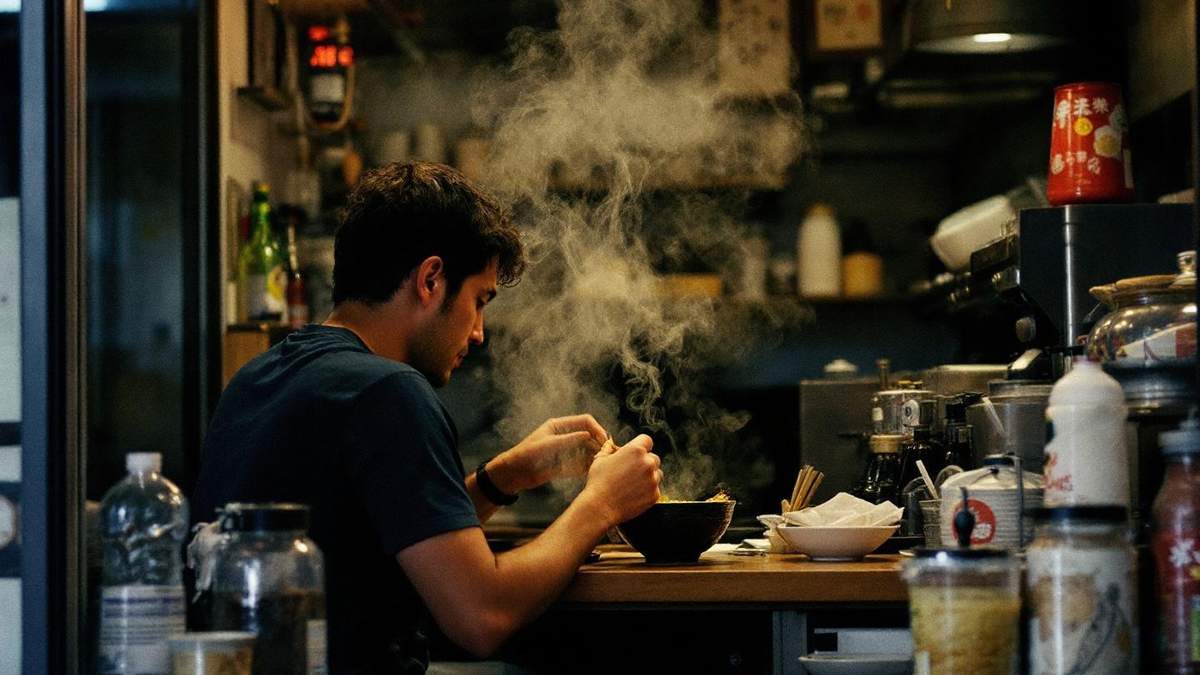
The solo dining culture in Japan is a functional part of everyday life, not an embarrassing exception. Ramen shops are designed around counter seating. Gyudon chains like Yoshinoya, Sukiya, and Matsuya consist almost entirely of counter seats. Sushi bars are built around the interaction between a single chef and a counter of individual diners. At these establishments, eating alone is not only normal but the intended experience.
Ticket Machine Restaurants
Many Japanese restaurants use a vending machine at the entrance where you select your meal, pay, receive a ticket, and hand it to the kitchen. This system eliminates the need for any verbal interaction whatsoever. For solo travellers with zero Japanese, it is a genuinely liberating arrangement. Ramen shops, gyudon chains, and tonkatsu restaurants commonly use this setup.
Ichiran and the Solo Dining Philosophy
Ichiran, the ramen chain, has taken solo dining to its logical conclusion with individual wooden booths separated by partitions, where you fill out an order form, hand it through a slot, and receive your food with minimal human interaction. For some travellers this sounds isolating; in practice it is deeply comfortable — you eat in quiet focus, contemplating a genuinely excellent bowl of ramen, with zero social performance required. It is a purely Japanese approach to the problem of being a person who needs to eat.
Set Lunch at Sit-Down Restaurants
For a more relaxed solo lunch, any restaurant displaying a set lunch menu (ranchi setto or teishoku) is welcoming to solo diners. The staff will typically seat you quickly, the meal is clearly defined, and there is no expectation of lingering. Many izakaya have counter seating along the bar where solo diners are completely normal, and these are among the best places to have an organic conversation with a stranger if you want company.
Accommodation for Solo Travellers
Capsule Hotels
Capsule hotels are practically designed for solo travellers. The pod is your private space; everything outside it is shared and social at whatever level you choose. A well-designed capsule hotel gives you a clean sleeping pod with individual lighting and power sockets, access to shared shower facilities and often an onsen, and a comfortable lounge area that is easy to inhabit alone.
Prices range from 2,500 to 4,500 yen per night. Modern capsule hotel brands like Nine Hours and First Cabin have elevated the concept considerably. Note that most capsule hotels are gender-segregated, with male and female floors accessed separately.
Hostels with Social Common Areas
Japan has excellent hostels, many specifically designed with solo-traveller socialisation in mind. Hostels with strong common rooms, bar areas, and organised activities make meeting other travellers straightforward if you want it. Hostel dorm beds cost 2,500 to 3,500 yen per night. Private rooms in the same hostels typically run 5,000 to 8,000 yen — considerably cheaper than a hotel — and give you the social infrastructure of a hostel with private space to retreat to.
Business Hotels
The Japanese business hotel offers small but thoughtfully designed private rooms at around 6,000 to 10,000 yen per night, typically with onsen-style communal baths, a simple breakfast option, and a reliable, consistent experience. Toyoko Inn and Dormy Inn are the two leading chains. They are excellent for solo travellers who want privacy without paying luxury hotel prices.
Making Connections
Japan has a reputation as a socially reserved country, and in some contexts this is accurate. Spontaneous conversation with strangers in public is less common than in Southeast Asia or Latin America. But Japan has an active expat and traveller community that self-organises through platforms like Meetup Japan, and language exchange apps like HelloTalk and Tandem.
Language exchange meetups in Tokyo, Osaka, and Kyoto are particularly useful for solo travellers seeking genuine cultural exchange. These events — held at cafes or bars, typically free or low-cost — bring Japanese people who want English conversation practice together with English speakers. The resulting conversations are often genuinely interesting and memorable.
Izakaya are the other natural venue for impromptu social contact. Sitting at the bar of a local izakaya and ordering through gesture and pointing tends to generate goodwill and occasionally conversation. Staff at traditional-neighbourhood izakaya are frequently curious about foreign visitors in a way that feels genuine rather than performed. A simple kampai (cheers) gesture is all the social opening needed.
Day tours — cycling tours, food tours, cultural experience tours — are disproportionately attended by solo travellers and are excellent for meeting people with similar interests.
Practical Essentials
Google Translate with camera mode: Point your phone’s camera at Japanese text and see a live translation overlay. This handles menus, signs, and product labels. It is not perfect but it reduces the information barrier significantly.
Download offline maps: Japan’s cell coverage is excellent in cities but can drop in mountain and rural areas. Download offline Google Maps for your specific regions before you travel.
Learn basic phrases: “Hitori desu” (one person), “sumimasen” (excuse me), “arigatou gozaimasu” (thank you), and “toire wa doko desu ka?” (where is the toilet?) will serve you well. Even attempting a few words in Japanese is appreciated.
Emergency numbers: Japan’s emergency number is 110 for police and 119 for fire and ambulance. The Japan Visitor Hotline at 0570-073-800 provides multilingual travel support 24 hours a day.
Book accommodation early: Solo rooms sell out faster than double rooms. If you are travelling in spring or autumn, book several months ahead.
The Mental Side of Solo Travel
Travelling alone for an extended period brings a particular emotional texture that is different from group travel. The highs are more immediate — a beautiful temple at dawn when you are the only person there, a meal that exceeds every expectation, the quiet satisfaction of navigating a complex journey successfully. The lows are also unshared — a day when nothing works as planned and there is no one to laugh about it with.
Japan is well-suited to the mental experience of solo travel. Brushing up on Japan etiquette will help you navigate daily situations with confidence. The sheer density of new information, sensory stimulation, and practical problem-solving that fills each day keeps the mind thoroughly engaged. The culture’s emphasis on self-sufficiency and quiet competence aligns naturally with the solo-travel mindset.
The advice most consistent among solo travellers who visit Japan: do not fill every day with scheduled activity. Allow for unplanned wandering, particularly in older neighbourhoods. Get deliberately lost in Yanaka in Tokyo, Gion in Kyoto, Nakazakicho in Osaka, or the back lanes of any mid-sized city. Japan rewards the solo traveller who is willing to be curious about small things: a shop selling one specialised product, a temple with no English signs, an alley that ends unexpectedly in a peaceful garden.
Solo travel in Japan is, for most people who attempt it, among the best trips they have ever taken. The combination of safety, accessibility, cultural richness, and the particular pleasure of being fully present and responsible for your own experience creates something that is genuinely hard to find elsewhere.