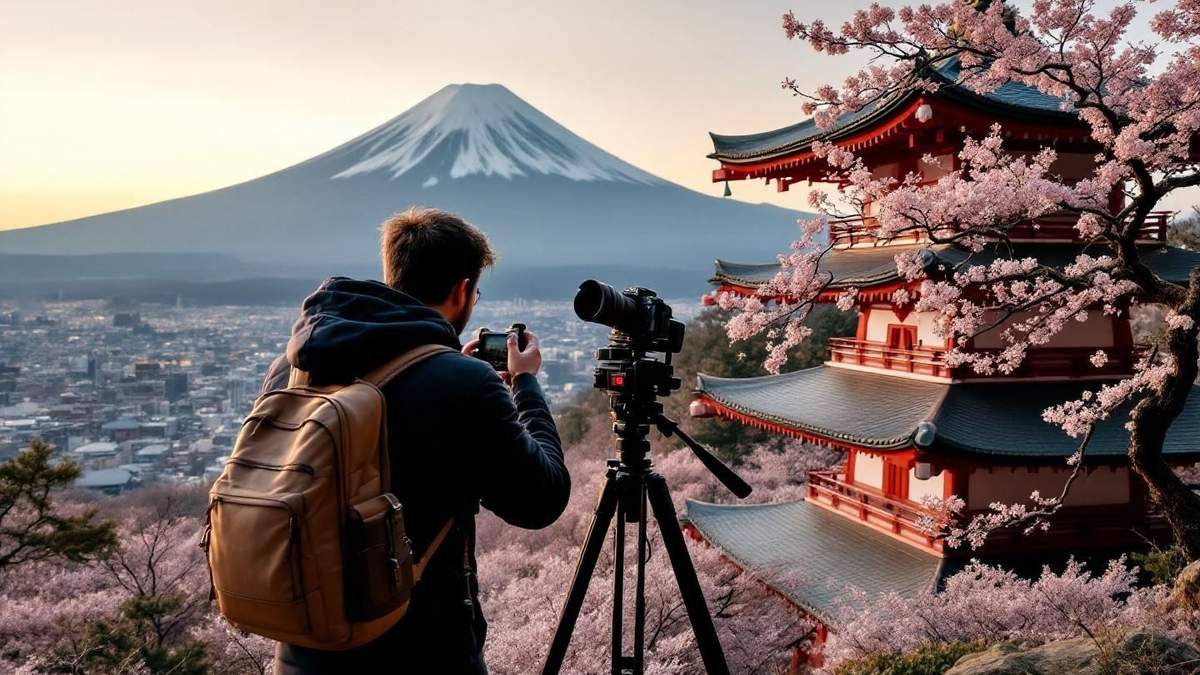
25 Most Photogenic Spots in Japan
Last updated: March 2026
Japan offers more extraordinary photography opportunities per square kilometre than almost any country on earth. From Kyoto’s temple gardens to the iconic views around Mount Fuji, the range is extraordinary. The combination of a deeply aesthetic visual culture (traditional arts, architecture, garden design), dramatic natural landscapes, dense seasonal beauty, and centuries of human construction specifically designed to be beautiful from certain angles makes it a photographer’s dream.
This list includes both iconic and less-photographed locations, with timing and access notes for each.
Tokyo
1. Shibuya Crossing at Night
The most famous pedestrian crossing in the world is at its most photogenic from above — shoot from the windows of Mag’s Park or the Starbucks on the second floor of the Tsutaya building in the Shibuya Mark City complex. The best timing is early evening (5-7pm) when foot traffic peaks and the neon illumination is at full strength. From street level, a wide-angle lens shows the scale of simultaneous pedestrian movement.
2. Senso-ji Temple, Asakusa — Dawn
Tokyo’s oldest temple is at its most photogenic between 5am and 7am, before the crowds arrive. The Kaminarimon gate with the enormous red lantern, the Nakamise shopping street leading to the main hall, and the five-storey pagoda all photograph beautifully in early morning light with steam from incense burners drifting through the frame.
3. Meiji Jingu Gaien Ginkgo Avenue — Late November
One hundred and forty-six ginkgo trees line a 300-metre boulevard in a canopy of pure yellow for approximately two weeks in late November. The light on a clear afternoon turns the avenue incandescent. This is one of Tokyo’s finest seasonal photography opportunities.
4. Shinjuku Golden Gai — Night
The narrow alleyways of Golden Gai — two hundred tiny bars packed into a city block — photograph most powerfully at night when lanterns, neon signs, and window light create a dense layering of colour and shadow. A 35mm or 50mm lens at wide aperture (f/1.8 or f/2) captures the atmosphere best.
5. Kiyosumi-Shirakawa Coffee District — Morning
The industrial warehouse streets of this neighbourhood photograph beautifully in morning light, with the graphic quality of concrete and corrugated steel contrasting with artfully painted cafe facades and window arrangements. Street-level detail photography.
Kyoto
6. Fushimi Inari Taisha — Early Morning
The iconic tunnel of thousands of orange torii gates on the mountain behind Fushimi Inari shrine is at its most photographically extraordinary between 6am and 8am, when the colour of the gates glows in early light and the crowds have not yet arrived. Higher up the mountain, above the main tourist area, the gates become older and more weathered, with forest light filtering through at interesting angles. A polarising filter enhances the orange against blue sky.
7. Arashiyama Bamboo Grove — Dawn
The narrow path through towering bamboo north of Tenryu-ji photographs best in morning mist or early diffused light. The vertical lines of bamboo converging upward in a narrow frame is the classic composition. A tripod allows long exposures that render the bamboo as texture.
8. Tofuku-ji Temple — November Peak
The Tsuten Bridge over the valley of maple trees at Tofuku-ji temple, photographed from one of the designated viewpoints during peak autumn colour (typically mid-November), shows a sea of red and orange canopy below. This is Kyoto’s most dramatic single autumn foliage scene.
9. Kinkaku-ji (Golden Pavilion) — Early Morning on Calm Days
The reflection of the gold-leaf pavilion in Kyoko-chi (Mirror Pond) requires calm water — arrive early before foot traffic disturbs the surface. Misty mornings or winter snow (very rare in Kyoto, but spectacular when it occurs) create the most atmospheric versions of this ubiquitous image.
10. Philosopher’s Path — Cherry Blossom and Autumn
The canal path lined with cherry trees photographs beautifully in both spring (pink petals over water) and autumn (yellow and red maple canopy). Morning light is best. A polarising filter deepens the canal water colour in autumn.
Nara
11. Todai-ji and Nara Park Deer — Morning
The approach to Todai-ji temple in morning light, with deer grazing in the foreground against the backdrop of the Great Buddha Hall and the cypress trees behind, is one of Japan’s most classically beautiful compositions. The deer are most active in early morning. A telephoto lens compresses the depth between deer and temple. For the best photography spots around Mt Fuji, see the Mount Fuji guide.
Rural Japan
12. Shirakawa-go — Winter
The UNESCO-listed village of Shirakawa-go in Gifu Prefecture, with its steep-roofed gassho-zukuri (prayer-hands) farmhouses, is among Japan’s most extraordinary photography destinations. In winter, with heavy snow loads on the thatched roofs and smoke rising from hearths inside, the village looks like a living nineteenth-century painting. The hillside observation platform above the village provides the classic wide composition.
When: Late January to mid-February for maximum snow. The village operates special early-morning access periods during peak winter weekends.
13. Nakasendo Highway — Autumn
The preserved Edo-period post towns of Magome and Tsumago on the Nakasendo highway in Nagano Prefecture are connected by a three-hour walking trail through mountain forest. In autumn, the trail passes through turning forest, past tea houses and stone markers, with almost no modern infrastructure visible. A film simulation preset on digital cameras (or actual film for the committed) suits this subject.
14. Oirase Stream — Autumn
The Oirase Stream in Aomori Prefecture runs for 14 kilometres through beech and maple forest between Lake Towada and the town of Yakeyama. A series of small waterfalls and rapids along the stream turn into extraordinary compositions when the surrounding trees are at peak autumn colour (mid to late October). Slow shutter speeds (1/10 to 1/2 second) with a tripod render the water as silk. Arrive at dawn.
15. Hasedera Temple, Nara — Wisteria
Hasedera’s main hall and its approach via covered wooden staircases is one of Japan’s most architecturally beautiful temple complexes, and in late April when the wisteria trellises flanking the staircases bloom in hanging cascades of purple-white, it becomes extraordinary.
16. Hitachi Seaside Park — Blue Nemophila
In late April and early May, the hillsides of Hitachi Seaside Park in Ibaraki Prefecture fill with millions of blue nemophila (baby blue eyes) flowers, creating an intense blue landscape against the sky that photographs with an almost surreal quality. The contrast between the flowers and distant coastal sea is enhanced by telephoto compression.
Hokkaido
17. Biei Patchwork Hills — Summer
The rolling farmland of the Biei area in central Hokkaido, with its patchwork of differently coloured crops — green wheat, purple lavender, yellow canola, red poppies — photographs best from hilltop viewpoints in summer. The “Blue Pond” (Aoiike) near Shirogane Onsen, an artificial reservoir with birch trees and a deep cerulean colour caused by dissolved aluminium hydroxide, has become one of Japan’s most shared natural images.
18. Daisetsuzan in Autumn
Japan’s largest national park contains alpine tundra that turns vivid red and orange in mid-September — often among the earliest autumn colour in Japan. The Akadake massif and the Asahidake ropeway area provide access to high-altitude colour. The combination of volcanic rock, alpine flowers, and autumn colour is unique in Japan.
Osaka and Hiroshima
19. Dotonbori at Night — Long Exposure
Osaka’s Dotonbori canal at night, with its neon signage, running lights, and reflections in the canal water, is best photographed on a tripod from the Ebisubashi bridge or the Dotonboribori canal walkway below. A 10-20 second exposure at base ISO renders the reflections as light trails. The famous Glico running man sign is best composed with the canal reflection included.
20. Miyajima Island — Floating Torii at High Tide
Itsukushima Shrine’s “floating” torii gate — which stands in the sea and appears to float at high tide — is one of Japan’s Three Views (Nihon Sankei). At high tide, the gate and shrine buildings reflect in the surrounding water. A telephoto lens from the hillside above the shrine includes the gate, shrine, and Mt Misen in a single frame.
Unique and Less-Visited
21. Ine Town (Kyoto Prefecture) — Funaya Boathouses
The village of Ine on the Tango Peninsula has 230 traditional funaya (boathouse buildings) lining a narrow inlet, built so that boats enter directly into the lower level of the home. Photographed from the water on a boat tour, or from the hillside above, the scene of wooden boathouses reflected in still water is one of Japan’s most unusual and beautiful.
22. Kenroku-en in Snow — Kanazawa
Japan’s most celebrated landscape garden occasionally receives significant snow in winter, and the traditional practice of yukitsuri — suspending ropes from central poles to prevent heavy pine branches from breaking under snow load — creates distinctive conical rope structures around the garden’s most important trees. Photographed in snowfall, the garden takes on an ink-painting quality.
23. Zao Onsen Snow Monsters — February
The “snow monsters” (juhyo) of Zao — fir trees at high altitude encased in wind-blown ice and snow that builds into bizarre, massive shapes — photograph most dramatically in poor weather, when mist and low cloud add to the otherworldly atmosphere. Telephoto lenses isolate individual formations; wide angle shows the full surreal landscape.
24. Ginzan Onsen at Night — Winter
The Taisho-era hot spring village of Ginzan Onsen in Yamagata, with its multi-storey wooden inn buildings lining both banks of the Ginzan River, lit by gas lanterns while snow falls, is one of Japan’s most atmospheric and photographed scenes. The best time is a winter evening after 5pm when the lanterns are lit and before the tourist tour buses arrive for the evening illumination viewing.
25. Yakushima Forest — Any Time
The ancient cedar forest of Yakushima Island off Kyushu, where Jomon Sugi cedar trees are estimated to be between 2,000 and 7,200 years old, is one of Japan’s UNESCO-listed natural sites. The forest is perpetually moss-covered and often in mist, giving it an impossibly atmospheric quality. Wide-angle lenses and natural light (the forest floor receives diffused light on overcast days) are the tools; tripods are essential for the long exposures the low light requires.
Photography Tips for Japan
Early morning is essential: Most of Japan’s famous spots become significantly more photogenic and significantly less crowded before 8am. Set the alarm.
Respect photography restrictions: Some temples and shrines prohibit photography. These restrictions are posted and must be observed. Some museums prohibit photography of specific exhibits. Always check before shooting.
Permission for portraits: Japanese people are generally private and photographing individuals requires more discretion than in some other countries. Street photography is practiced openly by Japanese photographers, but photographing individuals without implied consent in tourist contexts is worth approaching thoughtfully.
Tripod policies: Many sites permit tripods; some prohibit them in narrow or crowded areas. Carry a compact travel tripod and ask if unsure.
Japan rewards the photographer who wakes early, stays late, and returns in different seasons. The same location in cherry blossom, summer green, autumn colour, and winter snow is four entirely different photographs.
Equipment and Practical Considerations
Camera gear: Japan’s photographic subjects cover an enormous range — from night street photography to mountain landscapes to intimate temple interiors. A versatile zoom lens (24-70mm or 24-105mm equivalent) covers most situations. A wide-angle lens (16-35mm) is excellent for architectural interiors and forest canopies. A telephoto (70-200mm or 100-400mm) is useful for wildlife (deer in Nara, snow monkeys in Nagano), mountain details, and compressed cityscapes.
Light quality: Japan’s maritime climate produces dramatic and changeable light. The golden hour before sunset is reliably beautiful, but overcast days have their own quality — particularly in forest and garden settings where harsh direct sun creates unflattering contrast. Rainy days thin crowds at famous spots while adding atmospheric reflections and mist.
Carrying gear safely: Japan is very safe for carrying camera equipment. Theft is rare. The primary concerns are rain (Japan has significant rainfall, particularly in the rainy season June-July and during typhoons August-September), and the physical demands of carrying heavy gear over long walking days.
Film photography: Japan has experienced a significant film photography revival. Black-and-white and colour film is available at major camera stores (Yodobashi Camera, BIC Camera) in Tokyo and Osaka. Several specialist film processors offer fast turnaround in Tokyo. The aesthetic of film, with its grain and latitude, suits Japan’s atmospheric and high-contrast subjects particularly well.
Shooting with a smartphone: The photographic quality of modern smartphones is sufficient for outstanding travel photography. Japan’s subjects, with their strong graphic elements, vivid colours, and seasonal drama, photograph well on any camera. The primary smartphone limitation — difficulty in very low light without stabilisation — is manageable with the help of night mode on modern devices.
Etiquette for Photographers
Photography in Japan requires the same awareness of context that all cultural engagement requires:
Some temples charge an additional photography fee or prohibit interior photography. Check signs at the entrance.
Taking photographs of geisha or maiko (apprentice geisha) in Gion is technically permitted on public streets but has become a significant enough irritant that the Gion district has posted requests asking visitors not to photograph them. These requests are worth honouring.
Street photography of individuals in public spaces is legal in Japan and practised by Japanese photographers. Using good judgment about when someone appears uncomfortable being photographed and responding appropriately is the standard.
Japan’s extraordinary photogenic character extends to the unplanned moment as much as to the famous composition. Stay alert, walk slowly, and let the country present itself to your lens on its own terms.