Japan Autumn Foliage Guide: When and Where to See Fall Colors
Last updated: March 2026
Autumn in Japan is a national event. For general timing advice, see the best time to visit Japan guide, or read the full Japan in autumn seasonal overview. The annual transformation of the country’s forests, temple gardens, and mountain valleys into a mosaic of crimson, amber, and gold is followed by tens of millions of people with the same anticipation and precision that cherry blossom season receives in spring. The phenomenon has its own word — koyo, meaning the reddening of leaves — and an entire industry of forecasting, reporting, and tourism has grown up around it. For a visitor, it is one of the most beautiful things Japan offers, and timing it well makes an enormous difference.
How the Koyo Forecast Works
Japan’s autumn foliage does not happen all at once. The colour change begins in the mountains of Hokkaido in early October and travels progressively southward and down to lower elevations over a period of roughly eight weeks, reaching Kyushu and the lower elevations of Honshu in late November.
Japan’s meteorological services issue koyo forecasts that predict peak colour dates for hundreds of locations across the country. The forecast is based on temperature models — specifically, cool night temperatures trigger the production of anthocyanins in leaves, producing the red and purple tones, while the breakdown of chlorophyll reveals the yellow and orange pigments that were always present. A warm summer followed by a sharp temperature drop in autumn produces the most vivid colours; a warm, mild autumn produces duller results.
Key terms to know:
- Koyo or momiji: the general term for autumn colour
- Koyo-zensen: the “autumn colour front,” the progression of peak colour across Japan
- Mankai: full colour, when leaves are at their most vivid
- Chiri: when leaves begin to fall, marking the end of the best viewing period
Websites like Weathernews Japan and numerous English-language Japan travel sites publish updated weekly forecasts from late September onward.
When to Go: A Regional Timeline
Hokkaido — Early to Mid-October
Hokkaido’s autumn arrives first and is spectacular. The mountains of Daisetsuzan National Park — Japan’s largest national park — begin changing colour in late September at higher elevations and work their way down through October. Sounkyo Gorge, with its sheer canyon walls draped in flame-coloured foliage, is one of the definitive autumn scenes in Japan. Noboribetsu and the area around Lake Toya also produce excellent displays, and the combination of autumn foliage with Hokkaido’s open farmland landscapes creates views unlike anything in southern Japan.
The weather in Hokkaido in October turns cold quickly. Warm layers are essential.
Tohoku and Nikko — Mid to Late October
The Tohoku region — northeastern Honshu — has some of Japan’s finest mountain scenery and is relatively uncrowded by the standards of the season. Towada-Hachimantai National Park, Bandai-Asahi National Park, and the lake and valley landscapes around Aomori and Akita produce outstanding foliage. Gorges like Genbikei and Geibikei in Iwate Prefecture are particularly dramatic. Kakunodate in Akita Prefecture, famous for its samurai streetscape, is surrounded by weeping cherry trees that turn vivid red in autumn.
Nikko reaches peak colour in mid to late October. The ancient cedar forests of the shrine complex turn shades of gold, while the surrounding mountains blaze with colour. The combination of elaborate gold-and-vermillion shrine architecture with autumn foliage is one of the most photographed scenes in Japan. The winding Irohazaka road up to Lake Chuzenji becomes a dramatic drive through layers of forest colour.
Japanese Alps and Central Honshu — Late October to Mid-November
The Japanese Alps reach peak colour in late October to early November. Kamikochi, the alpine valley in Chubu Sangaku National Park accessible until mid-November when the road closes for winter, surrounds itself with golden larch trees reflected in the Azusa River. The historic post towns of the Nakasendo — particularly Tsumago and Magome — gain an extra dimension when the forested hills above them colour. The Kiso Valley and Matsumoto Castle area provide accessible viewing with excellent historic context.
Tokyo and Kanto — Mid to Late November
Greater Tokyo’s parks and gardens hit peak colour in mid to late November. Shinjuku Gyoen is the most famous Tokyo viewing location — its formal lawns contrast beautifully with Japanese maples at their most vivid red. Rikugien Garden stages special evening illumination sessions during peak colour that are among the finest seasonal events in the city.
The ginkgo avenue of Meiji Jingu Gaien — 146 ginkgo trees arching over a pedestrianised boulevard — typically peaks in late November and is extraordinary when golden afternoon light filters through yellow leaves.
Hamarikyu Gardens, Koishikawa Korakuen, and the hill parks of western Tokyo round out the city’s best viewing spots. For day-trip options, Nikko peaks a few weeks earlier, and the Okuchichibu mountains in Saitama offer excellent less-visited mountain foliage.
Kyoto — Mid to Late November
Kyoto is Japan’s most celebrated destination for autumn foliage, and the concentration of temple gardens designed specifically to showcase autumn trees makes this reputation entirely deserved.
Tofuku-ji: One of the most famous foliage spots in Japan. The maple grove in the temple’s Tsuten-kyo bridge corridor becomes a canyon of crimson when seen from above. Crowds are intense but the view justifies them.
Eikan-do (Zenrin-ji): Renowned for its autumn colour and evening illumination sessions (momiji toro) that extend viewing into the night. One of Kyoto’s most beautiful temples in any season, but extraordinary in November.
Arashiyama: The forested hills above the bamboo grove and Togetsukyo bridge become a wall of red and gold. The Sagano Romantic Train — a scenic narrow-gauge railway along the Hozu River gorge — runs through peak foliage country and provides one of the finest train rides in Japan during this season.
Philosopher’s Path: The tree-lined canal walk in the Higashiyama hills connects Nanzen-ji and Ginkaku-ji through a corridor of maples. Best in early morning before crowds arrive.
Kinkaku-ji surroundings: The Golden Pavilion’s garden gains additional warmth from autumn colours, and the northern Kyoto hills around Kurama and Kibune offer excellent mountain foliage on a more intimate scale.
Peak in Kyoto is typically the second or third week of November. Plan accommodation well in advance — Kyoto in peak autumn is as crowded and as expensive as cherry blossom season.
Osaka, Nara, and Miyajima — Late November
Osaka’s Minoo National Forest, easily accessible on the Hankyu railway, has a famous waterfall trail lined with maples that produces reliable and excellent colour in late November. Nara’s temple grounds and Yoshiyama peak simultaneously, and the sight of deer grazing among coloured maples in Nara Park is one of Japan’s most charming seasonal combinations.
Momiji-dani Park on Miyajima island in Hiroshima Prefecture is arguably the finest single foliage location in western Japan. The park’s dense maple forest, threaded by streams and bridges, peaks in late November and is spectacular when the colour is visible simultaneously with the vermillion shrine gate in the bay below.
Kyushu — Late November to Early December
Japan’s southernmost main island sees koyo latest. Yufuin and Kurokawa Onsen are particularly beautiful — the mountain onsen-town settings gain additional depth from autumn colour, and the combination of open-air hot springs and coloured forest is exceptional. Kumamoto Castle surrounded by maples and Takachiho Gorge in Miyazaki are other regional highlights.
The Best Koyo Experiences
Mountain Onsen in Autumn
Bathing in an outdoor onsen (rotenburo) surrounded by autumn leaves is one of Japan’s most celebrated seasonal combinations. The steam rising from the water, the vivid colours overhead, the crisp air — this is a specifically Japanese form of sensory pleasure that is available nowhere else quite like this. Mountain onsen towns like Ginzan Onsen in Yamagata, Nyuto Onsen in Akita, and Yufuin in Oita reach their annual peak in this season.
Forest Hiking
The full sensory experience of koyo happens in the mountains, not in city parks. The colour is all around you — overhead, underfoot in fallen leaves, visible across valleys. Nikko’s Senjogahara wetland trail, the Oze wetland boardwalks in Gunma and Fukushima, and the mountain paths above Arashiyama are among many outstanding forest walks that put you inside the colour rather than viewing it through a fence.
Traditional Garden Viewing
Japan’s strolling gardens were designed to be beautiful through all seasons, but autumn often shows them at their finest. Koraku-en in Okayama, Kenroku-en in Kanazawa, and the major Edo-period gardens in Tokyo each offer distinct autumn experiences that reward slow walking and careful attention.
Evening Illuminations
Night-time illumination of temples and gardens with coloured lighting during peak autumn is common in Kyoto, Tokyo, and many other cities. These events are ticketed, require booking ahead, and are genuinely spectacular — a completely different visual experience from daytime viewing. At Eikan-do and Kodai-ji in Kyoto, the combination of real maple colour, still water reflections, and careful artificial lighting produces something genuinely extraordinary.
Photography Tips
Overcast days produce richer colour. The diffuse light of a cloudy day reveals the depth of red and amber tones without harsh shadows. Reserve sunny days for wide mountain landscapes and visit temple gardens on overcast days.
Early morning is essential at popular spots. Tofuku-ji, Eikan-do, and the Philosopher’s Path are genuinely uncrowded before 8am. The same spots after 10am on a weekend are shoulder-to-shoulder. The early morning light is also softer and more flattering for photography.
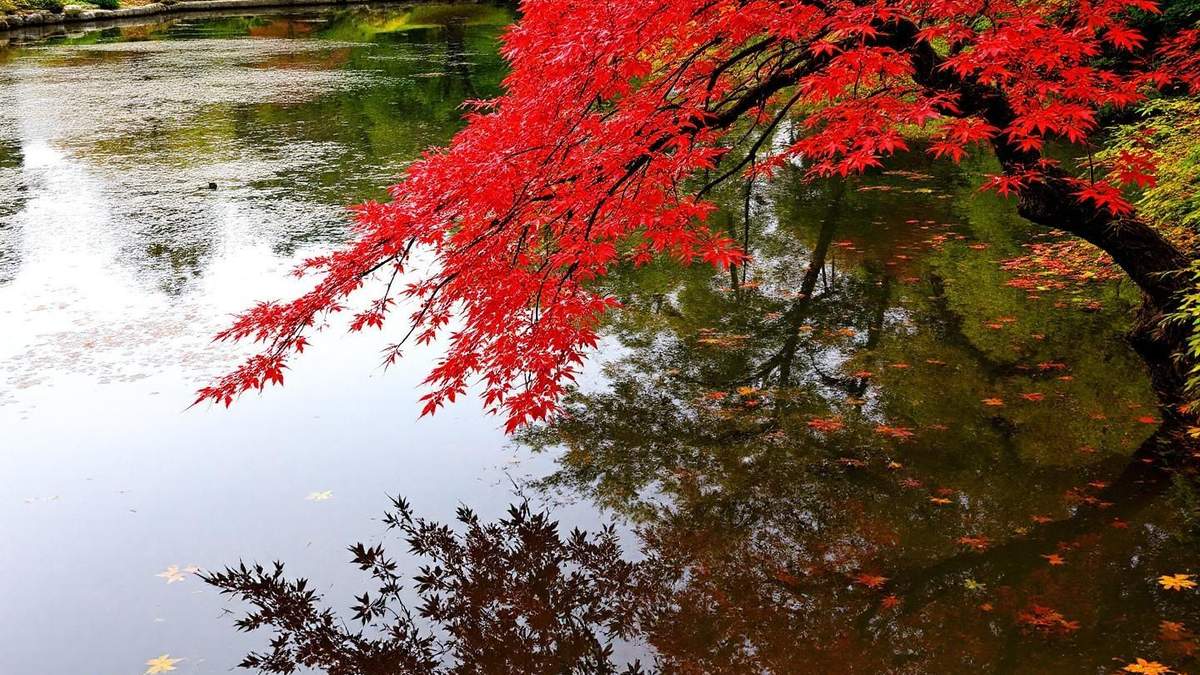
Japan’s temple gardens were designed with water elements specifically because they mirror the sky and surrounding trees. A still morning with coloured maples reflected in a pond is one of the classic autumn images. Arrive at gardens before the wind picks up to find the best reflections.
Planning Your Autumn Trip
The fundamental challenge is that forecast models can be wrong, and even correct forecasts work in windows of five to ten days. A trip planned for “peak Kyoto” two months in advance may arrive a week early or late depending on the year’s weather.
The best strategy: plan your itinerary to start in a northern or higher-elevation area and work south over one to two weeks. This increases the probability of hitting peak colour at several locations even if individual forecasts shift. A two-week itinerary starting in Nikko or Tohoku in late October and finishing in Kyoto in mid-November is an excellent autumn framework.
Book accommodation early — particularly in Kyoto. The city’s best-located ryokan and hotels fill months ahead of the November peak. Travel midweek wherever possible; weekend crowds at popular autumn spots can genuinely diminish the experience.
Autumn is arguably Japan’s finest season. The temperatures are comfortable for walking, the skies are often clear, the food culture shifts to warming seasonal ingredients like matsutake mushrooms and new-harvest sake, and the landscape — whether mountain, temple garden, or riverside park — turns into something that rewards every moment of careful attention.
Underrated Autumn Foliage Destinations
Beyond the famous destinations, Japan has extraordinary autumn foliage in places that rarely appear in international travel guides:
Osore-zan, Aomori: This volcanic caldera lake, considered one of Japan’s three most sacred mountains and associated with the spirits of the dead, takes on an almost supernatural quality when the surrounding mountain foliage turns in October. The sulphurous landscape, coloured water, and vivid autumn trees create a scene unlike anything else in Japan.
Tazawa-ko, Akita: Japan’s deepest lake reflects the surrounding autumn mountains in its extraordinarily clear deep-blue water. The combination of vivid foliage and intense blue makes for remarkable photography. The area has good onsen access via the Nyuto Onsen hot spring cluster.
Koya-san, Wakayama: The mountaintop monastic complex, accessible by cable car, has the autumn forests of the Kinki mountains surrounding its stone walls and cemetery paths. Walking the Okunoin cemetery through autumn maple canopy while staying at a shukubo (temple lodging) is one of Japan’s most atmospheric seasonal experiences.
Urabandai, Fukushima: The Urabandai plateau, formed by the 1888 eruption of Mount Bandai, contains dozens of small volcanic lakes in a landscape of extraordinary colour in mid-October. The Goshiki-numa (Five Coloured Ponds) — volcanic lakes of different mineral compositions and different colours — surrounded by peak autumn foliage, are one of Japan’s finest and most undervisited natural scenes.
The autumn foliage forecast and your willingness to travel slightly beyond the main tourist corridor leads to experiences that rival anything on a conventional itinerary. Japan in autumn has more beauty than any single trip can exhaust.